
Lotto 1041 - A212 Arti decorative - giovedì, 27. marzo 2025, 13h30
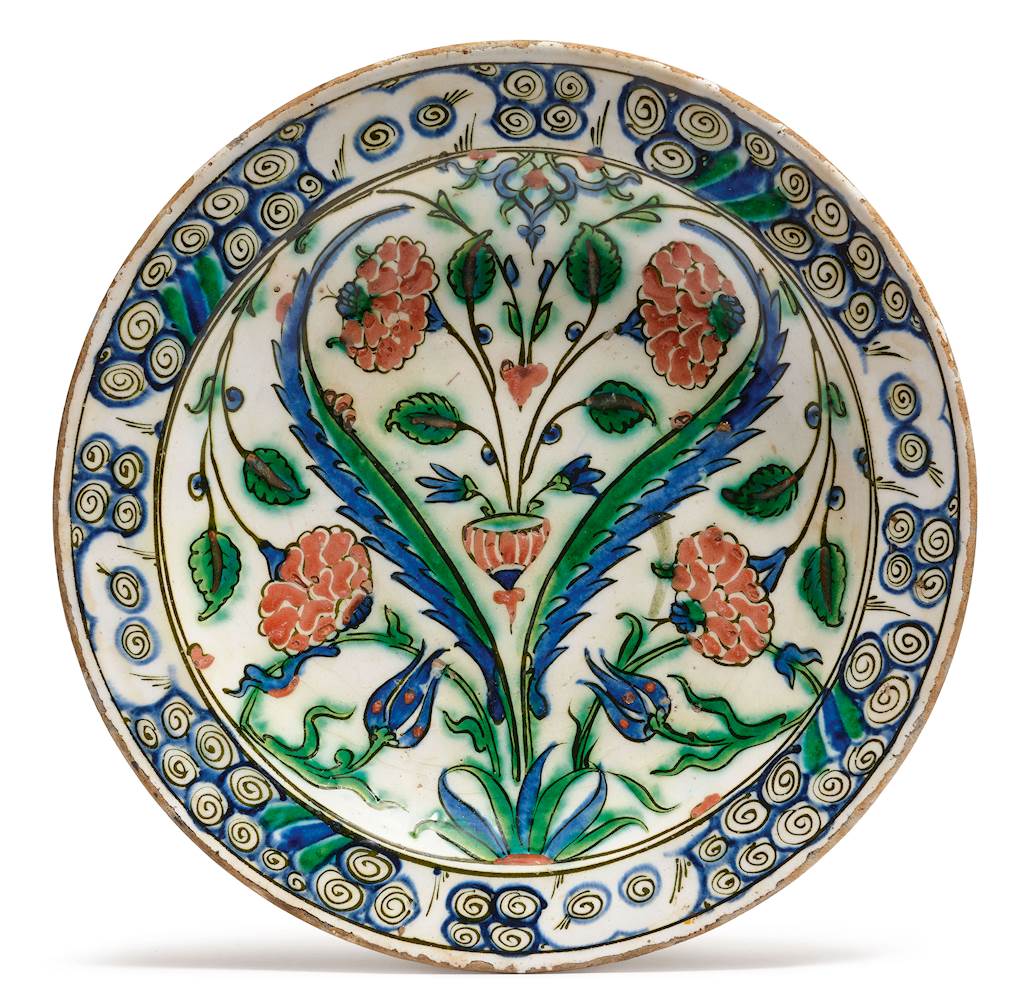
IZNIK POTTERY PLATE FROM THE LAGONIKOS COLLECTION
Turkey, Ottoman Empire, late 16th century.
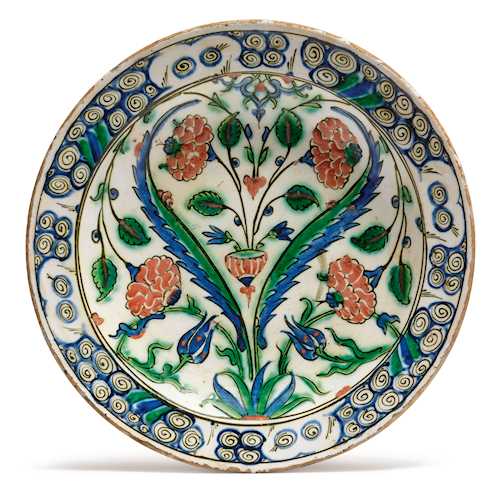
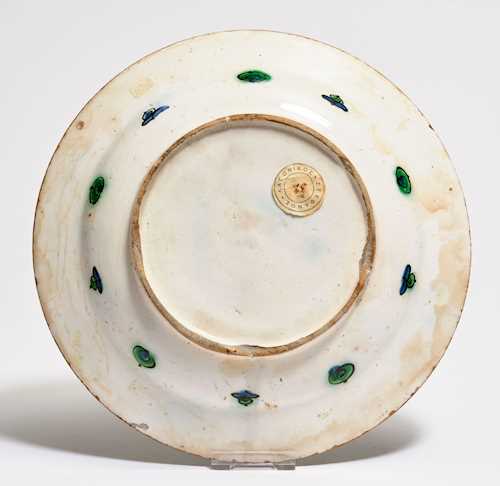
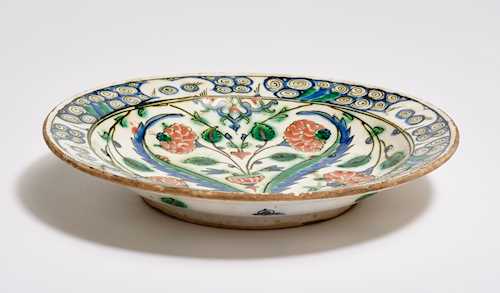
Painted in blue, emerald green and bole-red engobe. Decorated with two saz leaves emerging from tall grass, with roses and tulips between them. The lip is painted with a stylized “breaking waves” border in black, green and blue with a blue rim, and the back with alternating leaf and flower motifs in green and cobalt blue.
Ø 29 cm.
Provenance:
- Private collection, Geneva, since the 1960s/70s.
The foot ring is chipped, and there are chips to the glaze of the rim.
A group of influential and wealthy Greeks who settled in Alexandria, Egypt, in the late 19th century were among the world's most famous Iznik collectors in the early 20th century. The plate on offer bears an inventory label from the Stefanos Lagonikos collection.
Alexandria was a hub of trade, art and creativity from the late 19th century. Lagonikos and, before him, Anthony Benaki, whose name is given to the important Benaki Museum in Athens, Ch. A. Nomikos, a Greek art historian, the Choremis family and the Salvagos enjoyed a key position in Alexandrian society and were extremely successful in business thanks to the booming Egyptian cotton industry. It was against this background that significant collections of European antiques were established.
A small circle of this group devoted themselves to collecting Islamic art, with Anthony Benaki and Ch. A. Nomikos leading the way. In 1925, Alexandria was the venue for a much-acclaimed exhibition of Islamic art that presented objects exclusively from private collections, including some Iznik plates from the collection of Stefanos Lagonikos. Gaston Migeon, curator at the Louvre at the time, curated the exhibition and wrote the preface to Exposition d'art Musulman, published in Alexandria and Paris (Gaston Migeon, Exposition d'art musulman. Les amis de l'art, Alexandrie, mars 1925). In 1991, a large part of the Lagonikos collection was sold in Monaco, with an essay by John Carswell (La Collection Lagonico, Sotheby's Monaco, 7.12.1991).
CHF 2 000 / 3 000 | (€ 2 060 / 3 090)
Venduto per CHF 10 000 (incl. premio)