


Lotto 1003* - A212 Arti decorative - giovedì, 27. marzo 2025, 13h30
LARGE CYCLADIC IDOL - FROM A SWISS PRIVATE COLLECTION
Early Cycladic, Spedos type, ca. 2500–2400 BC. Attributed to the Goulandris Sculptor.
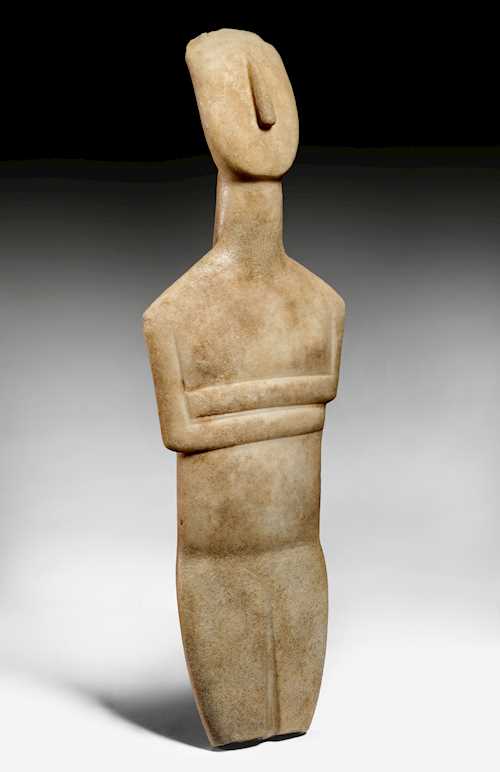
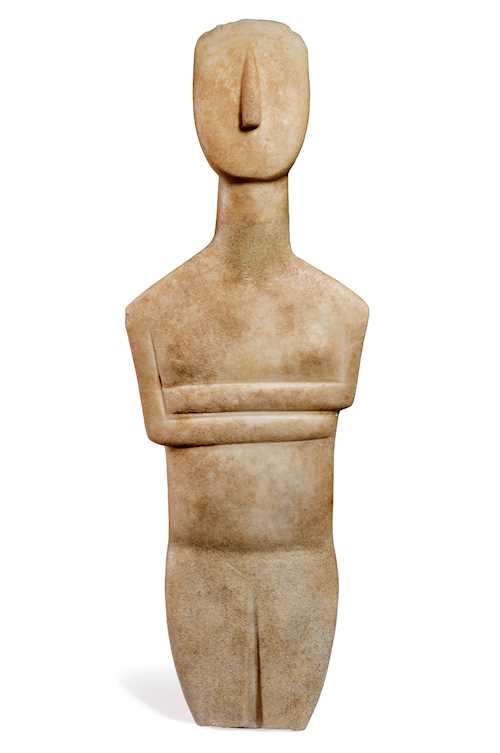
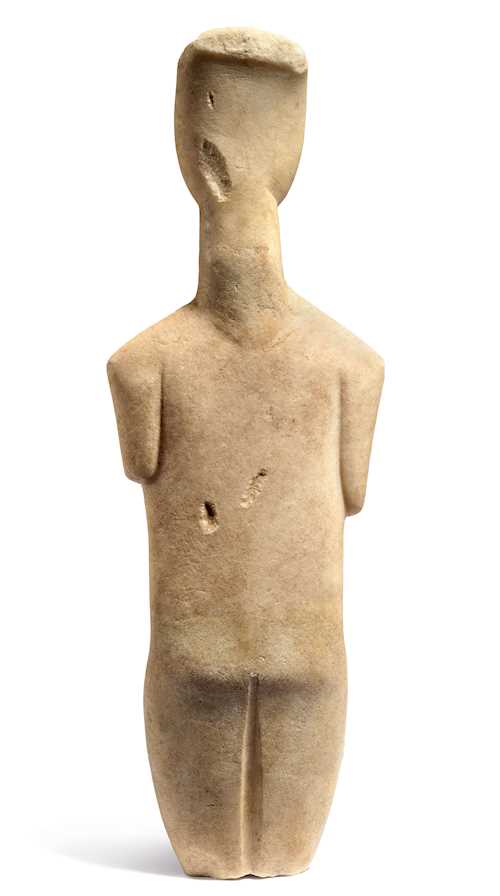
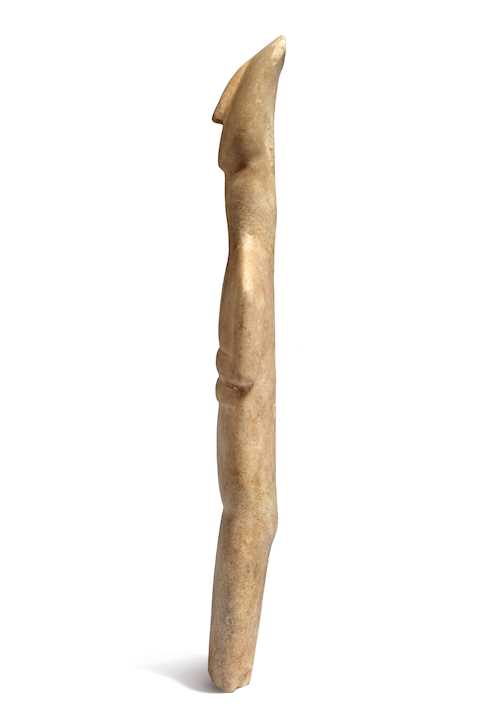
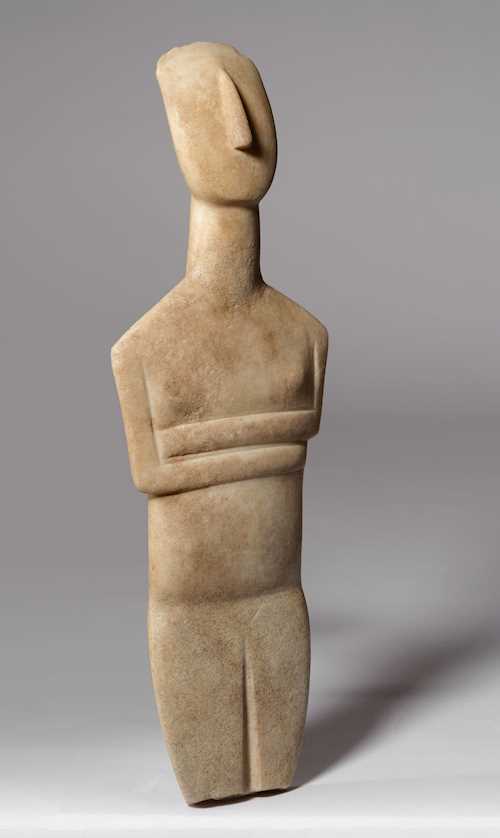
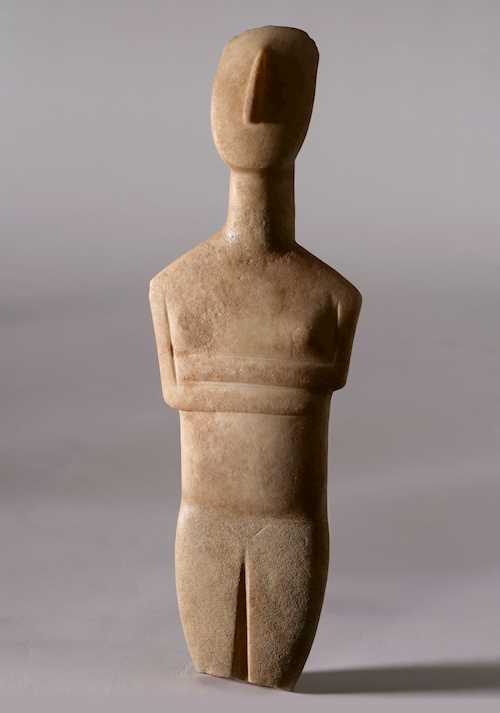
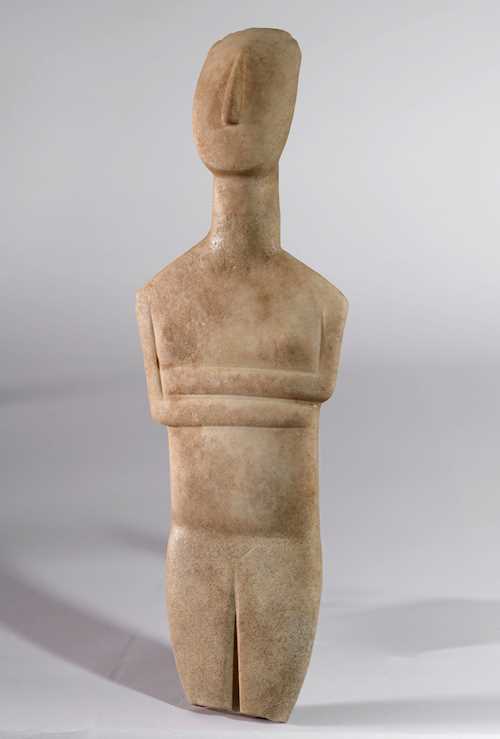
Marble. Large fragment of a female idol. Lyre-shaped head with a prominent, elongated nose merging directly into a receding forehead, harmoniously rounded chin. Long, slightly thickened neck (restored). Sloping shoulders, the shoulder base at slightly different heights. Broad torso with small, widely spaced, pointed breasts. The slender arms are crossed under the chest. Slightly bulging belly, notched underbelly fold merging into a stylized pubic triangle. Slightly curved thighs with a deeply notched thigh slit. Visible notched upper arm slits on the back. Straight back with slightly bulging buttocks and a deeply notched thigh slit. With a later metal frame.
H without mount 42.6 cm.
Provenance:
- Ars Antiqua SA, Geneva, acquired from the above in September 1977 (according to a file card).
- Swiss private collection.
Exhibited:
- Presented at TEFAF in Maastricht, 2021/2022.
Literature:
Head and torso possibly assorted. Tip of the nose replaced. Head and back with breaks. Broken edge above the knee. Weathering.
Marble idols from the Cycladic cultures are among the most amazing and mysterious artifacts of the Neolithic and Early Bronze Age. The figures are named after the places where they were found on the Cycladic Islands of Greece, which is why the name “Cycladic Idol” has become established for these unique cult objects. These predominantly female statuettes in various sizes and forms are characterized by an abstract stylization of the human body and, even today, the reduced formal language continues to amaze the modern eye. Their exact function is still a matter of speculation among researchers. Patricia Getz-Preziosi, a leading expert in the field of Cycladic idol research since the 1970s, emphasizes in her numerous studies that the idols' iconography provides no clear evidence of a specific religious function. Instead, their meaning could vary depending on the context. The emphasis on feminine forms, such as the pointed breasts, the slightly bulging bellies, the incised pubic triangles and the sometimes protruding hips, suggests that they could be read as fertility figures. An important aspect emphasized by Getz-Preziosi is the aesthetic and material dimension of the idols. Their smoothly hewn surfaces, original polychromy and the use of high-quality marble suggest that the statuettes had not only a symbolic function, but also representative functions. The discovery of pigment residues also indicates that the idols were originally painted, which must have significantly changed their visual impact.
The earliest products are dated to around 5000 BC, with the artistic peak being reached around 2500 BC, during the Early Cycladic II period of the Keros-Syros culture (approx. 2700–2400/2300 BC). During this period, the typical basic form, as exemplified by the specimen on offer, was canonized. In the late 1960s, Colin Renfrew proposed four types of Early Cycladic idols, classified according to their chronological appearance: 1. “Kapsala type”, 2. “Spedos type”, 3. “Dokathismata type” (whereby the Spedos and Dokathismata types can occur simultaneously) and 4. “Chalandrianityp” (Colin Renfrew: The Development and Chronology of the Early Cycladic Figurines. In: American Journal of Archaeology 73, 1969, pp. 1–32). The figure on offer is counted among the Spedos variants.
In her studies, Patricia Getz-Preziosi has shown that these types not only reflect chronological developments, but also provide clues to different workshop traditions. In a paper published in 1987, she attributes the torso of the example on offer to the Goulandris Sculptor. It is illustrated without its head under number 22 (Patricia Getz-Preziosi: Sculptors of the Cyclades: Individual and Tradition in the Third Millennium B.C. University of Michigan, 1987, Pl. 32, No. 22). Named after the Greek private collection, which houses two complete idols of the Sculptor, she has compiled a corpus of around 100 idols and idol fragments that bear the signature of this Sculptor. According to our current knowledge, some fifty pieces can be attributed to the Goulandris Sculptor. Getz-Preziosi is particularly enthusiastic about the Goulandris Sculptor, describing him as “one of the best sculptors of his time” (ibid., p. 99). The figures created by him are characterized by a robust appearance with soft, subtle contours. Cleanly incised lines emphasize the horizontal lines of the chin, décolletage, stomach, knees and ankles. The head has the classical shape of a lyre and is characterized by a prominent, elongated nose with a half-round tip, which is often quite low on the face. The arms are slender and the small breasts are placed wide apart. The abdominal area is defined by a broad line that forms the apex of a small pubic triangle. Idols attributed to Goulandris Sculptor sometimes differ significantly in size. The smallest idol measures 16.5 cm; by far the largest, from the Copenhagen Glyptothek, measures 98 cm. The idol on offer, with a torso size of 29 cm, is in the upper range. For Getz-Preziosi, this is a further indication of quality: “It would seem that the smaller, less elaborate, thicker figures of the Goulandris Sculptor represent an early phase of his development, while the larger, thinner, more detailed, more carefully planned and modeled works (e.g. ... 22 (the copy on offer)) represent the Sculptor's highest attainments” (ibid. p. 104).
Idols or idol fragments attributed to the Goulandris Sculptor come mostly from two islands, Naxos and Keros. From the article by Getz-Preziosi, it is clear that the item on offer comes from Keros (ibid. p. 108). According to a handwritten note on a copy of an index card with a photo, the idol on offer was in an anonymous English private collection until November 8, 1977, when it was traded (currency stated as pounds) for what is now a Swiss private collection.
The rediscovery of Cycladic sculptures took place in the 19th century. The exhibits found their way into the collections of major museums such as the Louvre in Paris and the British Museum in London, where they represented a new source of inspiration for modern artists. Their abstract nature, their reduction and simplicity radiate a timelessness. We can see influences of Cycladic art in the sculptures of Pablo Picasso, Constantin Brancusi, Amedeo Modigliani, Alberto Giacometti and Henry Moore. It is hardly surprising that Cycladic idols have long since found their way into modern and contemporary art collections due to their timeless elegance and mystical radiance.
Cycladic Idol
CHF 350 000 / 600 000 | (€ 360 820 / 618 560)
Venduto per CHF 622 000 (incl. premio)