

Lotto 3729 - A213 Stampe e multipli - giovedì, 26. giugno 2025, 10h00
ANDY WARHOL
(Pittsburgh 1928–1987 New York City)
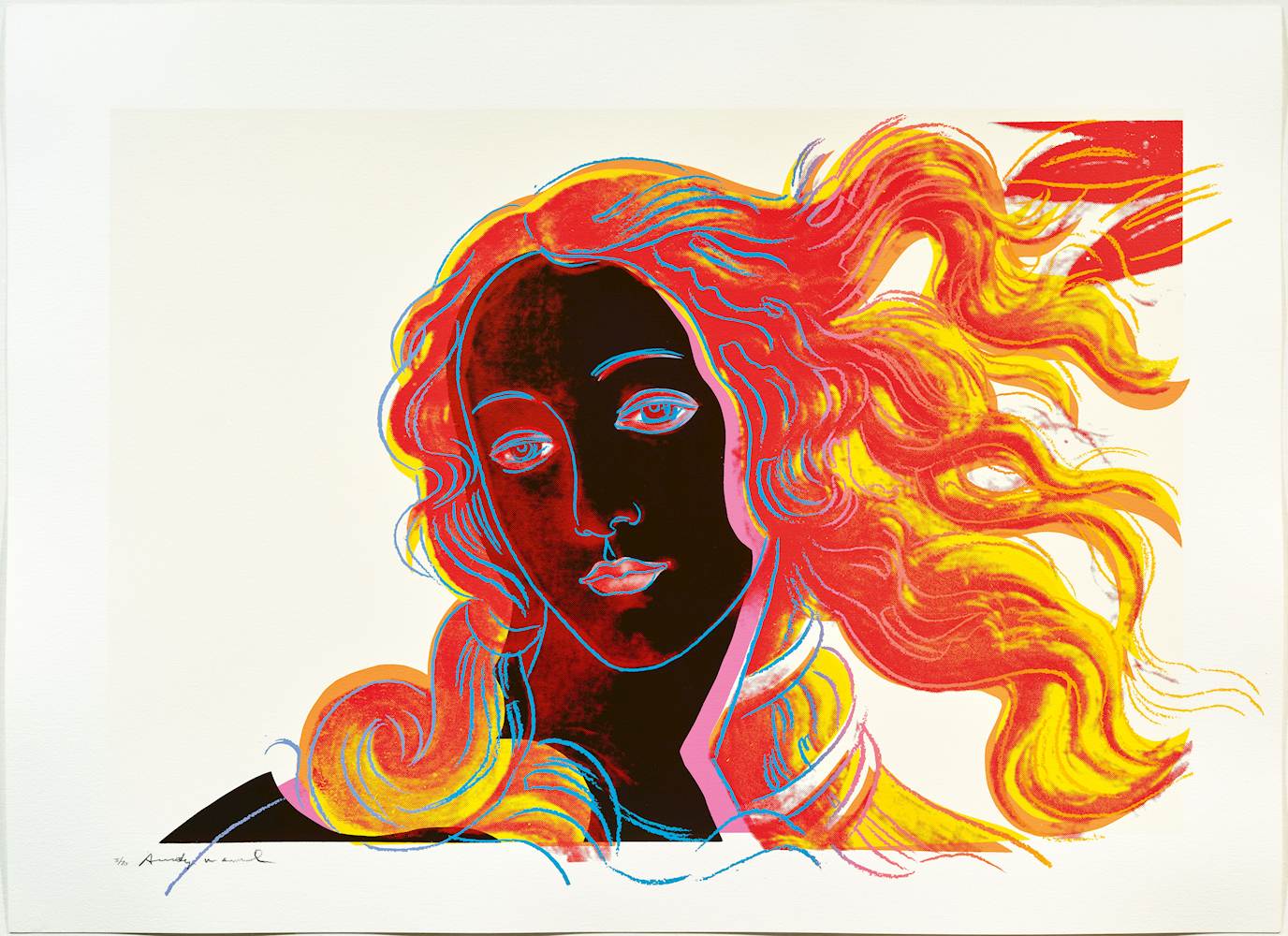
Detail of Renaissance Paintings (Sandro Botticelli, Birth of Venus, 1482). 1984.
Colour silkscreen. 3/70. Signed in pencil lower left: Andy Warhol. Image 63.5 × 94 cm on firm Arches Aquarelle wove paper 81.3 × 111.9 cm. Published by Editions Schellmann & Klüster, Munich. Printed by Rupert Jasen Smith, New York City.
Sheet 3 from the 4-part series of the same name.
Sheet 3 from the 4-part series of the same name.
Provenance:
Catalogue raisonné:
Andy Warhol's four-part series ‘Details of Renaissance Paintings (Sandro Botticelli, Birth of Venus)’ from 1984 marks a significant turning point in his late period, in which he engaged intensively with European art history. In this group of works, Warhol devoted himself to central icons of the Old Masters - including Leonardo da Vinci, Paolo Uccello and Piero della Francesca - and reinterpreted them through the lens of his characteristic Pop Art aesthetic.
Warhol extracts emblematic details from canonised masterpieces and transfers them into a new cultural context characterised by serial reproduction, garish colour contrasts and the aesthetics of consumer culture. In this colour silkscreen, he chooses a greatly enlarged section of the Venus figure from Botticelli's famous ‘Birth of Venus’. By focussing on the face of the goddess, he shifts the perspective from the overall narrative context to the iconic close-up. The use of atypical, bright colours and the serial reproduction emphasise the tension between the original and the reproduction, between historical high culture and contemporary mass aesthetics.
Warhol's approach to Botticelli is far more than a postmodern homage. Rather, it is a conscious artistic appropriation in which the sacred status of one of the most important works within the Western art tradition is translated into the visual language of advertising, fashion and pop culture. Venus, once a symbol of idealised beauty and divine grace, becomes a secularised pop icon - her aura is broken, reproduced, demystified and at the same time restaged.
With this work, Warhol enters into an open dialogue with art history and at the same time questions its supposed inviolability. He shows that even the most sublime works are not immune to the codes of 20th century culture and media. He succeeds in combining classical ideals with contemporary imagery, thereby radically reflecting on the mechanisms of the production of cultural meaning.
CHF 60 000 / 90 000 | (€ 61 860 / 92 780)
Venduto per CHF 143 750 (incl. premio)