
Lotto 1109* ♣ - A212 Arti decorative - giovedì, 27. marzo 2025, 13h30
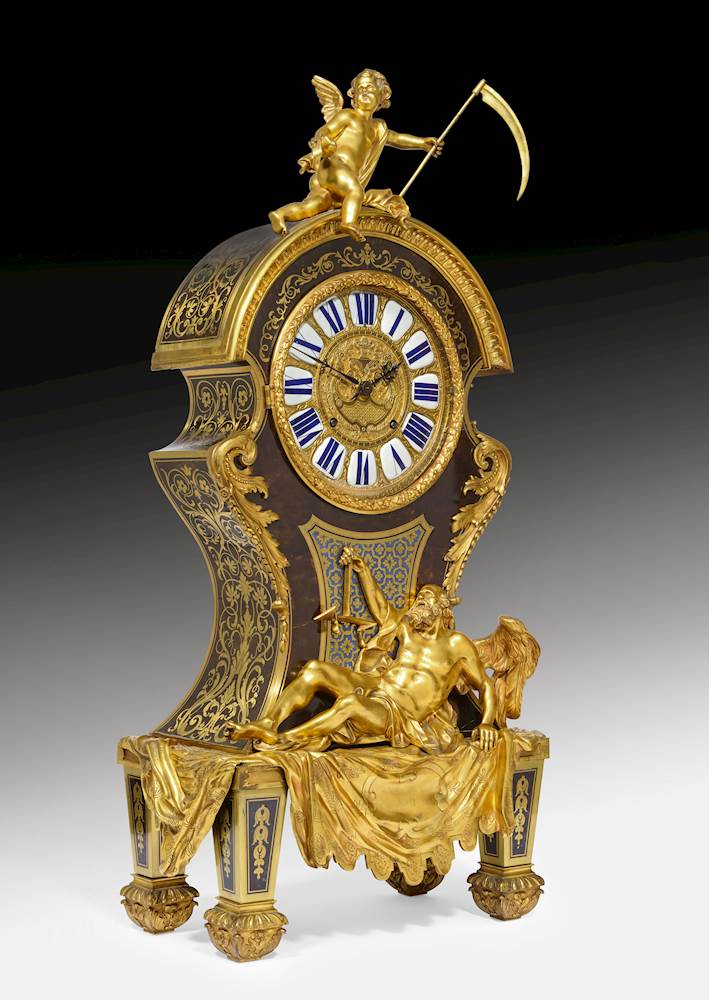
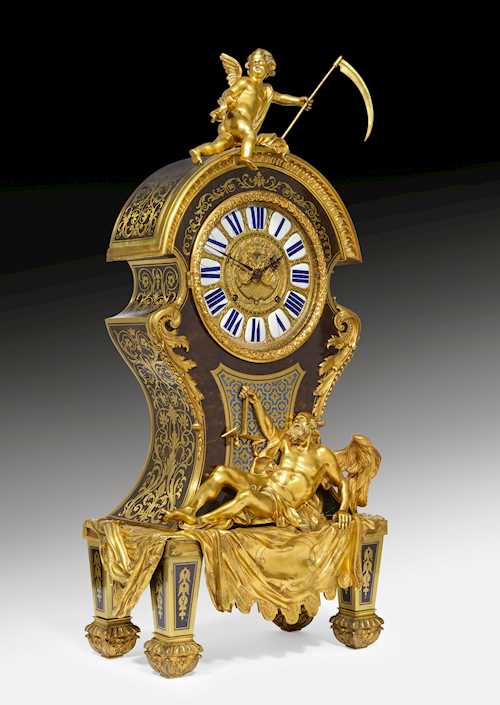
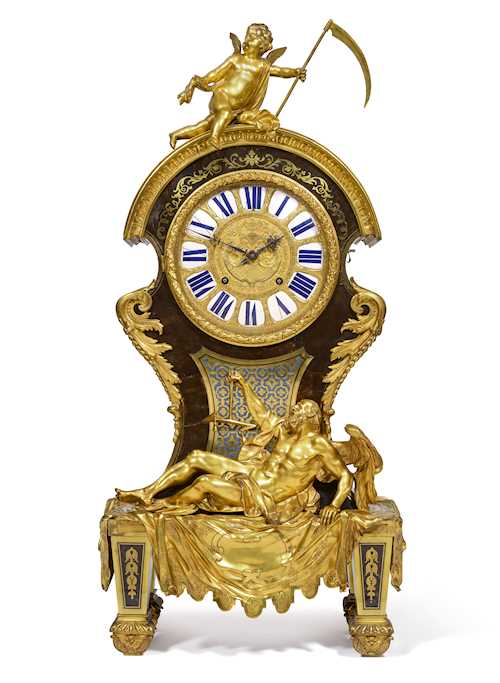
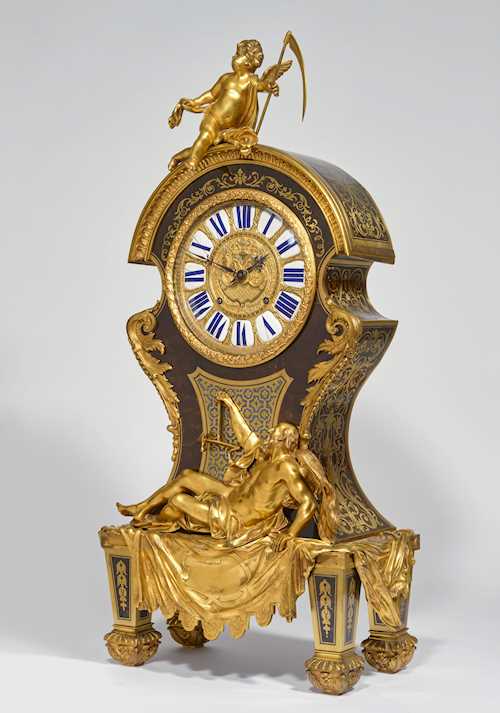
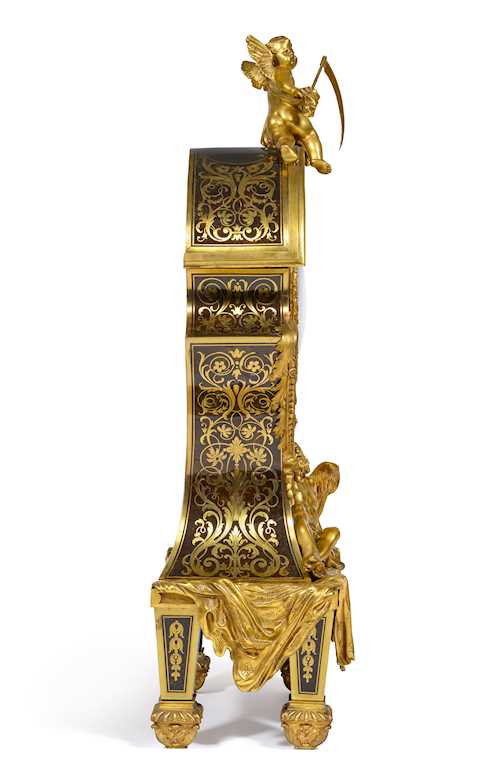
MANTEL CLOCK “L'AMOUR TRIOMPHE SUR LE TEMPS”
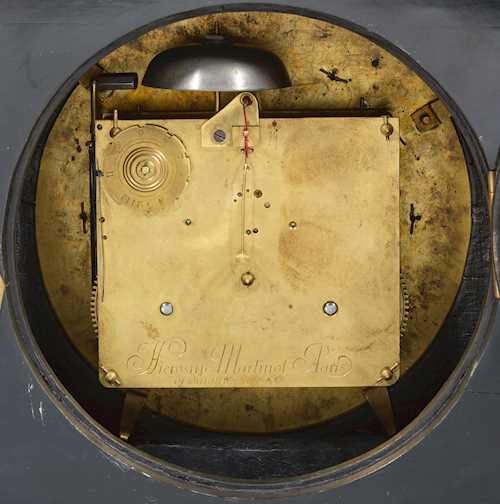
Louis XIV, Paris, ca. 1720/25. Designed by André-Charles Boulle (1642–1732), signed by Hiérosme Martinot (1671–1725) A Paris Ordinaire du Roy and numbered 41 N.
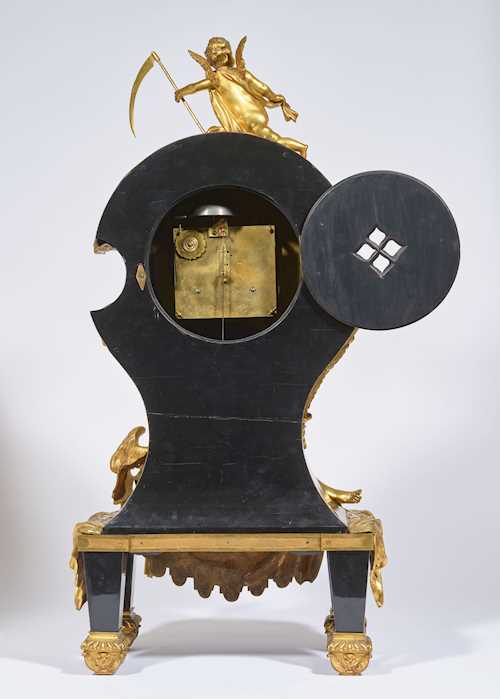
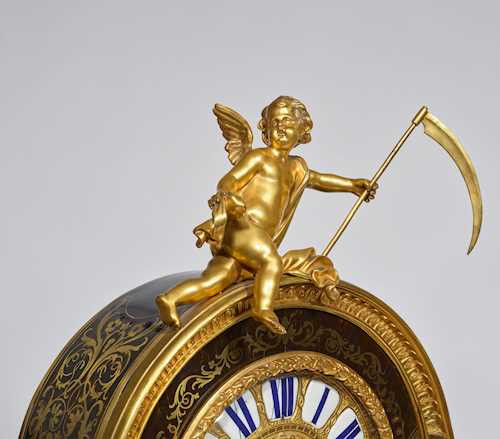
Wooden case, partly blackened, with dark and blue underlaid tortoiseshell and horn, inlaid with engraved brass leaves and tendrils. Curved case, sharply constricted in the upper third, known as “tête de poupée”, on tapering pilaster legs and compressed bronze feet decorated with leaves and gadroons. Finely engraved and gilt bronze mounts in the form of friezes and acanthus leaves. Featuring an enthroned figure of Cupid, triumphant over Chronos, who reclines at the base. Both figures by François Girardon (1628–1715). Gilt bronze dial with relief work (probably a later addition) and white enamel cartouches. The movement converted to anchor escapement and half-hour strike on bell.
48 × 25.5 × 97 cm.
Various restorations, including to the interior. Internal engravings partly thinned out. Later additions to the bronzes such as the scythe and parts of the dial.
A sketch made by André-Charles Boulle himself and now in the Musée des Arts Décoratifs in Paris (inv. no. 723 D6) proves that he was the creator of this model, which is considered to be one of his first and most famous models (Hans Ottomeyer/Peter Pröschel: Vergoldete Bronzen. Munich 1986, vol. 1, p. 38, no. 1.2.1). The bronze figures of the Cupid, who has wrested the scythe from Chronos and thus defeated time and death, and of Chronos lying on the ground with a balance beam, which stands for the regulated progression of time, are the common motifs.
The pendulum clock is part of the most important collections, each of which differs in details and in the movements used. The main differences are in the design of the base (apart from the two main figures, Chronos and Amor) and the bronze decorations used, as well as the type of marquetry. The clock is characterized by the curved acanthus leaves on either side of the dial, the drape over the base and the prominent pilaster feet, which are the most similar features to those of the model in the J. Paul Getty Museum, Los Angeles (inv. no. 72.DB.55). The movement of this pendulum is signed by Paul Gudin. (Cf. Hans Ottomeyer/Peter Pröschel: Vergoldete Bronzen. Munich 1986, vol. 1, p. 40, no. 1.2.5). The versions from Waddesdon Manor and the Wallace Collection are also illustrated in the same publication. These differ not only in the design of the plinth, but also in the female masks on either side of the dial (ibid. Nos. 1.2.3 and 1.2.4). For another version, with a significantly modified base and plinth, see: Jean Nérée Ronfort: André Charles Boulle 1642–1732 A New Style for Europe. Paris 2009, pp. 220f. The movement of that clock was made by Thuret in Paris and was produced for Duke Johann-Wilhelm of Bavaria-Neuburg (1658–1716).
Export and import CITES available.
An expertise by Prof Dr Hans Ottomeyer is available (24.7.2020). The original document can be handed over to the potential buyer after the auction.
Per l'esportazione di questo oggetto è necessario un certificato CITES. L'acquirente è responsabile dell'ottenimento di questo documento. La spedizione all'estero non è possibile tramite Koller Auktionen. Per ulteriori informazioni contattare il dipartimento. Grazie.
CHF 35 000 / 60 000 | (€ 36 080 / 61 860)
Venduto per CHF 31 250 (incl. premio)