
Lotto 1055 - A212 Arti decorative - giovedì, 27. marzo 2025, 13h30
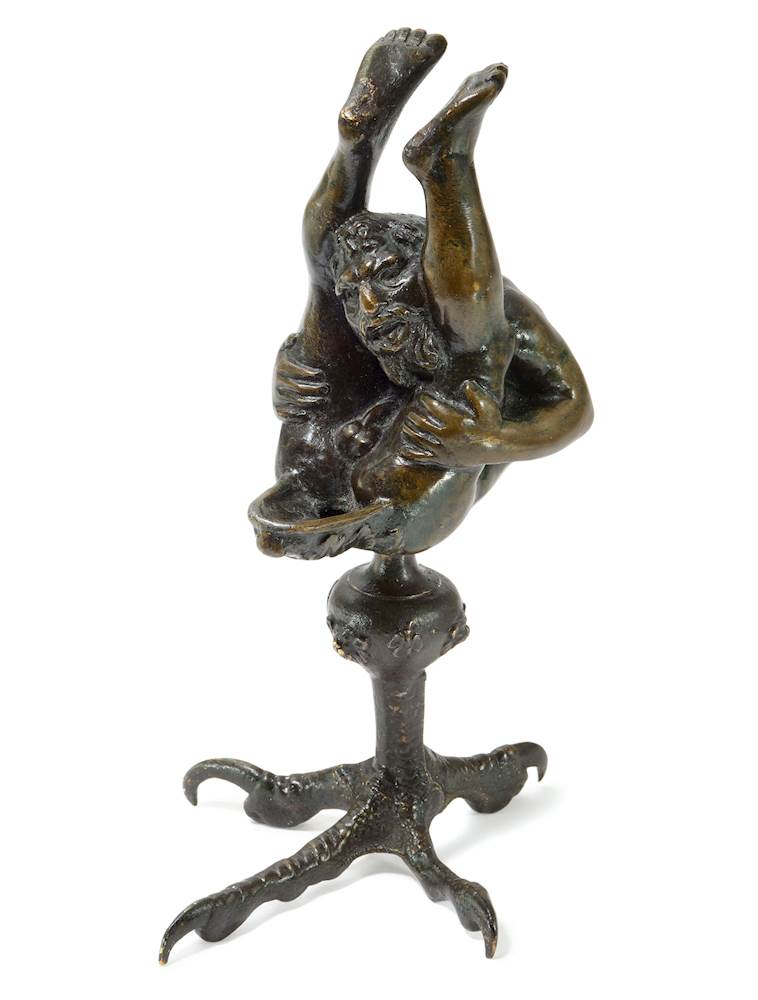
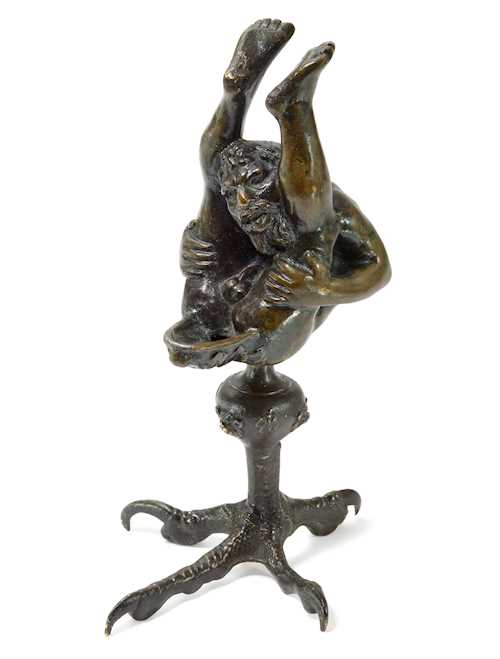
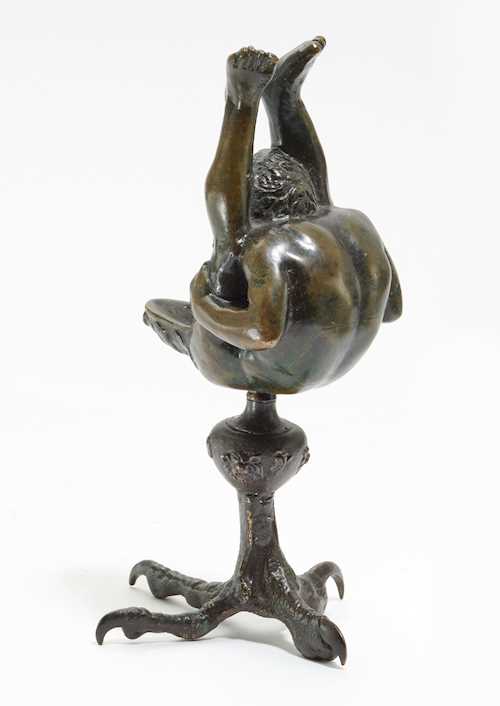
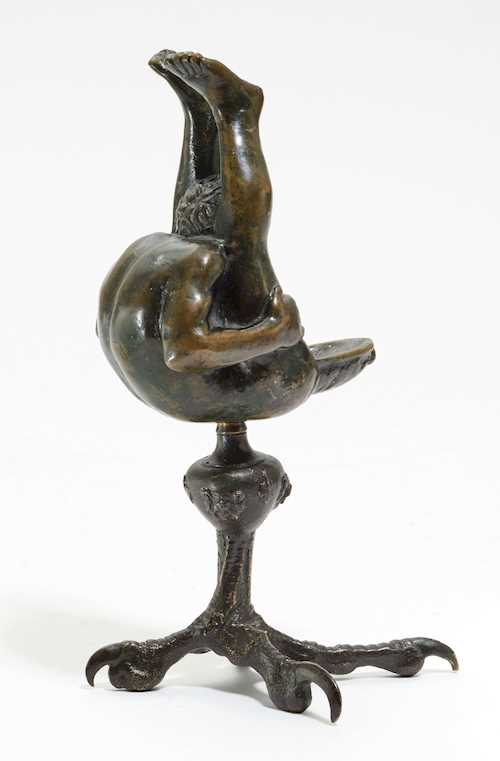
OIL LAMP DESIGNED AS AN ACROBAT
Padua, first third of the 16th century. After a model by Andrea Riccio or Severo da Ravenna. The eagle foot is a later addition.
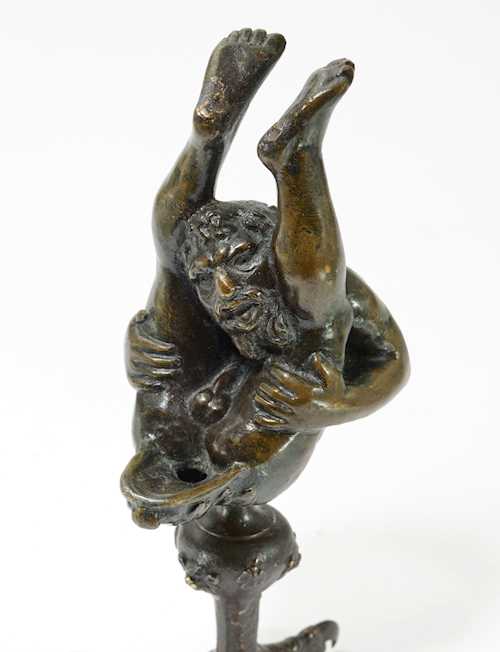
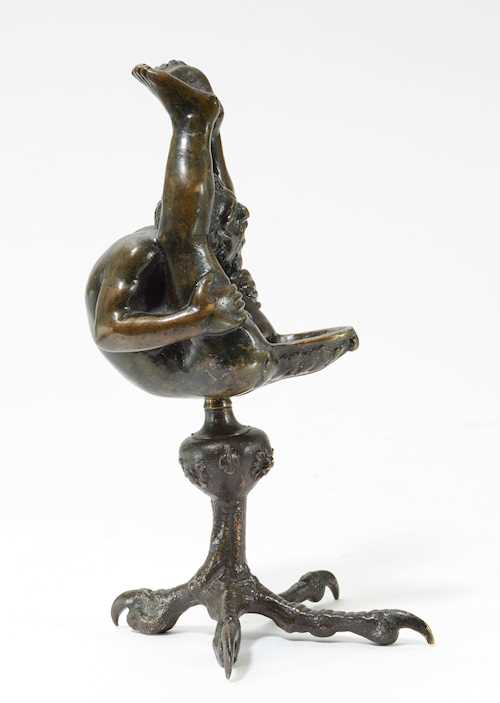
Bronze with a brown patina, designed as a contortionist in an acrobatic pose, the legs stretched towards the sky, the head pressed between the legs. The opening for the oil lamp growing out of the acrobat's bottom, the lower part designed as a leaf. Later, screw-on base in the shape of an eagle's claw.
H 24.5 cm.
Provenance:
- Ellin Mitchell, Works of Art, New York, 1982.
- Swiss private collection, acquired from the above dealer.
Patina rubbed in places. The soles of the feet probably once had attachment rings for suspending the lamp. An old correction to the casting in the lower back area.
Several bronze versions of the oil lamp on offer, modeled after Andrea Riccio (1470–1532), are known and show different facial features. One of them is in the Museo Nazionale del Bargello (inv. no. Bargello Bronzi 57), and has a chain fixed to the feet for suspending the lamp, rather than an eagle-shaped foot. Other examples of such acrobat oil lamps are attributed to Severo Calzetta, called Severo Da Ravenna (ca. 1496 - before 1538), for example a version with an eagle's foot in the Museo Nazionale del Palazzo di Venezia (inv. no. PV 9249).
Until the late 20th century, the acrobat oil lamps were erroneously attributed to Antiquity. One such lamp is depicted in the foreground of Johan Joseph Zoffany's “The Tribuna of the Uffizi”, 1772–1777 (Royal Collection Trust, inv. no. RCIN 406983), where it is placed in a row with other Roman, Greek and Etruscan antiques (Joseph R. Bliss: “A Renaissance Acrobat Lamp by Andrea Riccio: Its Mistaken History as an Ancient Bronze”, In: Notes in the History of Art, Vol. 14, No. 3, 1995, pp. 13–20).
Comparative literature:
- Leo Planiscig: Andrea Riccio. Vienna 1927, pp. 180-182, fig. 200.
- J. Bliss: A Renaissance Acrobat Lamp by Andrea Riccio: It's mistaken History as an ancient Bronze. History of Art, XIV, 3, 1995.
CHF 10 000 / 15 000 | (€ 10 310 / 15 460)
Venduto per CHF 12 500 (incl. premio)