

Lotto 3008 - A217 Arte svizzera - venerdì, 26. giugno 2026, 14h00
ALBERT ANKER
(1831 Ins 1910)
Der kleine Bruder. 1883.
Oil on canvas.
Signed and dated centre left: Anker 1883.
72 × 56 cm.
Provenance:
- Collection Guillaume de Montmollin, Basel, 1931.
- Auction Sotheby's Zurich, 30 June 1983, lot 20.
- Private collection, Switzerland, acquired at the above auction.
- By descent to the present owners.
Exhibited:
- Zurich 1911, Albert Anker, Kunsthaus Zürich, 7 May–5 June 1911, no. 38, as 'Die grosse Schwester'.
- Bern 1931, Albert Anker 1831–1910. Jahrhundertausstellung, Kunstmuseum Bern, 20 June–23 August 1931, no. 79 (verso with label).
Literature:
- Exh. cat. Albert Anker, Zurich 1911, p. 8, no. 38, as 'Die grosse Schwester'.
- Exh. cat. Albert Anker 1831–1910. Jahrhundertausstellung, Bern 1931, p. 3, no. 26.
- Conrad von Mandach: 136 Gemälde und Zeichnungen von Albert Anker, Zurich 1941, no. 55 (illustrated).
- Albert Anker, Max Huggler and Kunstmuseum Bern: Albert Anker. Katalog der Gemälde und Ölstudien, Bern 1962, no. 113 (illustrated).
- Sandor Kuthy and Therese Bhattacharya-Stettler: Albert Anker. Werkkatalog der Gemälde und Ölstudien, Basel 1995, p. 160, no. 305 (illustrated).
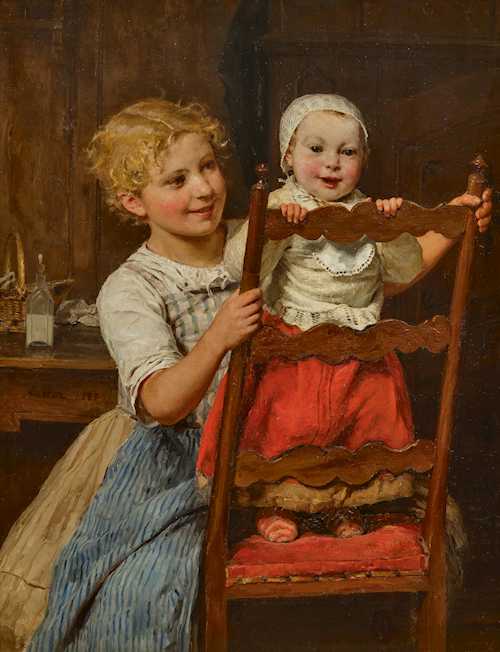
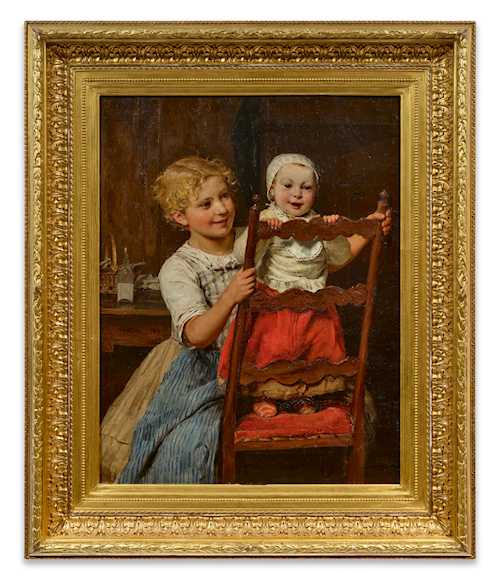
In this scene, imbued with tenderness and quiet cheerfulness, the lively, mischievous gaze of the child immediately draws the viewer’s attention. With ‘The Little Brother’, Albert Anker presents a particularly fine example of his genre painting, in which familial intimacy becomes a space for subtle observation.
Alongside those works in which Anker’s view of childhood may also be read as a social commentary, ‘Der kleine Bruder’ focuses entirely on the intensity of a single moment. The small boy has just raised himself up; his sister accompanies this first, still uncertain moment with visible pride, amusement and protective tenderness. The painting appears like a spontaneous snapshot, yet it is carefully composed. The soft light gently models the faces and lends the familiar domestic scene a warm, harmonious atmosphere.
It is precisely in this concentration that the narrative power of the work resides: a single scene is capable of suggesting an entire volume of stories from a child’s life. With a glance or an expression – in the tradition of Baroque portraitists such as Rembrandt, Frans Hals and Diego Velázquez – Anker succeeds in making the inner vitality of his sitters visible. The small child with wide-open eyes, in which a roguish sparkle flashes, transports us back to that time in our lives when everything was new and fascinating. The gaze of his sister speaks volumes and simultaneously turns the scene into a homage to the unifying power of family bonds.
While Anker frequently depicts children reading, learning or playing – often serious and concentrated – this work possesses an unusually bright and immediate presence. Precisely because depictions of such open-hearted carefree joy are not numerous in his oeuvre, ‘The Little Brother’ occupies a special position.
CHF 1 500 000 / 2 500 000 | (€ 1 546 390 / 2 577 320)
Venduto per CHF 1 807 000 (incl. premio)