

Lotto 1016* - A216 Works of Art & Decorative Arts - giovedì, 26. marzo 2026, 13h30
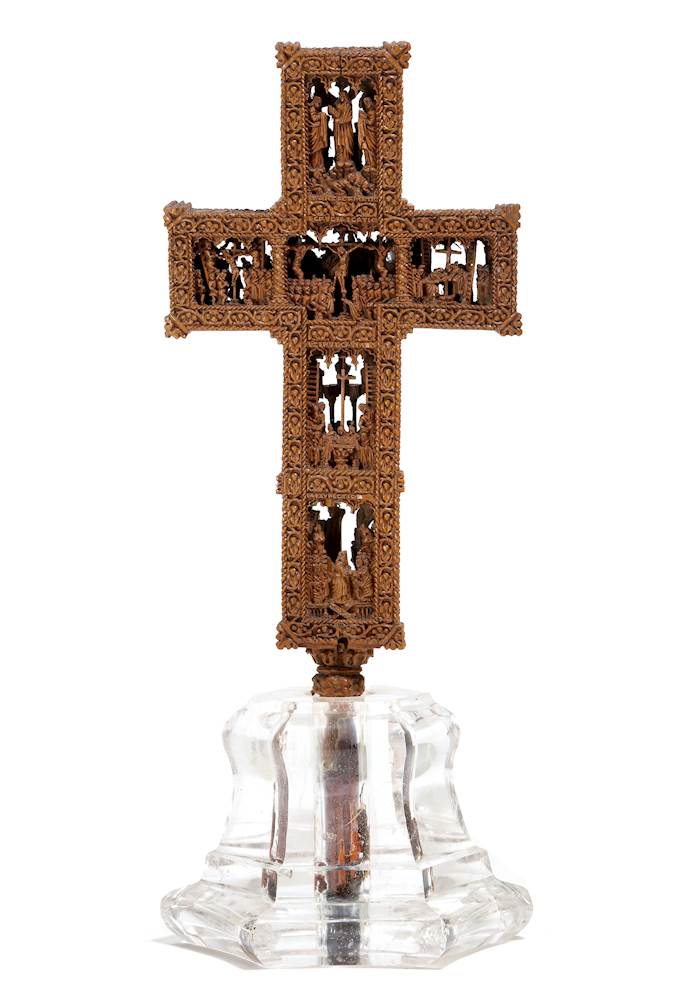
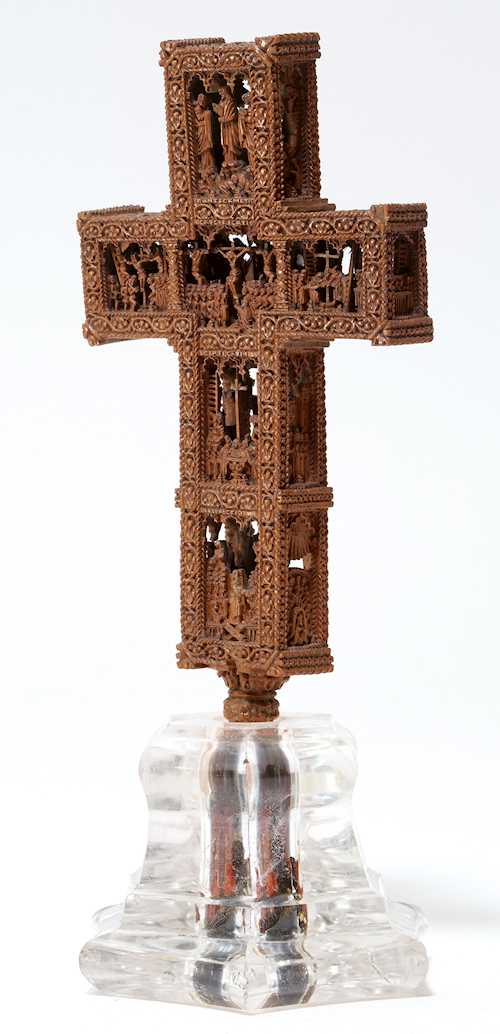
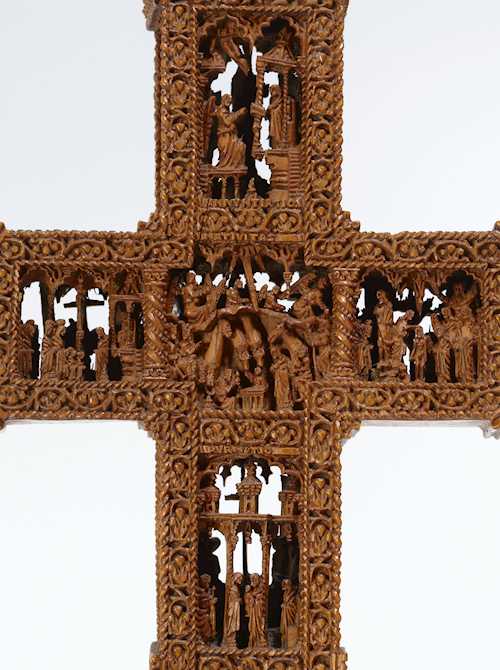
STANDING CROSS WITH MICRO-CARVING AND LATIN TITLES
Italo-Greek/Late Byzantine, last quarter of the 16th century. Attributed to Georgios Laskaris (active 1538–1583) and his workshop.
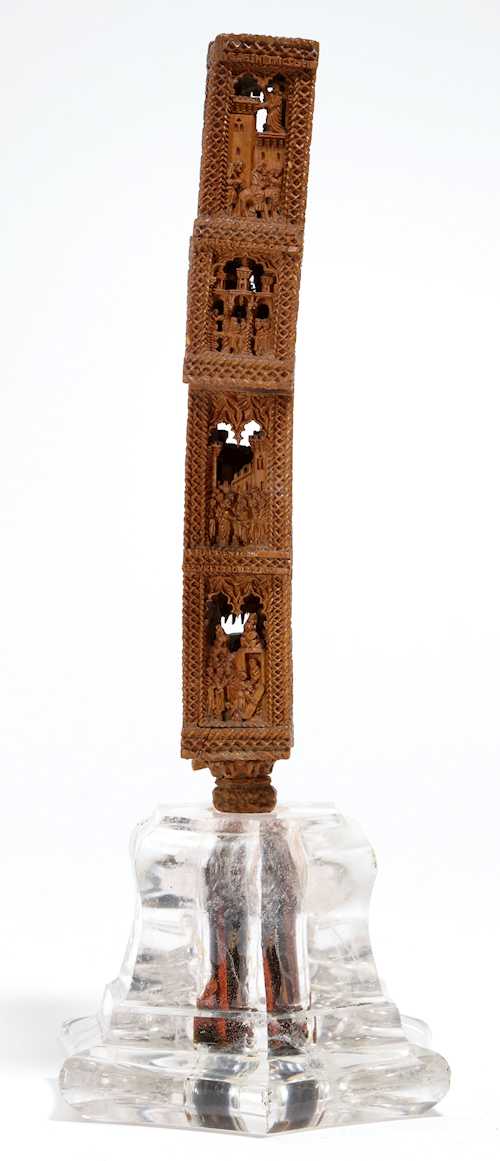
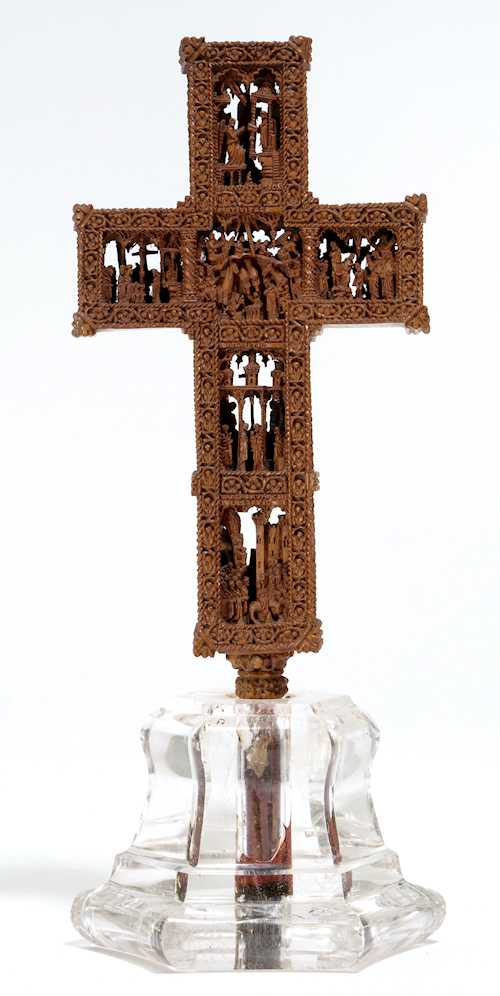
Boxwood, intricately carved on all sides and partly openwork, depicting 20 scenes from the New Testament divided into four registers, some with Latin titles for the scenes (Transformatio, Crucificatio, Sepulcrum, Resurectio, Annuntiatio, Nativitas, Pur(x)tio, Palmarum Celebratio, Christus Orat, Depositio (x) in Sepul, Chr. Docet Marias, Pencoste, (x) Genitrics Dei, Christus Docet, Palpatio, Resurectio Lazari). The narrow sides are similarly crafted. The relief panels depict Peter and Paul as well as a grotesque. On a hexagonal, stepped rock-crystal base.
H with base 23.3 cm, L 9 cm.
Chips and losses. Cracks.
Provenance:
Remarkably, this is already the third previously unpublished standing cross attributed to the carver Georgios Laskaris to be on offer at Koller Auctions (see Koller Auctions Zurich, 19 October 2024, A210/Lot No. 1030 and 21 October 2023, A206/Lot No. 1062). Unlike the majority of crosses from the carver's workshop, which are inscribed in ancient Greek, the example on offer features Latin inscriptions. It thus occupies a special position in the artist's oeuvre, whereby the cross on offer shows a direct relationship to the so-called “Malcove” cross (see Lillian Malcove Collection, Art Center, University of Toronto). As one of the few known blessing crosses from the Laskaris workshop, the Canadian counterpart also has Latin inscriptions (cf. Sheila Campbell: A 16th Century Italo-Byzantine Cross, Gorgias Press, New Jersey 2012). The cross on offer follows the Canadian example almost identically in terms of structure, form, and iconography. One explanation for Laskaris' use of Latin inscriptions could be that these crosses were commissioned for the Italian or Venetian market. The cultural exchange between Venice and the Byzantine region is well-known, so it can be assumed that Laskaris' blessing crosses enjoyed great popularity and were exported to Italian territories. Dr. Ueli Dubs suspects that such Latin blessing crosses were probably created during a mature phase of Laskaris' production.
Although little biographical information about the carver Georgios Laskaris is known, we know from 16 dated crosses (eight of which are also signed) that the artist, who probably came from Crete, was active between 1538 and 1583. Based on stylistic analogies and comparative analyses, depending on the source, a corpus of about 40–45 crosses is attributed to Georgios Laskaris and his workshop, which were probably produced in the second and third generations by a workshop that continued until the last third of the 17th century. The medium-sized, micro-carved crosses are typically characterized by a dome-like base divided into several registers, from which a Latin cross rises. The structure of these crosses usually follows a similar pattern, with the base often depicting scenes from the Old Testament, while the cross depicts scenes from the New Testament. Professor Myrtali Acheimastou-Potamianou believes that, contrary to earlier assumptions, Georgios Laskaris was not active on Mount Athos, but rather in Crete, presumably in the city of Chandax (nowadays Heraklion). Laskaris' crosses are part of the late Byzantine pictorial tradition, as cultivated in the monasteries of the Athos mountain region on the Greek mainland. The function of such micro-carved crosses is to be seen in the context of private worship and domestic religious practice.
We would like to thank Mr. Ueli Dubs, lic. oec. et iur., an expert and specialist on Georgios Laskaris, for confirming the authenticity of the cross on offer (Zurich, 4 November 2025).
Comparative literature:
– Victor H. Elbern: Ein Kreuz des Georgios Laskaris in den Berliner Museen, in: Jahrbuch der Berliner Museen, Berlin 2003, vol. 45, pp. 65–76.
– Myrtali Acheimastou-Potamianou: Wood Carved Crosses of the 16th Century by George Laskaris, in: Christian Archaeological Society, Studies of Archaeology and Art, Athens 2003.
CHF 20 000 / 30 000 | (€ 20 620 / 30 930)
Venduto per CHF 27 500 (incl. premio)