
Lotto 1044 - A218 Collezione Dr. Peter Ducret - giovedì, 17. settembre 2026, 14h00
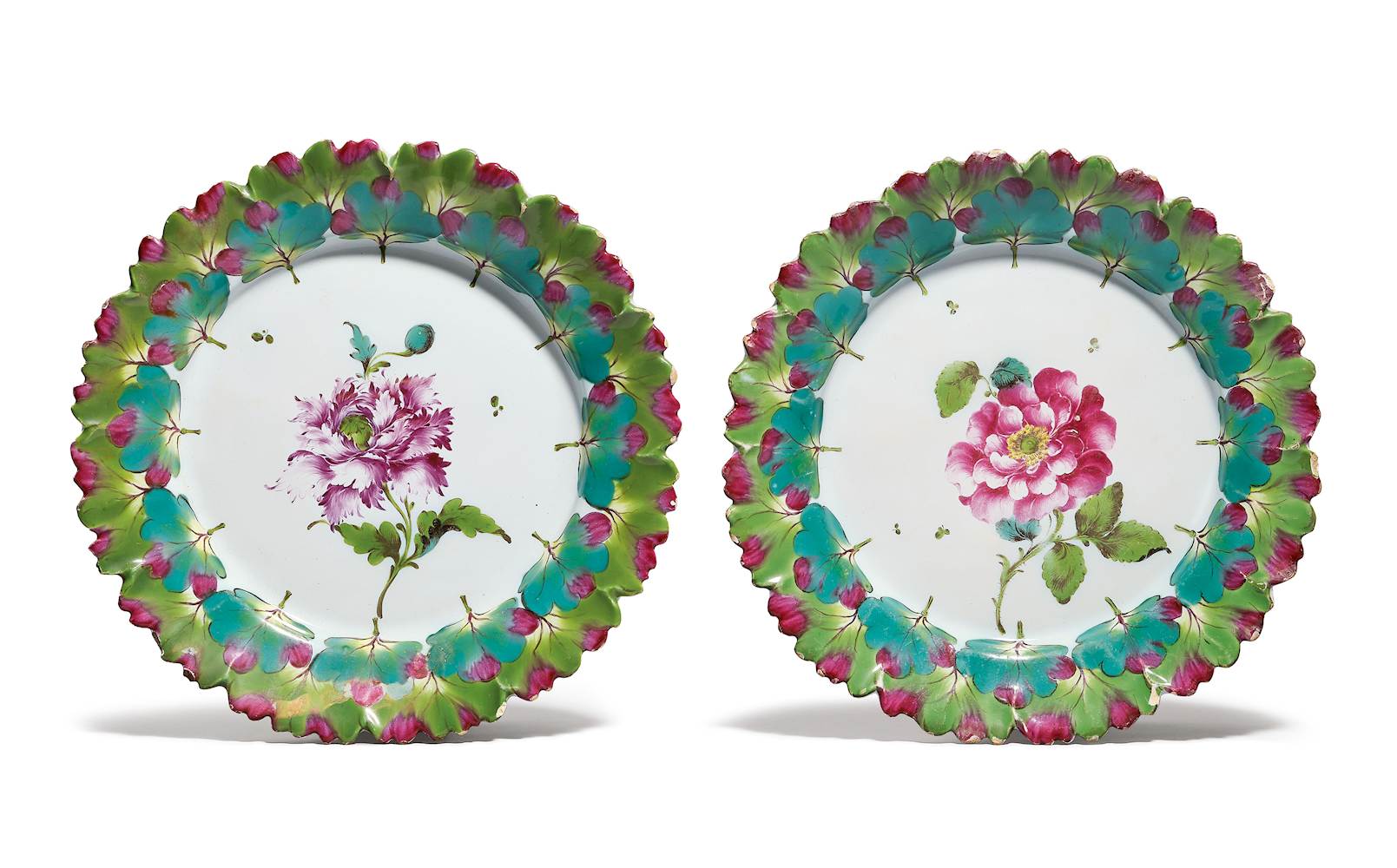
PAIR OF PLATES "FEUILLES EN RELIEF SUR L'AILE"
Sceaux, Jacques Chapelle period (1748–63), circa 1755.
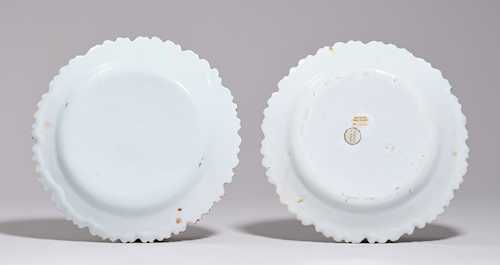
Faience decorated in overglaze enamels. The border painted with foliage in trompe-l’œil manner in green and purple, with rose decoration. Unmarked.
Ø 23 cm.
Small glaze chips and shallow chips to the rim.
Provenance:
- Vandermeersch Art Gallery, Paris.
- Peter Ducret Collection, Kilchberg, acquired from the above in 1977.
Comparable examples: Musée des Arts Décoratifs, Paris (inv. no. 24967); Metropolitan Museum of Art, New York (object no. 17.190.1923); Château-Musée de Saumur (C. Lahaussois-A. Hallé, cat. 2017, p. 190, no. 261).
Sceaux (1735–1879)
A pottery had already been established at Sceaux by 1735 and, following the partnership between François Despinal and Louis-François de Bey, focused on the development of porcelain. In 1748, they entrusted the management of the manufactory to Jacques Chapelle (1721–1773), who had previously worked as a modeller at the manufactory on the Rue de Charenton. Various journeys, including to Strasbourg and Vincennes, during which Chapelle also worked at the local manufactories, attest to his already extensive experience.
The royal privilege, or monopoly, granted to the Vincennes manufactory for the production of porcelain proved an obstacle not only to Paul Hannong but also to Jacques Chapelle, forcing the trained chemist to pursue new inventions. Chapelle’s "faïence japonnée" sought to imitate the highly prized porcelain through the use of a broad palette of overglaze enamels on a milky-white ground and by making the body as light as possible. His spirit of experimentation attracted numerous artists to Sceaux and enabled the manufactory to flourish with imaginative faience wares. These included the "trompe-l’œil" tablewares that were fashionable in the mid-18th century. The inventory of the Château d’Issou records an extensive vegetable service from Sceaux that included, among other pieces, melons, heads of cabbage, fruit dishes and bundles of asparagus.
Thanks to the patronage of Anne-Louise Bénédicte, Duchess of Maine, and later the Duke of Penthièvre, the manufactory gained further prestige among the French nobility.
During the period of Charles S. Jacques and Joseph Jullien at Sceaux (1763–72), the manufactory produced primarily lively landscape scenes with birds, fruits and gallant scenes. Sceaux experienced another period of prosperity under the direction of Richard Glot (1772–1794), who was also mayor of the town. Under his leadership, the manufactory developed into an industrial enterprise.
Faced with increasing competition during the 19th century, the manufactory shifted its focus increasingly toward commercial wares, leading to its gradual decline and eventual closure in 1879.
CHF 1 000 / 1 600 | (€ 1 030 / 1 650)
Venduto per CHF 2 375 (incl. premio)