


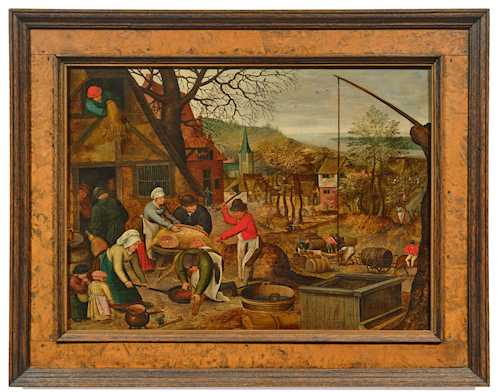
Lotto 3027 - A216 Dipinti antichi - venerdì, 27. marzo 2026, 14h00
PIETER BRUEGHEL the Younger
(Brussels 1564–1638 Antwerp)
Allegory of Autumn. 1622.
Oil on panel.
Signed and dated lower right on the rim of the fountain: P. BREVGHEL. 1622.
Verso with brands of the City of Antwerp and of the panel maker Michiel Claessens (active in Antwerp 1590–1637).
Verso with brands of the City of Antwerp and of the panel maker Michiel Claessens (active in Antwerp 1590–1637).
41.1 × 56 cm.
Provenance:
– Probably collection of Arthur Brölemann (1826–1904).
– Probably collection of Blanche Bontoux (1859–1955), niece of Arthur Brölemann, wife of Étienne Mallet (1853–1929), resident at Villa Choisi, western Switzerland.
– Probably Auction Sotheby’s, London, 19 June 1935, lot 7, offered as part of a series of the Seasons (with Spring, Summer and Winter), acquired there by Rosenbaum.
– With Marguerite Schulthess, Basel, 1935.
– Private collection, Switzerland, for four generations.
Literature:
– Probably exh. cat. ‘Von Cranach bis Monet. Europäische Meisterwerke aus dem Nationalen Kunstmuseum Bukarest’, ed. Ruxandra and Alexander Jotzu, Wuppertal 1994, p. 76.
– Probably Klaus Ertz, ‘Pieter Brueghel der Jüngere (1564–1637/38). Die Gemälde mit Kritischem Oeuvrekatalog’, vol. II, Lingen 1988/2000, pp. 537 and 598–599, no. E649.
Exactly 404 years ago, Pieter Brueghel the Younger painted this impressive ‘Allegory of Autumn’, signed P. BREVGHEL and dated 1622. It was created as part of a series depicting the four seasons and was probably last offered at auction in 1935. Since then, it has been in a Swiss private collection and has remained with the same family for four generations. It is particularly gratifying that this fine, museum-quality work can once again be seen in public.
Pieter Brueghel the Younger was one of the most important representatives of the Brueghel dynasty and played a decisive role in disseminating his father’s artistic legacy. He was only five years old when his father, Pieter Brueghel the Elder (1520/25–1569), died; his younger brother Jan the Elder (1568–1625) was still an infant. The brothers initially received their artistic training from their mother, Mayken de Coecke (1545?–1578), daughter of the Antwerp master Pieter Coecke van Aelst (1502–1560) and Mayken Verhulst (1518–1596/99), who, as their grandmother, subsequently exerted a formative influence on their education. After 1578 the family moved to Antwerp, where Pieter the Younger was admitted as a master’s son (and free master) to the Guild of St Luke in 1584/85; Jan Bruegel followed in 1597.
Around 1600, there was an enormous demand for the Brueghelian style of painting established by the work of Brueghel the Elder. Following his death, this pictorial language had initially been taken up by artists such as Pieter Balten (1527/28–1584) and Marten van Cleve (1527–1577/81). Pieter Brueghel the Younger mastered his father’s repertoire to an exceptional degree, including representations of the seasons, proverbs, Adoration of the Magi, and wedding and fair scenes, disseminated through prints and drawings. Although he undoubtedly knew some original works by his father, very few were accessible, having entered aristocratic collections at an early date. It was Pieter Brueghel the Younger who ultimately secured and staged the enduring popularity of his father’s pictorial idiom, a development further encouraged by the scarcity of original paintings by Pieter Brueghel the Elder. Pieter the Younger excelled above all in the depiction of figures in the style of his father, while his younger brother, known as ‘Velvet Brueghel’, specialised in flower still lifes and landscapes. Pieter the Younger varied and expanded his father’s compositions, transforming them into his own artistic specialisation.
The present ‘Allegory of Autumn’ is a characteristic example from a series of the Four Seasons, combining rural life with activities emblematic of the autumn months. In the foreground, a pig slaughter is under way, observed by several children who have already secured an inflated pig’s bladder to play with. The scene unfolds before the Crown Inn, whose eponymous sign is prominently displayed to the right of the tree. From a dormer window, a figure hands down a bundle of straw. In the background, set within a broad river landscape, vineyards and peasants harvesting grapes can be discerned on the right. In the middle ground, the grapes are brought in baskets, trodden in a large wooden vat, and the juice transferred into sizeable wooden barrels, which are then transported away by a horse-drawn cart. In the distance, woodcutters are at work among the trees, while in the centre of the village passers-by pursue everyday activities. A man relieving himself against the wall of a house adds a touch of earthy humour.
Scientific analyses were carried out by KIK-IRPA (Royal Institute for Cultural Heritage, Brussels) under the direction of Dr Christina Currie, to whom we extend our thanks. The results reveal, among other things, the variety of underdrawings which demonstrate the artistry of the composition and the master’s virtuosity (see detailed report). Currie particularly emphasises the high quality of the execution by Pieter Brueghel the Younger.
On the reverse are the brands of the City of Antwerp, showing the city gate with the two hands and splayed fingers, as well as the mark of the panel maker Michiel Claessens, an indication of the quality of the panel (see ill. 1). A petition dated 13 November 1617 called for establishment of official standards in the production of panels and frames; it was submitted to the mayor and aldermen of Antwerp by a group of members of the Guild of St Luke and approved one month later. The initiative was launched by the alderman Michiel Claessens together with twenty-one other panel makers, mirror makers and frame makers. In the petition, the masters identified themselves by their personal symbols or initials, which they also branded onto their panels (see ill. 2). Michiel Claessens’s cloverleaf, visible on the reverse of the present panel, was even applied twice. Presumably the first attempt was deemed insufficiently legible, as one of the two cloverleaf marks appears noticeably weaker in its contours.
Professor Jørgen Wadum, whom we also thank for his assistance in cataloguing this work, notes that the brands on this panel are of outstanding quality and that the wooden support survives in its original state of workmanship, as evidenced by the pronounced tool marks on the surface. Wadum classifies the visible Antwerp brand as type no. 1, in use between 1617–1626 (see also Jørgen Wadum, ‘The Antwerp Brand on Paintings on Panel’, in ‘Looking through Paintings’, ed. Erma Hermens, London 1998, p. 189, pl. 2).
In 1570, the publisher Hieronymus Cock (1518–1570) issued a series of four engravings depicting the Seasons. Two of these were based, in reverse, on drawings by Pieter Brueghel the Elder (‘Spring’, Albertina, Vienna, and ‘Summer’, Kupferstichkabinett, Hamburger Kunsthalle). It remains unclear why Pieter Brueghel the Elder did not also provide models for autumn and winter; scholarship has suggested his early death as a possible explanation. These two were instead drawn by Hans Bol (1534–1593). The composition of the pig slaughter in the painting presented here derives from the autumn version of the series of engravings. While it cannot be proven beyond doubt that our painting once formed part of a complete set of the seasons, this appears highly likely, particularly in view of the probability that it was sold in London in 1935 from the collection of Mme Mallet de Choisi together with the three other seasons. A notarised certificate of authorship issued by Marguerite Schulthess, Basel, in the same year suggests that the series was broken up and the works sold individually at that time. In addition to the aforementioned series auctioned in London and dated 1622, Klaus Ertz records three other series. One - in the National Museum in Bucharest - is the only ensemble still in museum ownership today. The two others are dated 1624. The first of these sold at Fischer Auktionen, Lucerne, in 1927 (lots 14–17) and at Christie's London in 2016 (lot 6). The other sold at Sotheby's London in 1972, and at the Galerie L. Koetser in the same year (Ertz 1988/2000, p. 542).
The wonderfully preserved signature P. BREVGHEL which can be seen on our painting is characteristic of the artist and corresponds to the form he adopted from 1616 onwards, whereas previously it had been modelled on his father’s signature: P. BRVEGHEL. The additional date of 1622 serves as a valuable element, firmly situating the work within the artist’s oeuvre.
CHF 300 000 / 500 000 | (€ 309 280 / 515 460)
Venduto per CHF 1 807 000 (incl. premio)