
Lotto 3437 - A219 Postwar e contemporary art - giovedì, 03. dicembre 2026, 15h00
RICHARD SERRA
(San Francisco 1939–2024 Orient)
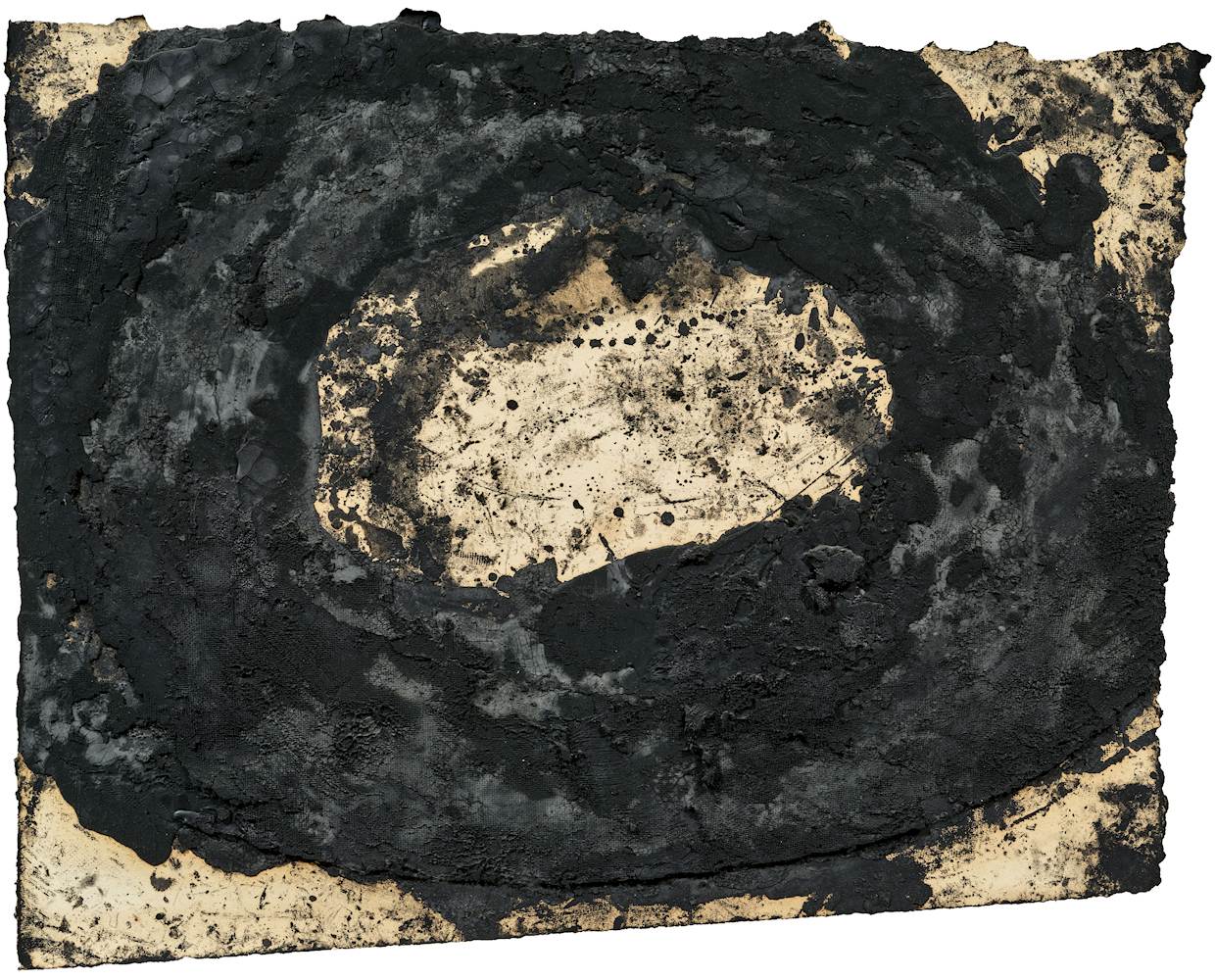
Torus III. 2000.
Paintstick on paper.
Dated, signed and inscribed with a directional arrow on the reverse: 2000 R Serra.
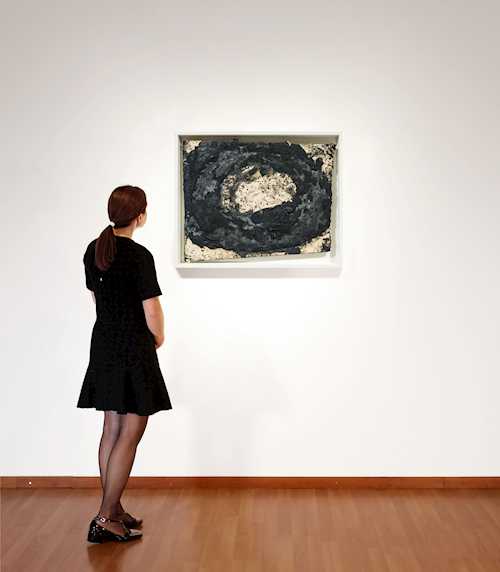
67.8 × 86 cm.
Certificate:
Provenance:
- Galerie m, Bochum.
- Private collection, Switzerland, acquired from the above gallery at Art Basel in 2002.
‘There is no way to make a drawing – there is only drawing’, Richard Serra explained in 1977. The quotation points to a central aspect of his drawings: for Serra, drawing is not merely the visualisation of an idea already developed, but an independent creative process. Since the early 1970s, drawing had constituted an autonomous part of his oeuvre, formally and conceptually closely connected to his sculptures without being subordinate to them as designs or preliminary studies. In both media, Serra investigates fundamental questions of weight, density, balance and the physical perception of form in space.
From the mid-1970s, Serra favoured black paintstick for his drawings, a solid combination of pigment, oil and wax. The material can be applied like paint, but also pressed, rubbed and worked into the support. His paintstick drawings thus acquire a pronounced physical, almost sculptural effect. Black appears not merely as colour, but as dense, light-absorbing matter that conveys a peculiar heaviness even on the flat paper surface.
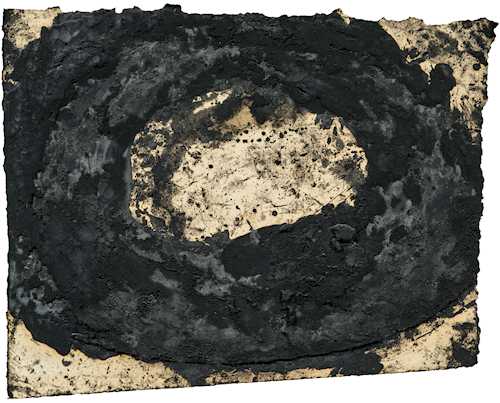
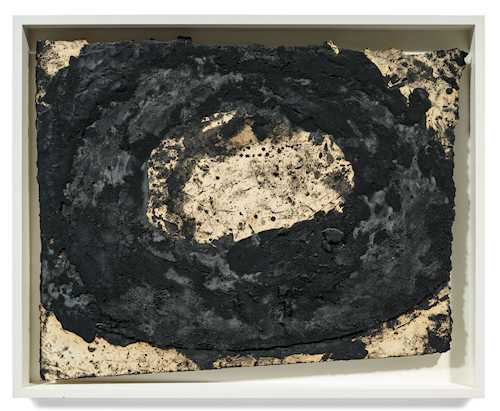
In ‘Torus III’, this conception of drawing encounters an elementary geometric form. A torus is a ring-shaped solid produced by rotating a circle around an axis outside its plane. Even mathematically, the form is thus the result of movement, a central concern in Serra’s work.
Through the application of paint, however, this basic geometric form loses its mathematical perfection. The surface is neither perfectly smooth nor homogeneous; concentrations of material, irregularities and traces of working make the process of production visible. At the same time, Serra contrasts the closed circular form with the trapezoidal format of the paper. Black mass and white surface, curvature and angular support stand in a relationship of tension. The paper contributes significantly to the sculptural effect.
Serra’s engagement with circles, ellipses and curvature gained particular importance from the 1990s. In the ‘Rounds’ produced in 1996 and 1997, he systematically explored circular and elliptical forms and their relationship to the rectangular paper format. In parallel, he created his first ‘Torqued Ellipses’. In these monumental steel sculptures, a recognisable basic geometric form is spatially transformed through torsion and inclination. As viewers walk through and around the sculptures, their perception of the form changes according to their vantage point. Geometry provides the starting point, but the spatial effect unfolds only through the viewer’s movement.
In ‘Torus III’, the same exploration appears in concentrated form on paper: as an interplay of geometric order, material density and spatial perception.
CHF 150 000 / 250 000 | (€ 154 640 / 257 730)