


Lotto 3446 - A213 Postwar e contemporary art - giovedì, 26. giugno 2025, 15h00
FERNANDO BOTERO
(Medellín 1932–2023 Monaco)
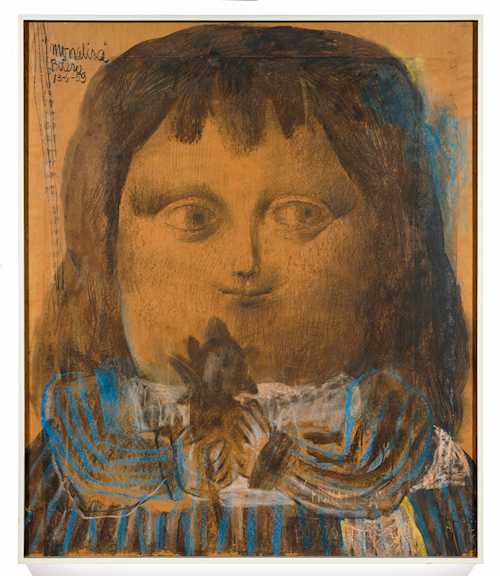
Monalisa. 1959.
Charcoal, colour chalk and wax chalk on kraft paper, firmly laid on wood.
Upper left and lower right signed, dated and titled: "monalisa" Botero 13-6-59 "MONALISA" Botero 13-6-59.
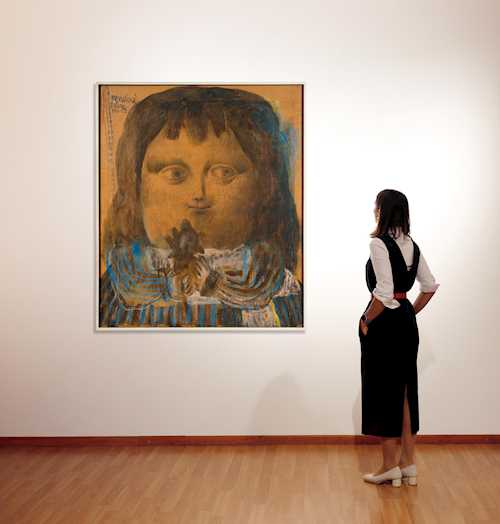
144 × 122 cm.
Provenance:
- Private collection, Switzerland, acquired at the above gallery in 1975.
- Private collection, Switzerland, by descent.
Our thanks to Galería Duque Arango for the confirmation of authenticity of the work, Medellín, 13.2.2025.
With this large-format drawing from 1959, Fernando Botero takes a closer look at one of the most famous pictorial motifs in Western art history: Leonardo da Vinci's ‘Mona Lisa’. But instead of a mere replica or ironic distortion, Botero presents a radical, personal interpretation - a Mona Lisa as a child, with childlike, rounded proportions, an oversized face and at the same time a facial expression that captures the grace of the original: the slightly sidelong gaze, the famous smile, the self-contained presence.
This work already displays the characteristic formal language for which Botero would later become famous: the monumental rendering of the body, the play with volume and scale. The strictly frontal figure wears a striped dress, her hands clasping a dark flower - a delicate, almost poetic motif amidst the exaggeration of form. The pink accents and the bright blue stripes in the clothing give the work a lively burst of colour and point to the young Botero's love of chromatic experimentation.
‘Mona Lisa’ is one of a small series of works in which Botero intensively explored the image of the ‘Gioconda’. In this phase, even before the final breakthrough of his ‘Boterism’, the motif served as a surface on which to project his formal and painterly experiments. As early as 1961, the related painting ‘Mona Lisa, Aged 12’ (Fig. 1) was purchased by the Museum of Modern Art in New York - a milestone in the international reception of the Colombian artist.
With subtle humour and formal rigour, in this work Botero combines an art historical reference with his personal signature. The drawing is emblematic of his early approach to the Western art tradition, which he adopted during his stay in Europe in 1953/54. He combines his exploration of the Old Masters - from Leonardo da Vinci to Velázquez and Piero della Francesca - with a modern, almost pop-cultural view of the icons of art history.
Botero's Mona Lisa refers not only to Leonardo, but also to the strategies of modernism: from Duchamp's ironic ‘L.H.O.O.Q.’ to Warhol's serial utilisation of icons. Botero comments - with Latin American originality - on the commercialisation of works of art and their status as common cultural property.
This rare and early drawing documents a key artistic moment: the emergence of an unmistakable formal language - and a work that joins the long history of the reception of the Mona Lisa with subtle irony and painterly quality.
CHF 250 000 / 350 000 | (€ 257 730 / 360 820)
Venduto per CHF 573 200 (incl. premio)