
Lotto 1663 ♣ - S20 IMPORTANTE COLLEZIONE PRIVATA DI POSATE ANTICHE - giovedì, 21. marzo 2024, 10h00
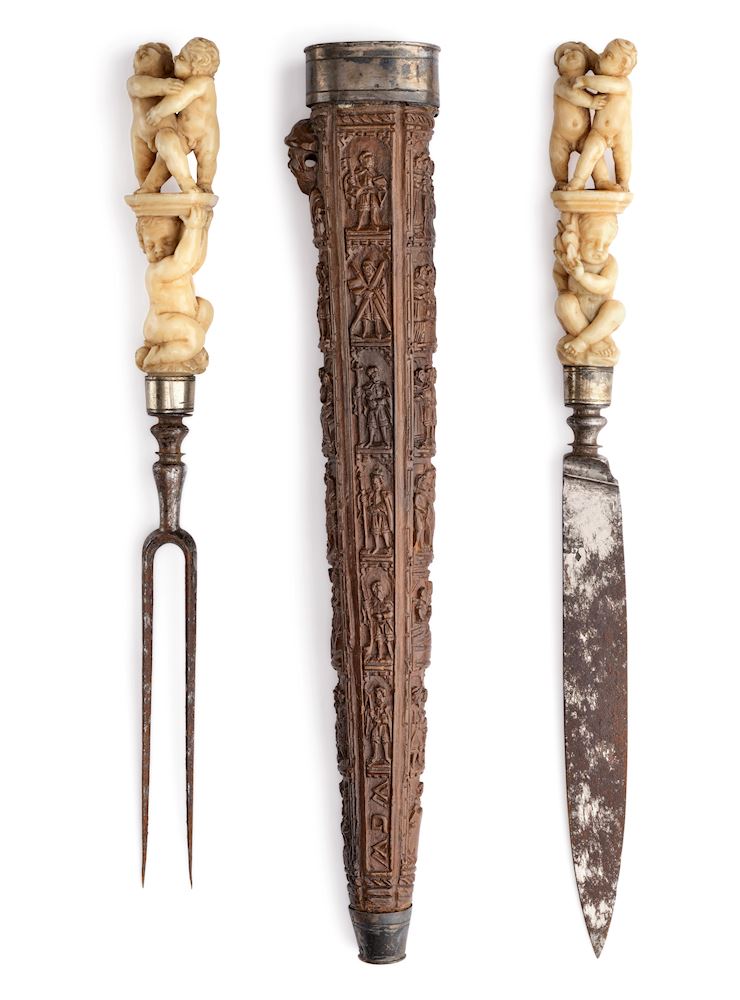
TWO-PIECE CUTLERY SET WITH KNIFE AND FORK AND CASE
Southern German, 2nd half of the 17th century. The case with the acronym WGW and dated 1618.
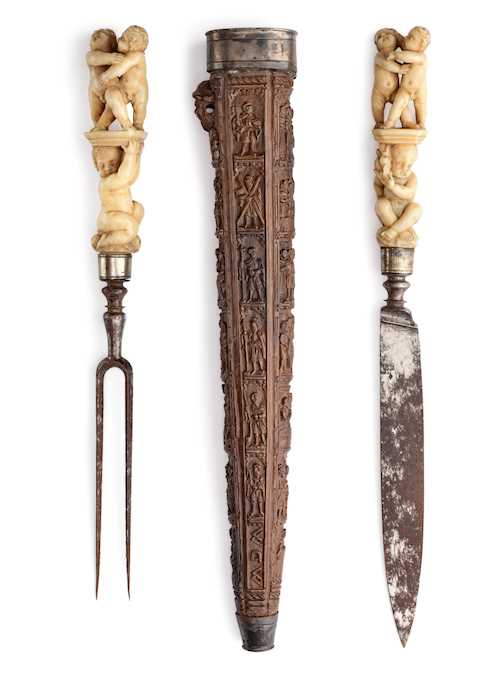
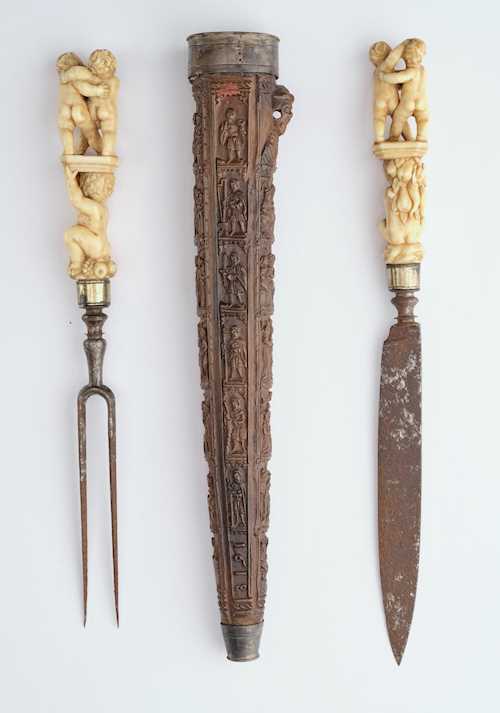
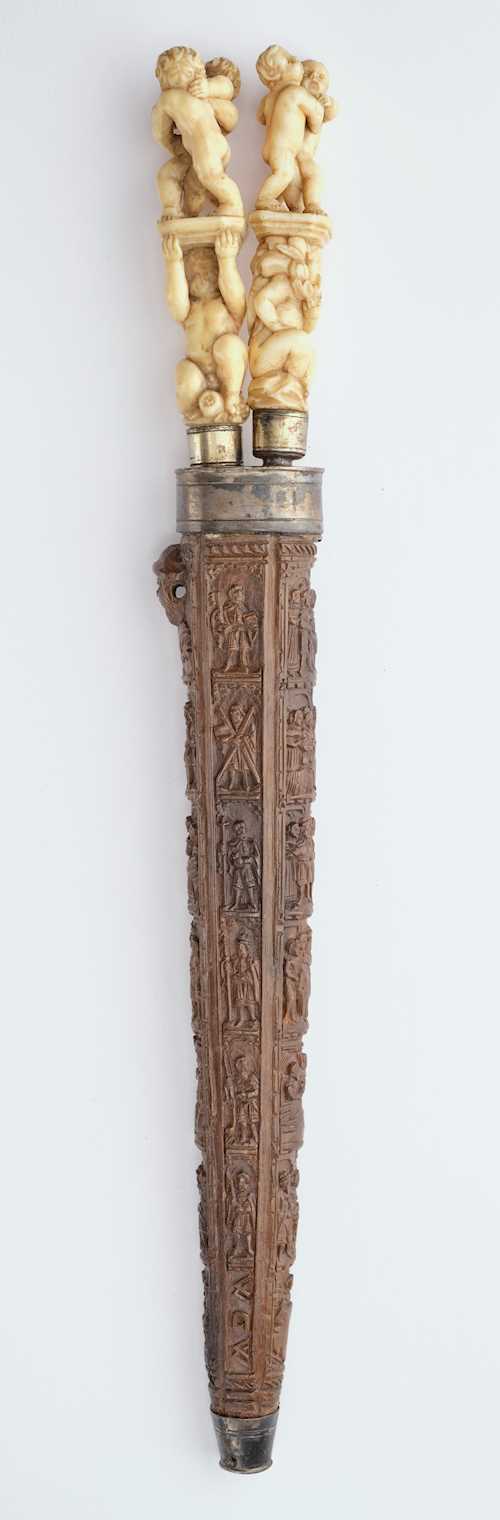
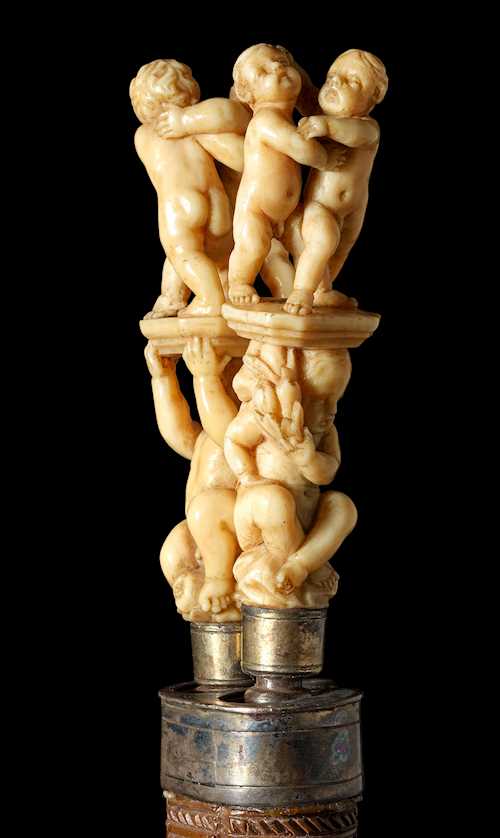
Both handles with fully sculpted ivory figures. In the lower half, a putto carrying a capital, with two putti wrestling with each other on top. Gilt, smooth handle collars. Shaped blade bolster. Blade with center tip. Fork tip with two tines, the bolster with baluster-shaped jointed lines. Assorted, fan-shaped wooden sheath with fine relief carving all round, depicting the 12 apostles. Eyelet carved in the shape of a bearded man's head. Tip and locket in silver. Dated 1618 and with the acronym WGW (probably "As God wills").
L holder 21 cm, knife 21.4 cm, fork 19.6 cm.
Minor wear to the handles, the knife handle with cracks. Blade and fork tip heavily corroded. Mouth plate and tip of the sheath loose.
Cf. on the upper part of the fork handle for a comparable putti battle scene, but on a more simple pedestal without another putto as a supporting figure: Klaus Marquardt. Europäisches Essbesteck aus acht Jahrhunderten. Stuttgart, 1997 p. 125, fig. 394. A related depiction of wrestling putti, carved from ivory and classified as a German work from the second half of the 17th century, from the former Egloffstein collection is kept by the Wartburg Foundation in Thuringia (inv. no. WSE cat. Amme 138a).
Cf. for a similar scabbard with the depiction of the 12 apostles and the monogram WGW from the Hollander collection: Musée d'Art et d'Histoire de Nice. Couverts de l'art gothique à l'art nouveau, Collection Jacques Hollander. Nice, 1994. p. 47, fig. 47. or Gertrud Benker. Alte Bestecke, ein Beitrag zur Geschichte der Tischkultur. Munich, 1978, p. 80, fig. 113. According to the authors, the acronym WGW (Wie Gott will) refers to the marriage relationship. In this case, the cutlery serves as a wedding gift.
The item on offer comes with a trade license for the EU. Due to the use of protected materials, this object may not leave the EU.
Il braccialetto è realizzato con una specie animale protetta. Quando esportiamo la orologi per l'acquirente, dobbiamo prima rimuovere il braccialetto. Questo verrà conservato presso la nostra sede per 1 anno.
CHF 2 000 / 3 000 | (€ 2 060 / 3 090)
Venduto per CHF 5 625 (incl. premio)