
Lotto 3446 - A219 Postwar e contemporary art - giovedì, 03. dicembre 2026, 15h00
SERGE POLIAKOFF
(Moscow 1900–1969 Paris)
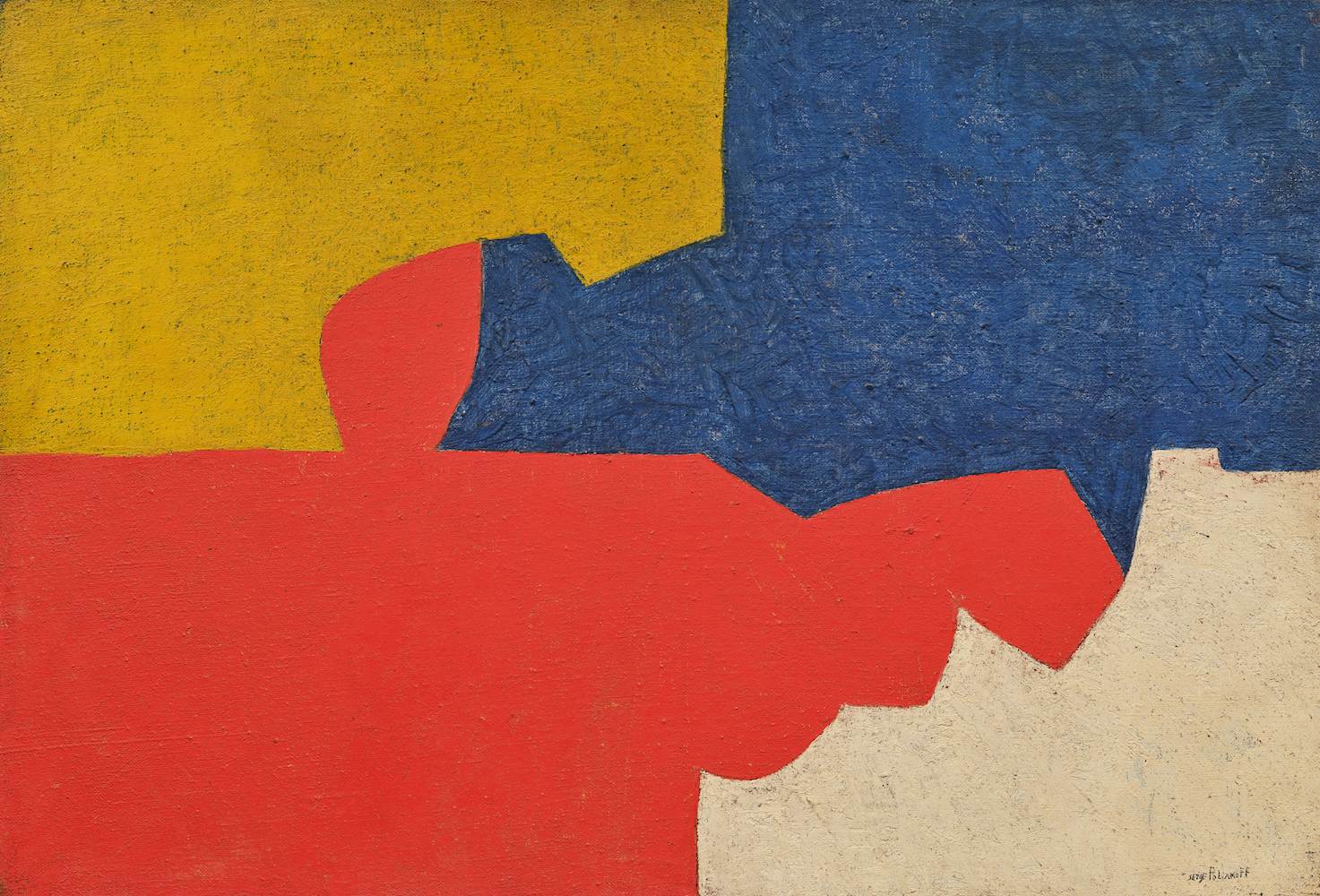
Composition abstraite. 1952.
Oil on canvas.
Signed lower right: Serge Poliakoff.
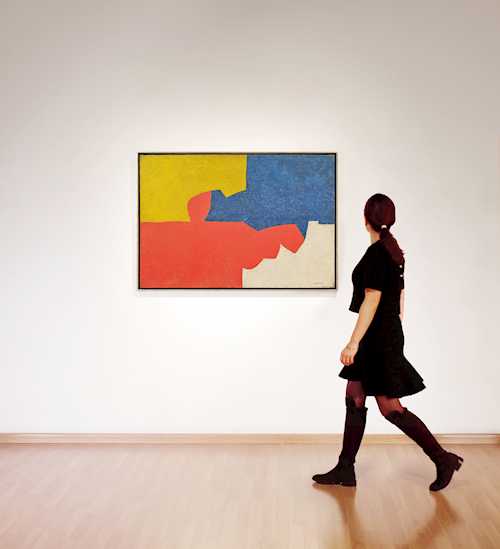
89 × 130 cm.
Provenance:
- Galerie Pro Arta, Zurich (label on verso).
- Private collection, Switzerland, acquired from the above gallery in 1989.
Exhibited:
- Paris, Galerie Melki, Paris (label on verso). xxx
- Zurich 1989, Serge Poliakoff, Galerie Pro Arta, 13 October–1 December 1989, cat. p. 19 (ill.).
Literature:
- Gérard Durozoi: Serge Poliakoff. Expressions contemporaines, Angers 2001, p. 164 (ill.).
Born in Moscow, Serge Poliakoff left Russia in 1917 and, arrived in Paris in 1923 after a period of travel. Alongside his work as a guitarist, he devoted himself to painting and, from the late 1930s onwards, developed an increasingly distinctive abstract visual language. Influenced by Wassily Kandinsky, Sonia and Robert Delaunay, and the Russian icon tradition, he concentrated on the expressive power of colour and the interplay of free forms.
Painted in 1952, ‘Composition abstraite’ belongs to the Nouvelle École de Paris and the tradition of lyrical abstraction. Poliakoff developed an autonomous pictorial order in which colour, form and materiality assume central importance. He remained largely faithful to his characteristic visual language throughout his career. His compositions follow a recognisable framework of principal lines and axes that clearly structure the image. The main axes run vertically, horizontally and diagonally through the centre, although the diagonals are slightly offset rather than pointing precisely towards the corners of the support.
The composition comprises four large, interlocking colour fields whose irregular contours form a composition both tense and balanced. Ochre yellow, blue, strong red and off-white meet directly. Poliakoff deliberately dispenses with illusionistic spatial depth. Nevertheless, the changing contours produce a subtle spatial effect: some areas appear to advance while others recede. The relationship between warm and cool tones, dark and light passages, and straight and organic boundaries determines the visual rhythm.
The granular, at times almost relief-like surface reinforces the painting's material presence. Fine irregularities within the colour fields interrupt their uniformity and lend them vitality.
The eye moves between the contrasting colour fields without finding a clear focal point. A dynamic equilibrium emerges in which each colour exerts its own effect while relating to adjacent areas. Abstraction thus appears not as rigid geometry but as an organically developed, almost musical order of colour, form and rhythm.
CHF 400 000 / 600 000 | (€ 412 370 / 618 560)