

拍品 1107* - A214 Works of Art & Decorative Arts - Donnerstag, 18. September 2025, 01.30 PM
ISTORIATO PLATE WITH A FAMILY COAT-OF-ARMS - The Embden Collection
Renaissance, Venice, ca. 1570. Probably Orazio Fortezza (or Horacije Fortezza, Šibenik, ca. 1530–1596)
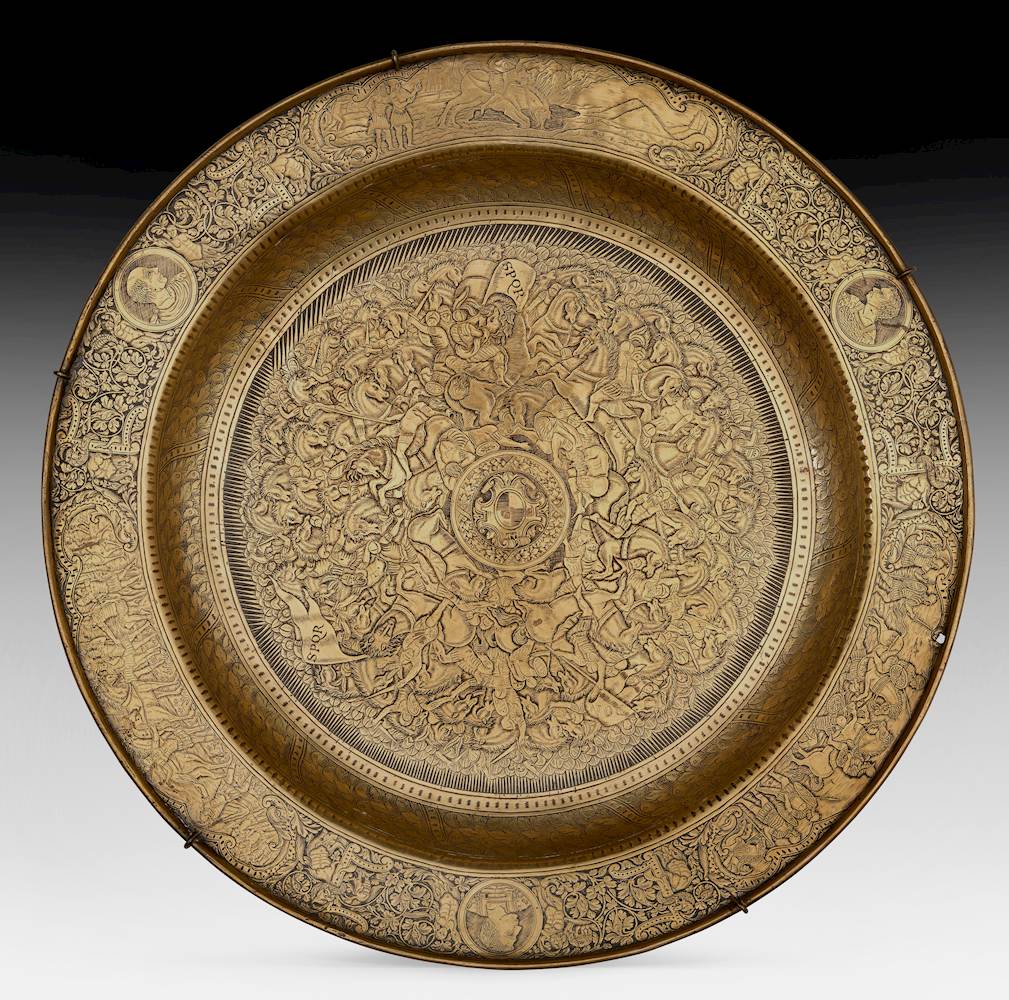
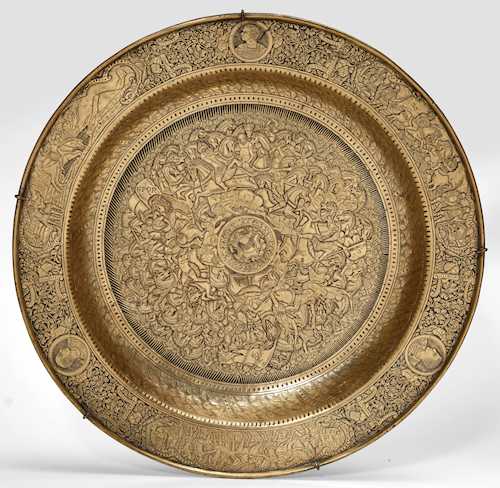
Brass, finely engraved and partially blackened. The lip features three medallions of Roman statesmen, with three battle scenes in cartouches between them, framed by tendrils with mythical creatures. In the center is a battle scene with soldiers and horsemen on horseback, three banners labeled SPQR and PON. Probably a depiction of the Battle of Pharsalus or a battle between Romans and Barbarians. In the middle is a coat of arms, probably of an Italian family (possibly Collalto).
Ø 50 cm.
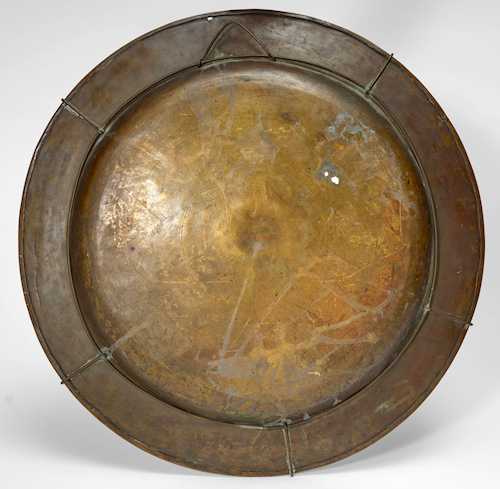
Perforation in the rim, minor dents and scuffs.
來源:
Born in Šibenik (Croatia), artist Orazio Fortezza, who was active in the second half of the 16th century, distinguished himself through the production of high-quality metal objects such as ceremonial vessels, ewers, and bowls, which were presented to a wider audience in a monograph published by Milan Pelc (see Milan Pelc: Horacije Fortezza, šibenski zlatar i graver 16. Stoljeća. Zagreb/Sibenik 2004). Due to their sophistication, Fortezza's objects were not intended for everyday use, but were designed to embellish the magnificent residences of wealthy clients, which certainly included Venetian noble families. At that time, the region of Dalmatia was under the rule of the Republic of Venice, and therefore Orazio Fortezza was able to sell many of his luxury objects directly to the lagoon city.
The decoration of the display plate on offer, especially the image in the well, which is identical down to the last detail, is strongly based on an example from the V&A in London (inv. no. M.163-1951). The London display plate is dated between 1555 and 1557 and features the coat of arms of the Venetian Foscari family.
According to the exhibition catalog of the Šibenik Museum, the image in the well can be identified as the Battle of Pharsalus (or Pharsalos in Greek). It took place on August 9, 48 BC, near Pharsalus (Thessaly, Greece). It was the decisive battle in the war between Caesar and Pompey. Prof. Milan Pelc, however, suspects that it is more likely to be a battle between Romans and barbarians. The inscription PON on the flag probably meant POENI (Carthaginians) and it was therefore more likely to be a battle between Romans and Carthaginians. The catalog of the Šibenik City Museum for the exhibition “The Mystery of Master Fortezza” (October 9–11, 2024) contains a very interesting clue as to the possible provenance of the plate on offer. The London specimen from the V&A (inv. no. M.163-1951) comes from the former collection of Sir Francis Cook and was added to the collection in 1951. Charles Oman, then curator of the V&A Museum, also suggested acquiring a second identical plate from the Cook collection. However, this was rejected by the management at the time because the central motif on both plates was identical and the second plate was damaged. A second, unidentified plate therefore disappeared into an unknown private collection. It is quite possible that this is the plate currently on offer. Given the connection between Antony Embden and London, it seems plausible that the second display plate from the Cook collection came into Embden's possession.
Other elements, such as the antique-style medallions of Roman rulers on the lip, can also be found in a similar form on a washbasin bearing the coat of arms of the Tagliapietra family from the Museo Correr (inv. no. Cl. XI N. 0759, cf. the article by Michele Asolati & Cristina Crisafulli: Oracio Fortezza da Sebenico fece: un bacile all’antica nelle Collezioni del Museo Correr di Venezia. In: Letteratura, arte, cultura tra le due sponde dell’Adriatico V. Zara 2014, pp. 231–266). The coat of arms on the plate on offer cannot be attributed with certainty to a specific family. Based on the heraldry and assuming that a Venetian family commissioned this plate, the Collalto family would be a possibility.
We would like to thank Prof. Dr. Milan Pelc for his assistance in cataloguing this object based on photographs (Zurich, August 5, 2025).
CHF 10 000 / 15 000 | (€ 10 310 / 15 460)
以瑞士法郎銷售 CHF 43 750 (包含買家佣金)
所有信息随時可能更改。