
拍品 1207 - A214 Works of Art & Decorative Arts - Donnerstag, 18. September 2025, 01.30 PM
COMMODE “À PORTES”
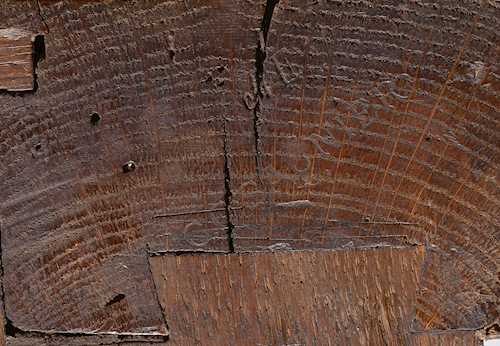
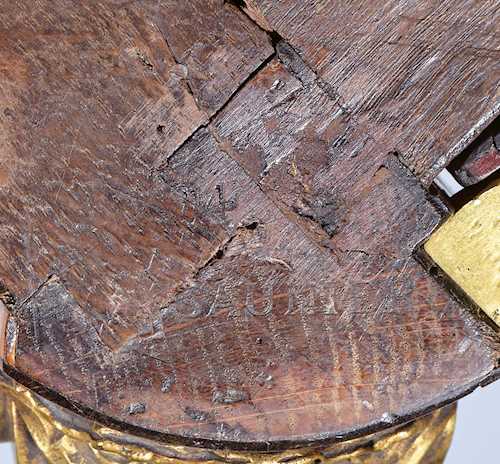
Louis XV, Paris, ca. 1750/60. Signed C.C. Saunier (Claude-Charles Saunier, master craftsman from 1752) and with the guild mark JME. The bronzes attributed to Jean-Claude-Thomas Duplessis.
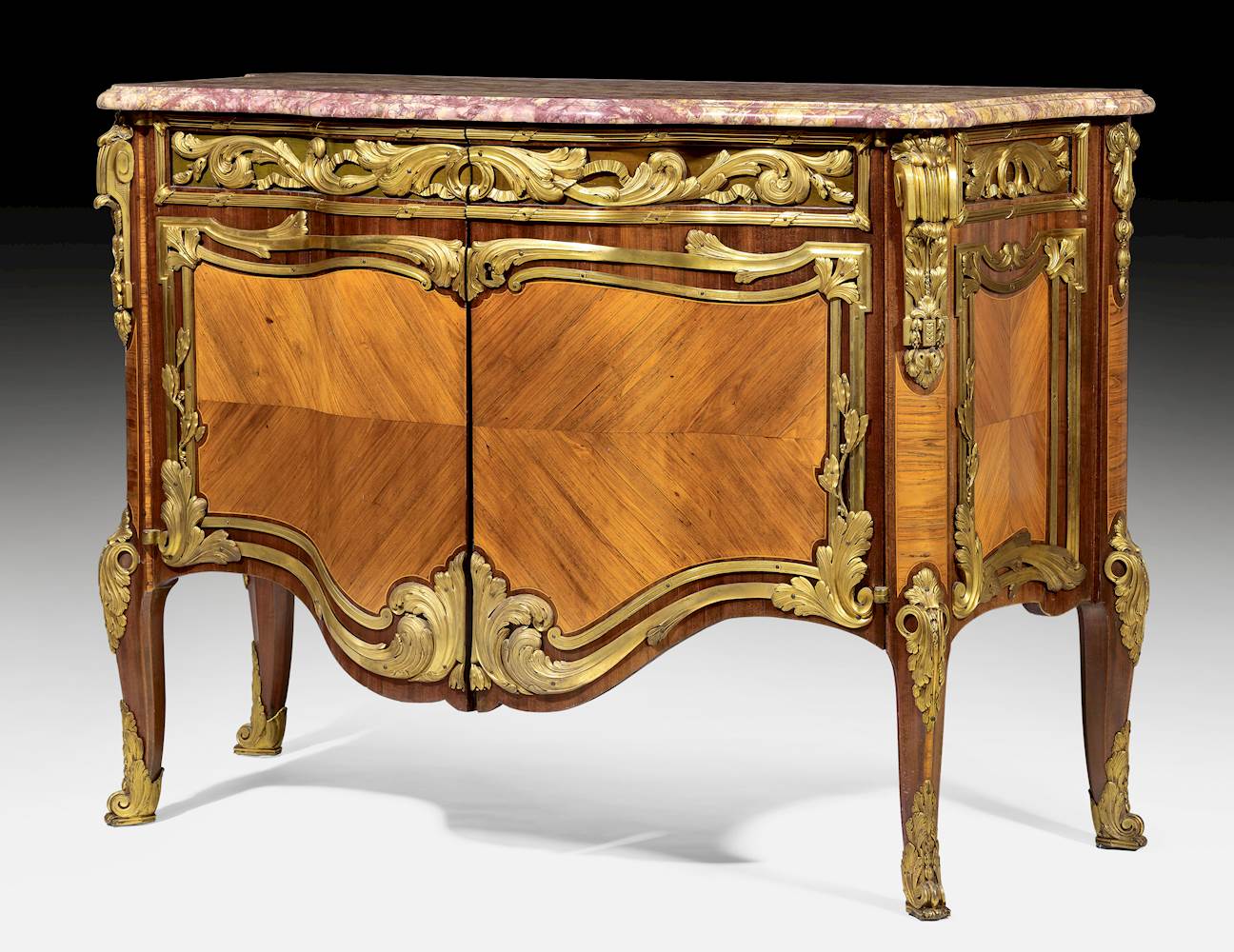
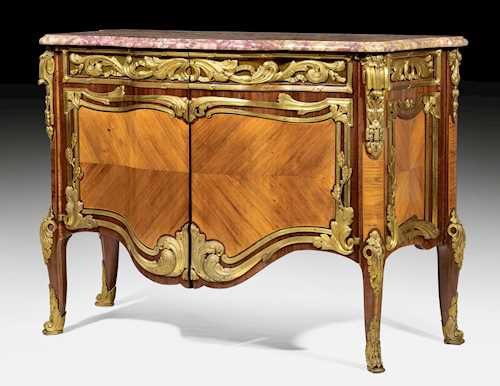
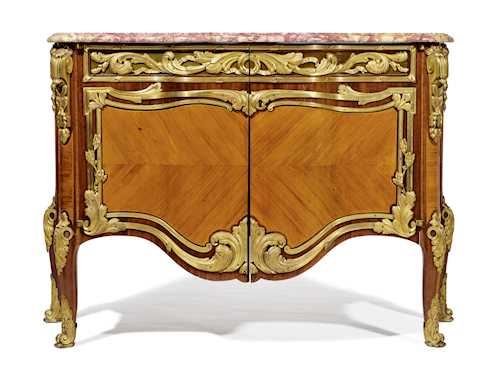
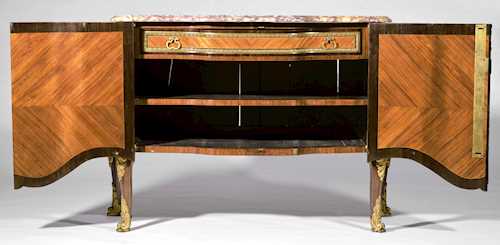
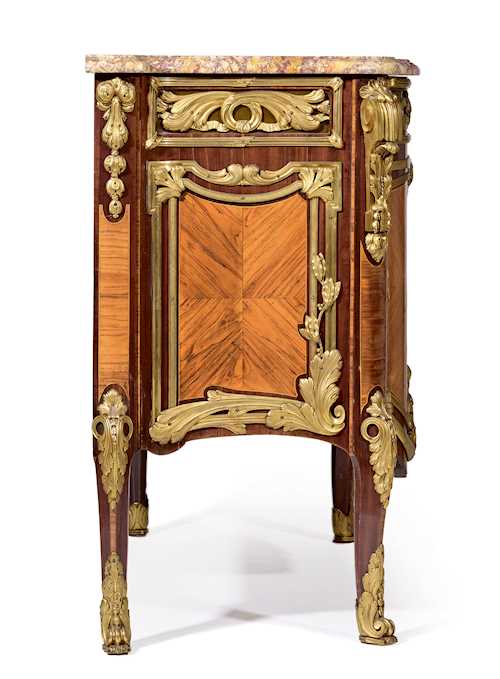
Tulipwood, amaranth and green-tinted boxwood in veneer and inlaid in matching curved reserves. Trapezoidal, three-sided curved body on a cut-out frame and curved legs with volute sabots. Front with double-doors, opening onto two compartments and a drawer. Rich and finely punched bronze mounts in the form of foliate scrolls, shells and laurel branches. In the upper area, a frieze of foliate scrolls in front of a recessed, green-tinted reserve. “Brocatello” marble top with shaped edge. 1 key.
139 × 59 × 100 cm.
Restored and repaired. One drawer in part supplemented. Cracks and losses to the veneer. Doors slightly warped. Marble replaced.
來源:
- probably auction Boudin: Succession de M. le Baron de Schlichting, Paris, June 1916, lot 127 (no illustration).
- Galerie Bernard Steinitz, Paris (according to the transport label on the marble).
- auction Galerie Koller, Zurich, May 18–31, 1978, lot 2912.
- important Swiss private collection.
文獻:
- Pierre Kjellberg: Le Mobilier Français du XVIIIe siècle. Paris, 1989, p. 772 (with ill.).
This outstanding "meuble d'entre-deux" was part of the Collection of Baron Basile de Schlichting (1857–1914), a Russian by birth who settled in Paris. He bequeathed a large part of his high-quality collection of Old Master paintings and furnishings, including the famous “commode aux singes” from the workshop of Charles Créssent, to the Louvre in Paris (inv. no. OA 6868). In an auction from 1916 entitled “Succession de M. le Baron de Schlichting”, a piece of furniture is described under lot number 127 that could actually be the one on offer: “127 - Commode mouvementée, ouvrant à deux portes et un tiroir intérieur, en bois de rose et satiné, ornée de bronzes ciselés et dorés. Style Louis XV. Marbre brèche”. The piece of furniture on offer was already illustrated in a 1913 catalog of French furniture in the possession of Russian nobility (Denis Roche: Le mobilier français en Russie: meubles des XVIIe et XVIIIe siècles et du commencement du XIXe, conservés dans les palais et les musées impériaux et dans les collections privées. Vol. III, Paris 1913, Pl. XL.). In the accompanying text about the furniture, the author Denis Roche particularly praises the high-quality bronzes: “Les bronzes du présent meuble, que l'on attribue à Duplessis, ne forment-ils pas, ceux de la frise et ceux du bas du tablier surtout, l'arabesque la plus imprévue, la plus vive et la plus nourrie?” According to the author, the striking bronze decorations are attributed to none other than Jean-Claude-Thomas Duplessis.
The piece of furniture on offer has a special place in the oeuvre of Claude-Charles Saunier (1735–1807), since it is a piece of furniture from his early creative phase, in which he still exemplified the style of the late Louis XV period. The chest of drawers impresses with its strong body and the large, centrally raised, bevelled front. The prominent bronze decorations in the form of acanthus leaves and scrolled leaves emphasize the imposing character without appearing to be overpowering. That this piece is an important exhibit of French furniture history is also recognized by Pierre Kjellberg, who includes the piece of furniture on offer in his magnum opus (Pierre Kjellberg: Le Mobilier Français du XVIIIe siècle. Paris, 1989, p. 772).
The piece of furniture on offer has a special place in the oeuvre of Claude-Charles Saunier (1735–1807), since it is a piece of furniture from his early creative phase, in which he still exemplified the style of the late Louis XV period. The chest of drawers impresses with its strong body and the large, centrally raised, bevelled front. The prominent bronze decorations in the form of acanthus leaves and scrolled leaves emphasize the imposing character without appearing to be overpowering. That this piece is an important exhibit of French furniture history is also recognized by Pierre Kjellberg, who includes the piece of furniture on offer in his magnum opus (Pierre Kjellberg: Le Mobilier Français du XVIIIe siècle. Paris, 1989, p. 772).
CHF 20 000 / 30 000 | (€ 20 620 / 30 930)
以瑞士法郎銷售 CHF 42 500 (包含買家佣金)
所有信息随時可能更改。