


拍品 3017 - A217 瑞士艺术 - Freitag, 26. Juni 2026, 02.00 PM
ALBERT ANKER
(1831 Ins 1910)
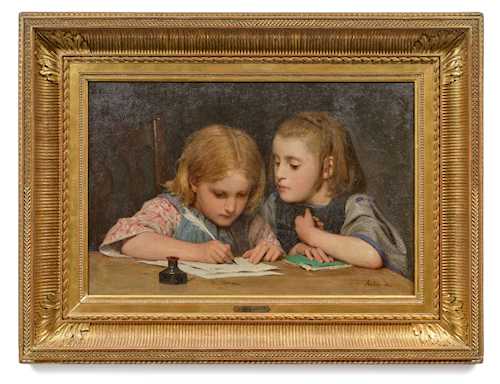
Schreibunterricht II. 1865.
Oil on canvas.
Signed and dated lower right: Anker. 1865.
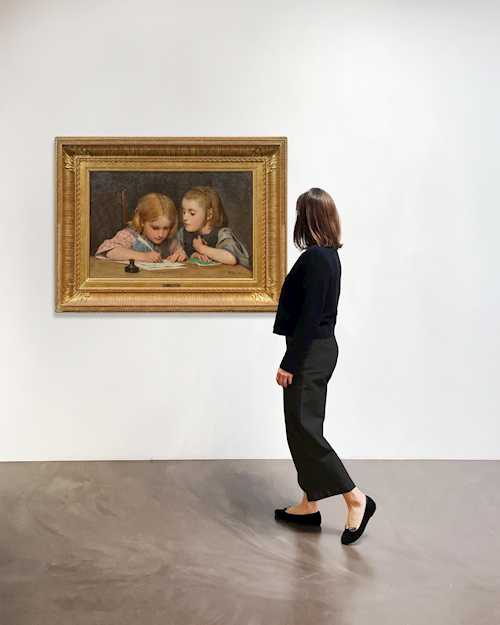
51 × 78 cm.
來源:
- Private collection, England.
- Auction Sotheby's London, 11 October 1967, lot 161.
- Auction Christie's Zurich, 10 April 1995, lot 18.
- Private collection, Switzerland, acquired at the above auction.
展出:
- Ins 1985, Albert Anker. Der Maler und sein Werk. Gemäldeausstellung aus Anlass des 75. Todestages, Sporthalle Ins, 23 March–21 April 1985, no. 57.
- Bern and Winterthur 2010/11, Albert Anker. Schöne Welt. Zum 100. Todestag, Kunstmuseum Bern, 7 May–5 September 2010; Museum Oskar Reinhart am Stadtgarten, 6 November 2010–6 March 2011, no. 60 (verso with label).
文獻:
- Gottfried Kinkel: 'Albert Anker', in: Julius Meyer: Allgemeines Künstlerlexikon, Leipzig 1878, vol. II, pp. 72 f.
- John Denison Champlin: Cyclopaedia of painters and paintings, New York and London 1888, vol. I.
- Friedrich von Boetticher: Malerwerke des neunzehnten Jahrhunderts. Beitrag zur Kunstgeschichte, Dresden 1891, vol. I, no. 7.
- Albert Gessler: 'Albert Anker. Der Meister von Ins', in: Die Schweiz, Zurich 1900, vol. IV, p. 172.
- Albrecht Rytz: Der Berner Maler Albert Anker. Ein Lebensbild, Bern 1911, pp. 46 f.
- Albert Anker, Max Huggler and Kunstmuseum Bern: Albert Anker. Katalog der Gemälde und Ölstudien, Bern 1962, no. 95 (illustrated).
- Sandor Kuthy: 'Anker in seiner Zeit', in: Exh. cat. Bern and Winterthur 1981/82, p. 25 (illustrated).
- Exh. cat. Albert Anker. Der Maler und sein Werk. Gemäldeausstellung aus Anlass des 75. Todestages, Ins 1985, no. 57.
- Sandor Kuthy and Therese Bhattacharya-Stettler: Albert Anker. Werkkatalog der Gemälde und Ölstudien, Basel 1995, p. 91, no. 95 (illustrated).
- Exh. cat. Albert Anker. Schöne Welt. Zum 100. Todestag, Bern and Winterthur 2010/11, p. 141, no. 60 (illustrated).
At the centre of Albert Anker’s artistic work lies, time and again, the depiction of social change in the young Swiss federal state, in particular the growing importance of education. The introduction of compulsory schooling in the 19th century was regarded as an expression of social progress and civic responsibility. Anker himself remained committed throughout his life to improving the living conditions of the Swiss population and was convinced that social progress begins with young people – above all through better schooling. In his home village of Ins, he campaigned for the establishment and improvement of schools and advocated educational opportunities for both girls and boys.
‘Schreibunterricht II’ depicts two young girls engaged in a writing exercise. The concentrated posture of the figures and the calm atmosphere lend the scene a quiet seriousness. Without narrative embellishment, Anker captures a simple moment from everyday school life and transforms it into a symbol of learning. The act of writing thus appears as a sign of development, acquisition of knowledge and future prospects.
The depiction of female pupils is of particular interest. Although girls increasingly gained access to primary education during the 19th century, their schooling continued to be shaped by social expectations and reservations. Anker approaches his figures with the same attention and dignity as in his depictions of boys, thereby subtly emphasising the universal value of education. Precisely within the apparent innocence of the scene lies a quiet social statement: girls, too, should participate in education and thereby be enabled to contribute to the shaping of a better society.
That this attitude was by no means self-evident is demonstrated by the contemporary reception. When the painting was awarded a gold medal at the Paris Salon of 1866 in 1866, a Swiss newspaper published an illustration under the headline ‘The Little Bluestockings’. In the 19th century, the term had increasingly acquired pejorative connotations and referred to the supposed inappropriateness or uselessness of female education. Against this background, Anker’s quiet school scene acquires an additional meaning: it combines everyday observation with a discreet plea for educational equality.
CHF 600 000 / 900 000 | (€ 618 560 / 927 840)
以瑞士法郎銷售 CHF 744 000 (包含買家佣金)
所有信息随時可能更改。