Non avete ancora un login?

Clicca qui per registrarti »


Sono già registrato - Login:


La storia di Koller ha inizio nel 1958 con le arti decorative. Le aste di mobili, argenti, porcellane e sculture rappresentano alcune delle nostre competenze più antiche. Nel corso dei decenni, numerose opere di grande significato sono state offerte nelle aste di Koller.

Quasi nessun'altra casa d'aste in Europa è in grado di presentare due volte all'anno una tale densità e qualità di arti decorative e oggetti da collezione, dal XV al XIX secolo. Oltre ai mobili di ebenisti come Charles Cressent, Abraham Roentgen, André-Charles Boulle, Bernard van Riesenburgh e Johann Friedrich Spindler, Koller ha acquisito una solida reputazione come una delle principali case d'aste in Europa per gli orologi antichi e i segnatempo, con opere di famosi orologiai come Berthoud, Deverberie, Breguet, Le Roy, Lepine e Jaquet-Droz.

Le porcellane e le faience sono state parte integrante delle nostre aste fin dalla fondazione di Koller, riflettendo la lunga tradizione di ambizioso collezionismo di ceramiche in Svizzera. Numerose porcellane di rilievo sono state vendute da Koller. Gli oggetti da collezione di Meissen, Sèvres, Strasburgo, Nymphenburg, Du Paquier e Zurigo, così come le maioliche italiane e le creazioni della Russia imperiale, sono ambiti dai nostri acquirenti più esigenti e spesso raggiungono prezzi record.

Le aste di argenteria di Koller includono regolarmente oggetti da collezione di alta qualità di varie epoche, dal XVI al XX secolo. L'argenteria presentata non proviene solo da manifatture svizzere, ma anche dai centri di produzione dell'argento storicamente più importanti del mondo, tra cui Londra, Augusta, Parigi, Mosca, San Pietroburgo, Torino e Norimberga.

Il dipartimento di Arti Decorative organizza regolarmente aste di intere collezioni on cataloghi speciali accuratamente studiati, che non solo assicurano il successo della vendita della collezione, ma fungono anche da testimonianza per il collezionista e documento utile per futuri collezionisti e ricercatori. Alcuni esempi includono la collezione di porcellane del dottor Siegfried Ducret, la collezione di strumenti scientifici Nessi e la collezione di sculture e manufatti dell'antica Roma e dell'Egitto della dottoressa Sylvia Legrain.

Le nostre aste di Arti Decorative si tengono a marzo e settembre. Le consegne sono accettate fino a metà gennaio per l'asta di marzo e fino a metà luglio per l'asta di settembre.

I nostri esperti saranno lieti di valutare i suoi oggetti in vista di una possibile vendita attraverso le nostre aste.


I migliori risultati delle aste passate


GOLD-EMAILDOSE MIT SINGVOGELAUTOMAT


Lot 1394 - Decorative Arts - Donnerstag, 17. September 2026, 10.00 Uhr

GOLD-EMAILDOSE MIT SINGVOGELAUTOMAT Genf, um 1790. Das Werk signiert Jaq(t) Droz & Leschot London (Jaquet-Droz & Leschot London). Meistermarke GRC unter Krone für Georges Rémond & Cie.
Ovale Golddose, guillochiert und graviert, der Deckel mit transluzidem, blauem Email überzogen. Die Wandung mittels ionischen Doppelsäulen unterteilt in vier rechteckige Felder, oben und unten weiss gerahmt. Abschlüsse mit emaillierten Zierfriesen in Weiss, Türkis, Blau und Gold. Aufklappbarer Deckel mit transluzidem blauem Email mittig ein zusätzlicher ovaler Deckel in perlenbesetzter Aussparung, bemalt mit einer Schäferszene nach dem Gemälde "La Marotte" von François Boucher (1703–1770). Darunter ein beweglicher Singvogel mit echtem Federkleid und Hornschnabel. Feines Werk mit Blasebalg und Pfeife(n). Unter dem Hauptdeckel der Aufzug sowie Teile des skelettierten Werkes. Seitliche Platine mit der Signatur. Unter dem guillochierten, aufklappbaren Bodendeckel verbirgt sich ein Fach. Beide Deckel mit Meistermarke GRC. 8,7 × 6 × 4 cm.


STIME / CONSEGNE


Noi valutiamo i Suoi beni gratuitamente In vista di una prossima consegna per le nostre aste. Ci mandi delle foto, se possibile, oppure ci telefoni direttamente e fisseremo un appuntamento a casa sua oppure nel nostro ufficio a Zurigo, Ginevra, Firenze, Monaco o Düsseldorf. In seguito riceverà la nostra offerta insieme alle stime, che Le servirà per il processo decisionale.

Ottieni una stima adesso
Ecco come consegnare
La preghiamo di contattarci
Contatti la nostra rappresentanza p.f.


Contatto


Stephan Koller

Responsabile
Mobili e decorazioni skoller@kollerauctions.com
+41 44 445 63 41

Flavio de Corso

Mobili e decorazioni decorso@kollerauctions.com
+41 44 445 63 46

Lara Halter

Mobili e decorazioni halter@kollerauctions.com
+41 44 445 63 45


Rappresentanti


Koller Ginevra

Cyril Himmer
geneva@kollerauctions.com
+41 22 311 03 85

Koller Monaco

Fiona Seidler
muenchen@kollerauctions.com
+49 89 22 802 766

Koller Düsseldorf

Ulrike Gruben
duesseldorf@kollerauctions.com
+49 211 30 14 36 38

Koller Italia

Lapo Bacarelli
italia@kollerauctions.com
+39 366 994 1836

Risultati selezionati Mobili & Decorazioni


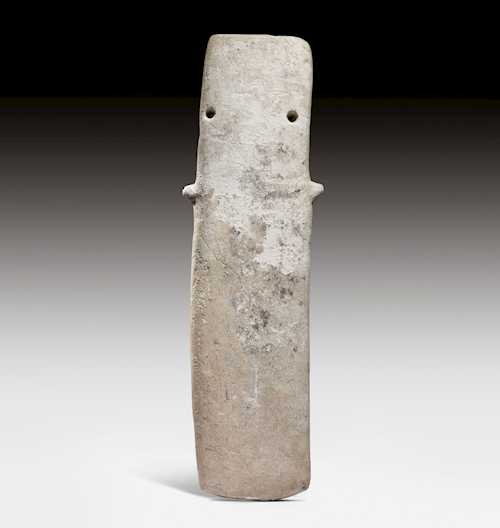
MONUMENTAL PLANK IDOL
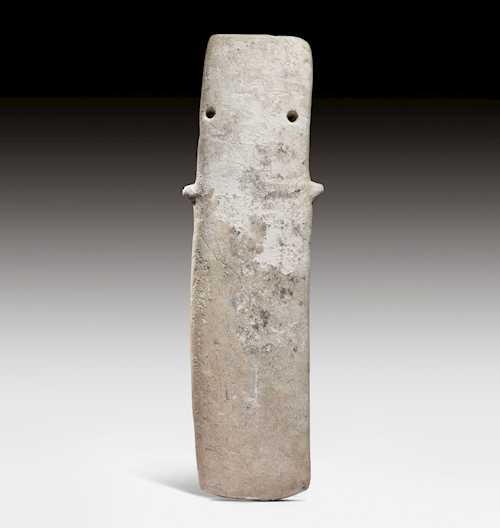
Early Cypriot, probably late 3rd millennium B.C.
Limestone with pierced holes for eyes. Rectangular, slightly curved, flat stele with rounded corners and projecting lateral extensions suggesting arms. With later base.
61 × 19 cm.
Encrustations. Repaired breaks. Scratches and chips to the surface.
MONUMENTAL PLANK IDOL

CHF 225 000

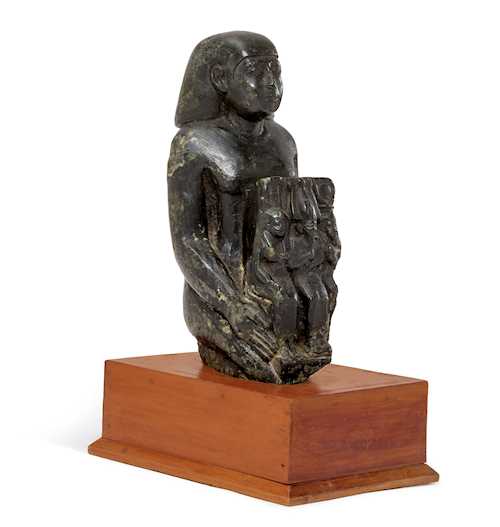
FRAGMENT OF A NAOPHOR
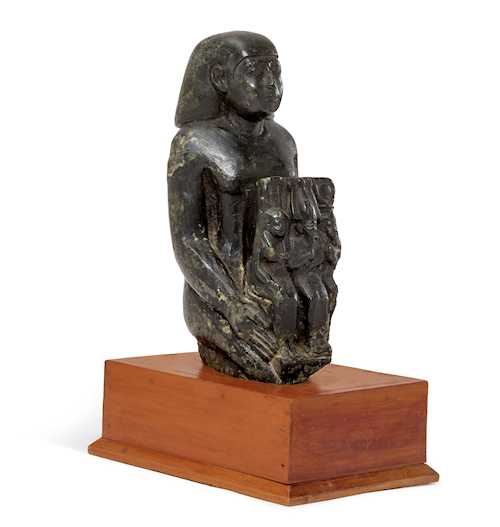
Egypt, Late Period, 26th–30th Dynasty, 664–343 BC.
Probably serpentine (?) with later black overpainting. Figure of a kneeling priest holding before him a shrine, a so-called naos, containing the figures of the seated divine triad of Nephthys, Osiris and Isis. On an old wooden base.
23 × 9.5 × 12.5 cm.
Breaks. Larger losses to the left side. Traces of adhesive.
FRAGMENT OF A NAOPHOR

CHF 47 500

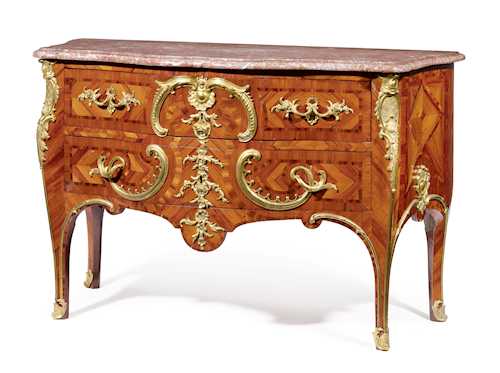
COMMODE
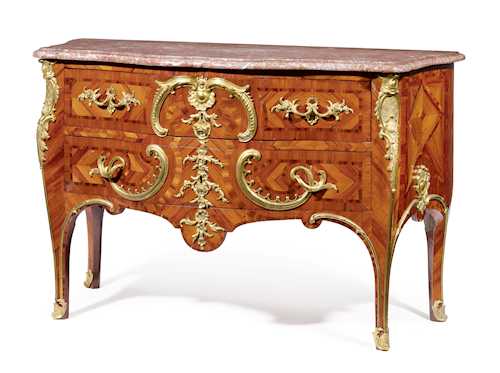
Louis XV, Paris, ca. 1730–40. Charles Cressent (1685–1768). Partially illegibly stamped: J. BOURD[x].
Rosewood and kingwood, inlaid in geometric reserves and with stringing, partly quarter-veneered. Shaped front with two drawers above a prominently shaped apron, on cabriole legs. The shaped sides inlaid with a quarter-veneered lozenge within a rectangular reserve, waisted at the bottom. Red and grey speckled marble top with moulded edge (probably replaced). Rich gilt-bronze mounts.
132 × 64 × 83.5 cm.
Signs of use and losses; slightly faded.
COMMODE
COMMODE

CHF 68 750

GOLD AND ENAMEL BOX WITH SINGING BIRD AUTOMATON
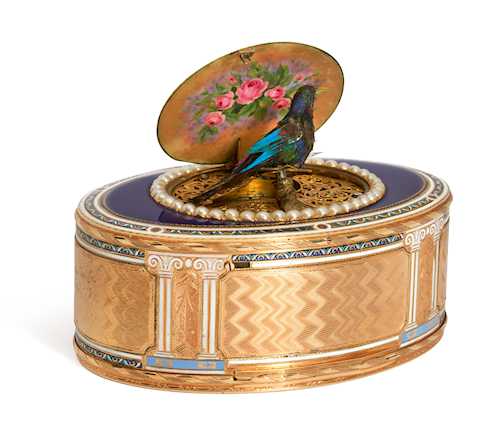
Geneva, circa 1790. The mechanism is signed “Jaq(t) Droz & Leschot London” (Jaquet-Droz & Leschot London). GRC maker's mark beneath a crown, for Georges Rémond & Cie.
Oval gold box, guilloché and engraved, the cover applied with translucent blue enamel. The sides divided by paired Ionic columns into four rectangular panels, bordered in white above and below. The upper and lower borders with enamelled decorative friezes in white, turquoise, blue and gold. Hinged cover with translucent blue enamel, centered by an additional oval cover within a pearl-set reserve, painted with a pastoral scene after François Boucher’s (1703–1770) painting La Marotte. Beneath, a movable singing bird with real plumage and a horn beak. Fine movement with bellows and pipe(s). The winding mechanism and parts of the skeletonized movement beneath the main cover. Side plate bearing the signature. A compartment concealed beneath the hinged guilloché base cover. Both covers with maker’s mark GRC.
8.7 × 6 × 4 cm.
Slight scratches and minor losses of the enamel. Minor restorations to the enamel. Sides and base formerly enameled.
GOLD AND ENAMEL BOX WITH SINGING BIRD AUTOMATON

CHF 137 500

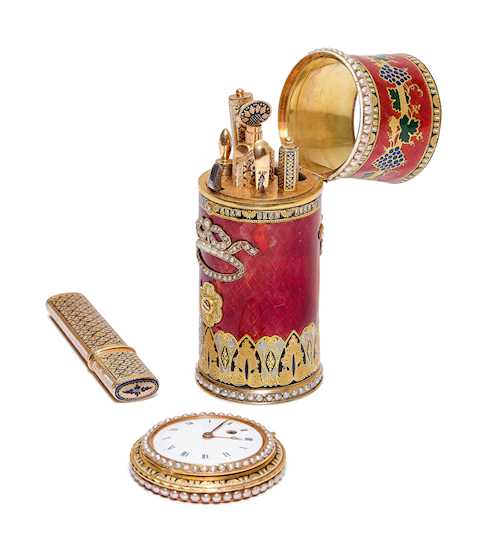
GOLD AND ENAMEL TRAVEL NECESSAIRE WITH WATCH
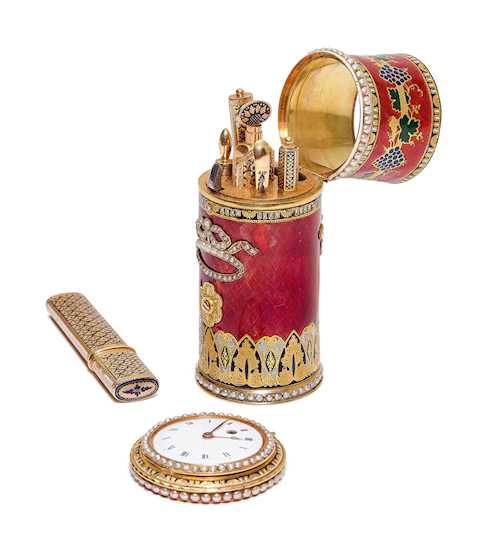
France, circa 1830–40.
Guilloché gold applied with translucent red enamel. The upper and lower borders set with pearl friezes and decorated with geometric enamel friezes in turquoise, white, blue and gold. The body applied with two pearl-set bows, with a continuous engraved and enamelled frieze of stylized foliage around the lower fifth. The cover surmounted by a watch, the white dial within a pearl-set bezel. White enamel dial with Roman hours. Movement with balance and key-wound spring drive. The rim of the cover with a geometric enamel frieze, the sides decorated with a continuous band of vine leaves and grapes. Beneath the hinged cover are an elongated box, a flask, a spatula, a knife, a watch key and a pencil holder, all in gold with enamel decoration. The base inscribed in red with the old inventory number "48.17".
H 9 cm, Ø 3.8 cm. Total weight: 100 g.
Restorations to the red enamel. Minor losses and cracks to the enamel. The lid of the watch needs to be attached
GOLD AND ENAMEL TRAVEL NECESSAIRE WITH WATCH

CHF 35 000

A MUMMY MASK

Egypt, probably from Fayum, Ptolemaic, ca. 3rd–1st c. BC.
Stuccoed and painted kartonage, in part gilt. The contours of the eyes and the eyelid line are inlaid with lapis lazuli, the pupils with glass and white or black enamel. A two-part stranded wig, parted at the front and falling down to the chest, with an Ankh knot on the back, the loops of which transition into a Uraeus serpent. A relief scarab with spread wings on the front of the crown-cap. Figurative and geometric decoration on the strands in three ranks; the lowest rank with four seated genies each holding the Uas scepter, above them the enthroned Osiris on the right strand, accompanied by the four sons of Horus: Hapi and Duamutef, and on the left strand Amset and Kebehsenuef. The strands end with a falcon crowned with a sun disk, holding the feather of the goddess Maat in its talons. The inside with a later, probably Arabic annotation.
H 45.5 cm, L 28.5 cm, D 27.5 cm.
Gilding and polychrome paintwork with losses. Cracks.
A MUMMY MASK
A MUMMY MASK

CHF 50 000

A MARBLE TORSO OF THE “BARTHOLONI” VENUS

Roman, Imperial period, ca. 2nd century AD. Knidian type, after the Hellenistic model by Praxiteles, “Aphrodite of Knidos” (ca. 350/340 BC).
Carrara marble, sculpted in the round. Venus, Goddess of love, stands naked, leaning slightly forward in a contrapposto pose with her weight on her right leg. Her left leg is extended and bent at the knee. Remains of the original support on the outside of the thigh. The right arm was originally lowered, with the hand, which is now missing, positioned above the pubic triangle. The left shoulder is slightly pulled back. An old engraved inventory number, 170, is visible on the support. Mounted on a later rotating base.
H without base 120 cm, H with base 184 cm.
Repairs. Cleaned. Rubbing and chipping. Fillings.
A MARBLE TORSO OF THE “BARTHOLONI” VENUS

CHF 1.17 Mio.

A MONUMENTAL COPTIC WALL HANGING
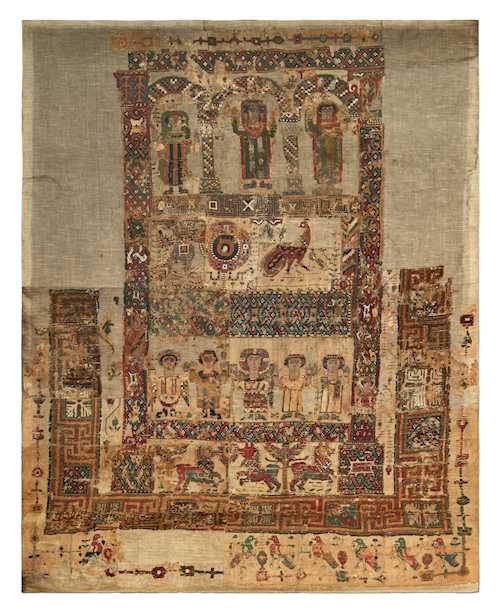
Coptic, Egypt, probably found in Sheikh Abadeh, ca. 5th–7th century AD.
Linen ground with polychrome wool threads. The upper depiction with three worshippers standing under round arches, their hands raised in prayer. The left and middle figures are probably female, wearing elaborate necklaces and earrings, the middle one also wearing elaborate hair ornaments. Above their heads are remnants of Greek inscriptions. Mosaic decoration on columns and arches. Below this is an image segment with a round medallion, probably a sun symbol, flanked by two birds, the left one probably an eagle, the right one a peacock. Below this is an image segment with five standing figures, the left and middle ones with wings, possibly representing angels, their hands also raised in prayer. The central figure has a halo and a staff. The figure on the far left also has a staff. Again with remnants of Greek titles. The lowest image zone shows leaping lions between trees. The four image zones are bordered by four horizontal strips with geometric, partly offset patterns. On the left and right, the four image zones are lined by two column-like vertical strips, with a head visible in each of the lower areas. An additional wide border with geometric meander band decoration frames the lower half of the scene. An additional lower strip shows a flock of birds, probably doves, with a stylized geometric garland of flowers.
Ca. 405 × 310 cm.
Various fragments joined together. Partially supplemented. Restorations. Tears.
A MONUMENTAL COPTIC WALL HANGING

CHF 646 400

THE ARCHANGEL MICHAEL - FORMERLY IN THE COLLECTION OF PRINCE EMANUEL OF LIECHTENSTEIN

Austria, Carinthia, Villach workshop, ca. 1480.
Carved wood, flattened on the back, painted, and in part gilt. The archangel stands in full armor in an expressive, dynamic pose with his sword raised, holding the Scale of Souls in his left hand. His cloak falls in soft, sweeping folds.
H 125 cm.
Paintwork partially restored. Wings, hands, and sword replaced. Chips on one of the weighing pans and on a fold in the garment. Figures on the Scale of Souls incomplete.
THE ARCHANGEL MICHAEL - FORMERLY IN THE COLLECTION OF PRINCE EMANUEL OF LIECHTENSTEIN

CHF 62 500

RICHLY INLAID MINIATURE CABINET

Southern Germany, second half of the 16th century. The ivory inlays are partly based on engravings by Virgil Solis (1514–1562).
Wood partly ebonized and richly inlaid with floral and foliage motifs featuring birds, hunting scenes, royal equestrian figures, etc. in rectangular reserves framed by scrollwork. Rectangular body structured by pilasters and molded cornices on a straight molded frame. Hinged lid with prismatic top, opening onto a compartment and side drawer. The top is inlaid with a cityscape, hunters with their prey, falconers on horseback, hunting dogs, and bears, hares, and wild boars, horsemen with pistols, and a cavalry battle. The inside of the lid is decorated with tendrils and birds. Finely engraved, gilt lock plate. The front has double doors above a drawer. The doors show a royal couple on horseback. The drawer front has two hunting scenes (probably later additions), owls, and birds. The double doors open onto eight drawers arranged around a door, the inlay work of which matches the exterior; the door shows a king with a scepter. The side walls and the back wall show royal horsemen in the middle section, the upper friezes show birds, and the lower friezes show hunting scenes. The pilasters in the lower section feature a total of nine ancient heroes based on engravings by Virgil Solis with different coats of arms. Iron grips on the sides.
45 × 33 × 38.5 cm.
Losses, minor supplements, missing parts, and cracks.
RICHLY INLAID MINIATURE CABINET

CHF 75 000