


Lot 3229* - A217 Impressionist & Modern Art - Friday, 26. June 2026, 04.30 PM
PAUL SIGNAC
(1863 Paris 1935)
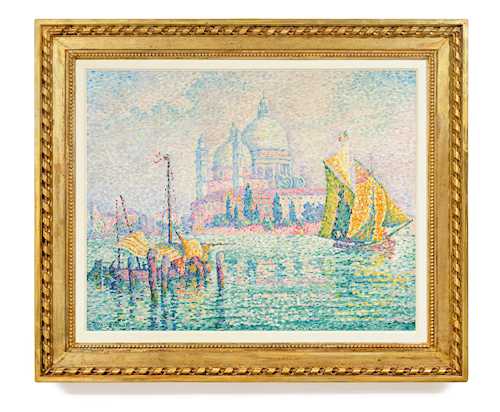
La Salute (Venise). 1906.
Oil on canvas.
Signed and dated lower left: P. Signac 1906.
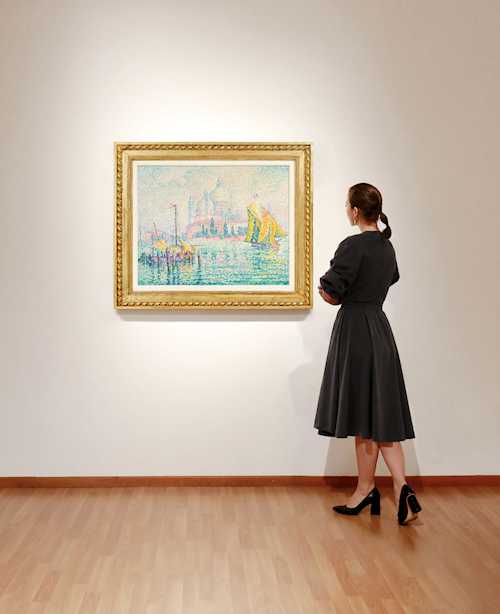
73 × 92 cm.
Certificate:
Provenance:
- Jos Hessel, Paris, 1907.
- Private collection, Munich, acquired in 1913 from the above gallery (original invoice available).
- Private collection, Germany, by descent.
Exhibited:
Literature:
- J.C. Holl, La jeune peinture contemporaine, Paris, 1912, p. 77.
- Lucie Cousturier, Paul Signac, Paris, 1922, p. 18 (with ill. of the sketch).
Vibrant and luminous, like a dance of colours, the gently moving water of the lagoon runs through the composition and plays around the silhouette of Santa Maria della Salute rising at its centre. The striking double dome of the votive church, built in the 17th century on the Grand Canal, appears from the perspective of the Giudecca Canal as an architectural landmark shimmering in the haze. The scene is flanked by boats with brightly coloured yellow sails, which open up the view onto the basilica while rhythmically structuring the pictorial surface. For Paul Signac – a sailor and lover of the sea – La Salute functioned as the"gateway to Venice".
As a co-founder of Neo-Impressionism, Signac regarded the lagoon city as an ideal field of study for light, water and colour: "Signac’s Neo-Impressionist Venice consists entirely of sky, light, reflections on water, shimmering colour and linear rhythms," writes Anne Distel (Anne Distel, Venedig, von Canaletto bis Turner und Monet, Fondation Beyeler 2008, p. 181). In 1904, he travelled to Venice for the first time. During this journey, he produced over 200 watercolours, which served as immediate and rapidly executed studies. These sheets capture atmospheric impressions in a fluid and spontaneous handling of colour. In the studio, Signac transformed these visual impressions into only around ten carefully composed paintings. The immediate experience of seeing was thus systematically translated into a structured pictorial order. The watercolours functioned less as preparatory drawings in the traditional sense than as visual records of light effects and chromatic atmospheres. The composition of "La Salute (Venise)" is clearly structured: the boats and posts in the foreground, the expanse of water as a central middle ground, and the striking architecture in the background are interwoven through rhythmically applied colour structures. The basilica does not appear as a solidly constructed body, but dissolves into a shimmering interplay of pink, lavender and blue tones.
This effect is based on the consistent application of the divisionist principle. Building on the colour theories of Michel Eugène Chevreul and the perceptual studies of Charles Henry, Signac juxtaposed pure, unmixed colours, which only combine in the viewer’s eye to produce maximum luminosity. In his theoretical treatise "D’Eugène Delacroix au néo-impressionisme" (1899), he formulated this method as a scientifically grounded development of a complementary colour theory that Delacroix had intuitively anticipated. The constructive effect of the composition becomes particularly evident in the interplay of colour contrasts: the warm yellows and oranges of the sails intensify the cool green-turquoise of the water, while rose and violet nuances set the surface into a vibrant movement. The water thus appears not as a naturalistic element, but as the result of a precisely calculated colour structure.
In the Venice paintings from 1904 onwards, Signac’s technique reached a particular maturity. It is therefore not surprising that many of these works are represented in major collections, including the Bührle Collection, Zurich, the Toledo Museum of Art (USA), and the Neue Pinakothek, Munich. Moving away from George Seurat, Signac enlarged his brushstrokes, applied them rhythmically in a mosaic-like manner, and thereby granted them autonomy. The brushwork creates a rhythmically structured surface. At the same time, the palette becomes lighter, and the colours combine into a luminous overall harmony. The architecture increasingly loses its material solidity and appears as a form dissolved in light.
In contrast to the Venice paintings of Claude Monet or William Turner – whose works Signac encountered during a stay in London – the water in Turner is not the bearer of a dramatically charged experience of nature or – as in Monet – a purely atmospheric impression. Rather, it is understood as a rhythmically organised field of colour. This shift is of central importance in art history: the Neo-Impressionists liberated colour from its descriptive function and established it as an autonomous means of expression. Through the division of colour and its increasing autonomy, it detaches itself from the depicted subject.
"La Salute" is thus an exemplary work in which Paul Signac conceives painting no longer as representation, but as a systematically organised perception of colour. The visible movement of the lagoon arises from the interaction of colour values and rhythms – it is constructed, not observed. In this consistent transformation of perception into structure lies the true modernity of the painting.
The painting is listed in the catalogue raisonné by Cachin, albeit without illustration, as it was previously known to the Signac archives only through a small ink sketch. "La Salute (Venise)" therefore constitutes a significant rediscovery. The work was last publicly exhibited in 1913, when it was sold by the renowned Parisian art dealer Jos Hessel – a cousin of the Bernheim brothers and long-time director of Galerie Bernheim-Jeune – to a Munich collector. As Marina Ferretti notes, Signac’s reputation grew in Germany from around 1900 onwards thanks to the tireless efforts of his close friend Henry Van de Velde, who introduced his works to key figures in the art world, including Harry Graf Kessler, Karl Ernst Osthaus, Hugo von Hofmannsthal and Hugo von Tschudi, to whom the Neue Pinakothek in Munich owes several important works by Signac.
In this climate of enthusiasm for emerging modernism and Neo-Impressionism, it is not surprising that the purchaser of "La Salute (Venise)", himself a supporter of Tschudi, acquired significant works by Paul Signac during his travels to Paris. Over the following century, the family carefully preserved not only the painting but also the original invoice from 1913. Since then, the work has remained in private ownership and has neither been published nor exhibited publicly. We are therefore particularly pleased to present it again to the public for the first time in over 110 years.
CHF 2 000 000 / 3 000 000 | (€ 2 061 860 / 3 092 780)
Sold for CHF 4 164 500 (including buyer's premium)