


Lot 3214* - A217 Impressionist & Modern Art - Friday, 26. June 2026, 04.30 PM
PIERRE AUGUSTE RENOIR
(Limoges 1841–1919 Cagnes-sur-Mer)
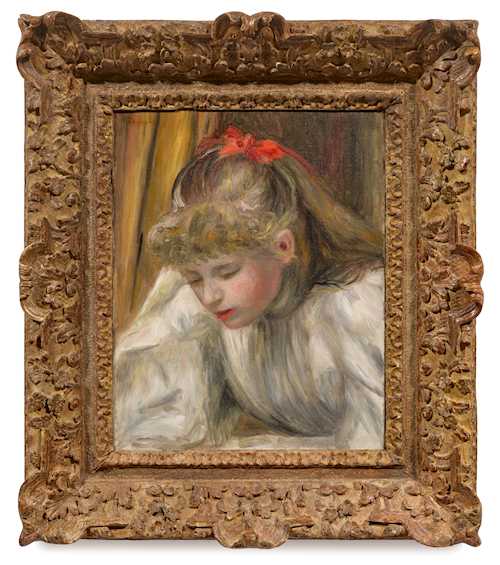
Jeune fille lisant. Circa 1890.
Oil on canvas.
Signed upper left: Renoir.
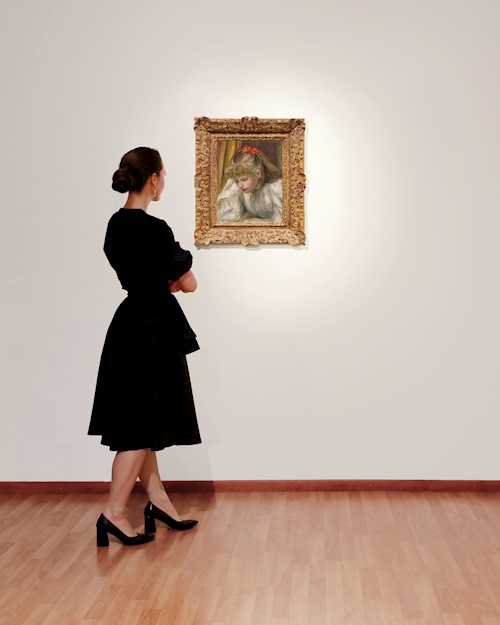
41 × 32.4 cm.
Certificate:
Provenance:
- Galerie Bernheim-Jeune, Paris, acquired from the above on 14 November 1908 (verso with label and designation).
- Charles Maniez, Valenciennes, acquired in the above gallery on 11 December 1909.
- Auction Galerie Georges Petit, Hôtel Drouot, Paris, collection Maniez, 2 December 1918, lot 27.
- Etienne Bignou, Paris.
- Alex Reid & Lefevre, London.
- Max Kaganovitch, Paris, from 1938.
- Private collection Canada, received by inheritance from the above circa 1978.
- Private property Switzerland, again received by inheritance from the above.
Exhibited:
- Paris 1950, Œuvres choisies du XIXe siècle, Galerie Max Kaganovitch, 22 May–5 July 1950, no. 30 (verso with label; as 'Liseuse').
- Kumamoto/Kanazawa/Okayama/Osaka 1983/84, Renoir, Kumamoto Prefectural Museum of Art, 1 November–4 December 1983/Ishikawa Prefectural Museum of Art, 7 December–25 December 1983/Okayama Prefectural Museum of Art, 14 January–12 February 1984/Nabio Museum, 17 February–18 March 1984, no. 25 (as 'Liseuse').
Literature:
- Ambroise Vollard: Pierre-Auguste Renoir. Paintings, pastels and drawings. Tableaux, pastels et dessins (revised edition, original from 1918), San Francisco 1989, p. 21, no. 82 (with ill.; as 'Tete de fillette').
- Georges Lecomte: L'Œuvre de Renoir, in: L'art et les artistes. Revue mensuelle d'art ancien et moderne, no. 4. 1920, p. 148 (with ill.; as 'Etude de jeune fille').
Renoir spent much of the 1880s preparing and executing "Les grandes Baigneuses". This monumental painting, depicting five playful nymphs, was intended as a manifesto of the linear style influenced by Ingres, to which Renoir devoted considerable time and energy. However, when the work was exhibited in Paris in 1887, it proved far from successful and was received largely negatively by critics.
After overcoming this disappointment, Renoir returned in 1888 with renewed motivation and a transformed painterly approach: "I have taken up my old style again, never to abandon it—soft and light in handling," he wrote enthusiastically to his dealer Paul Durand-Ruel in 1888 about his latest works. "This should give you an idea of my new and final manner—like Fragonard, only not as good." (Quoted in: House, Renoir in the Barnes Foundation, 2012, p. 121).
Renoir resumed traveling, drawing inspiration from masters such as Titian, Rubens, and the French Rococo, and pursued a continuation of 18th-century painting. He left behind the hard contours and cool tones of "Les grandes Baigneuses" and embraced a softer, warmer, and more luminous style.
A central theme of this period is the depiction of young bourgeois women and girls, often shown at play or engaged in leisurely activities. The young sitter in the present painting corresponds precisely to this type of figure that Renoir developed in the 1890s.
The girl is shown in half profile, her gaze lowered and absorbed in a book, which presumably rests on a table just outside the picture plane. Her porcelain-like skin is enlivened by delicately flushed cheeks and lips. Her thick, long hair is adorned with a red ribbon, an accessory Renoir frequently employed. His characteristic, flowing brushwork allows the contours to dissolve gently into one another, lending even the white blouse a loose and animated quality. The scene unfolds with a quiet intimacy, in which the lively brushwork and the radiant palette harmonize beautifully.
Here we encounter the gentle, idealized type that Renoir consistently pursued following his stylistic reorientation around 1890. As he himself emphasized: "For me, a painting must be something pleasant, cheerful, and beautiful—yes, beautiful!" (Quoted in: House, Renoir in the Barnes Foundation, 2012, p. 16).
The motif of the reader plays an important role in Renoir’s work and can be traced back to Fragonard, who remained a lifelong source of inspiration. Renoir had already explored this subject sporadically in the 1870s, but from around 1890 onward he returned to it with renewed intensity, producing numerous depictions of young girls reading, particularly in the first half of the decade.
With this renewed painterly approach—while still drawing on earlier tendencies—success quickly followed, marking the beginning of a period of growing prosperity and long-awaited recognition for the artist. His dealer Paul Durand-Ruel once again began to acquire works strategically, confident of finding buyers for them. "I am once again in demand on the market and have worked a great deal this spring," Renoir wrote to Bérard in 1890 (Quoted in: White, Renoir: His Life, Art, and Letters, 1984, p. 189).
A major milestone came in 1892 with the acquisition of "Jeunes filles au piano" by the French state for the Musée du Luxembourg—an official recognition that Renoir himself regarded as one of his greatest achievements. In the same year, Durand-Ruel organized a large retrospective, which was received with great acclaim and, as the critic Arsène Alexandre observed, marked "the beginning of a triumph."
CHF 900 000 / 1 400 000 | (€ 927 840 / 1 443 300)
Sold for CHF 1 171 000 (including buyer's premium)