

Lot 3437 - A213 Post-War & Contemporary - Thursday, 26. June 2025, 03.00 PM
HANS HOFMANN
(Weissenburg 1880–1966 New York City)
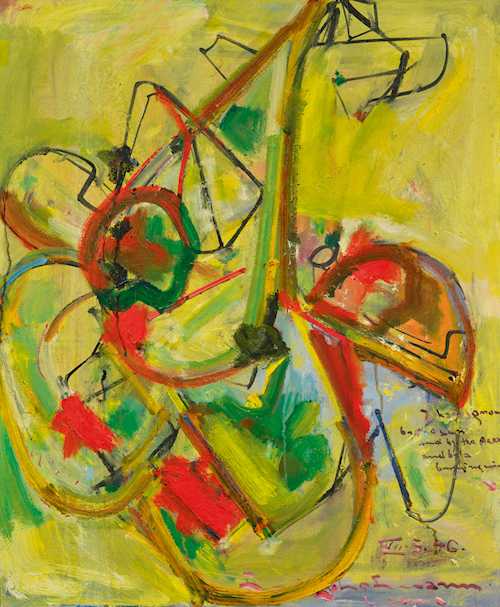
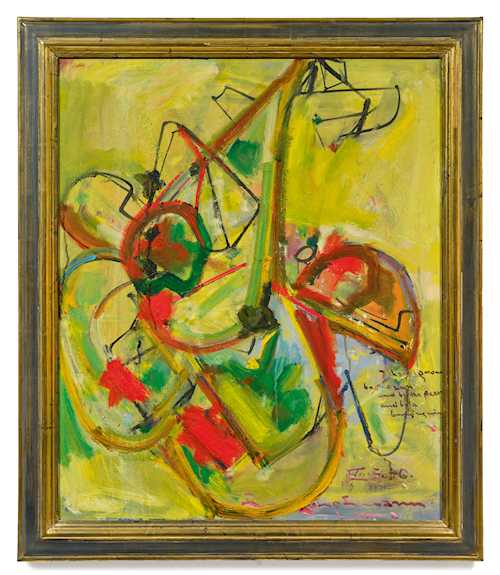
Untitled. 1946.
Oil on canvas.
Signed and dated lower right: VII.5.46. Hofmann, as well as inscribed lower right: I have grown by the sun and by the ocean and by a burning wind.
76.5 × 64 cm.
Certificate:
Provenance:
- Private collection, USA.
- Crane Kalman Gallery, London (verso with remains of the label).
- Private collection Switzerland, acquired at the above gallery.
- Private collection Switzerland, by descent.
Exhibited:
- Berlin 1990, Hans Hofmann, Galerie Michael Haas, October–November 1990.
Literature:
"For me, painting means shaping with colours." Hans Hofmann
Hans Hofmann's œuvre lies at the interface between constructive-geometric abstraction and gestural-expressive painting. It reflects his fundamental conviction that colour is not only a carrier of emotional energy but also generates form as an element that defines the image. This attitude secured the German-born artist a central position within American Abstract Expressionism.
On the canvas, Hofmann creates an autonomous, physically tangible pictorial world that draws on impressions of visible reality but eludes any mimetic reproduction. Colour functions as a structuring principle: it determines the rhythm of the composition and enters into an exciting, pulsating dialogue with form.
A central concept in Hofmann's thinking is his theory of "push and pull". It is based on the idea that spatial depth is not created through classical perspective, but through the interplay of colour, form and composition. Contrasts, overlays and the distribution of dense and open pictorial elements create a visual dynamic in which forces attract or repel each other - allowing movement and depth to be experienced within the surface.
The composition offered here combines sweeping lines with organic and geometric colour forms and testifies to Hofmann's characteristic preference for impasto painting. Particularly striking is the use of a bright red, which provides a strong visual accent as the dominant colour and enters into an intense dialogue with the surrounding colour fields. The spatial effect created by overlays and contrasts demonstrates in exemplary fashion the principle of "push and pull".
In this early phase of his work, Hofmann completed the decisive shift from representational forms to pure abstraction. This oil painting from 1946, which boasts a powerful energy and expressive use of colour, is an excellent illustration of this process of artistic transformation.
CHF 50 000 / 70 000 | (€ 51 550 / 72 160)
Sold for CHF 68 750 (including buyer's premium)