
The scene is imaginary, but the butterflies are real
 Carl Wilhelm de Hamilton (1668–1754)
A pair: Forest floor with squirrel and insects / Forest floor with barn owl. Oil on canvas. 72 x 56 cm each (one shown).
At first view, the three paintings by Carl Wilhelm de Hamilton (Brussels 1668–1754 Augsburg) in the 25 September auction (lots 3071 and 3074) appear to be charming depictions of the busy life on a forest floor: squirrels, snakes, snails and lizards go about their food-gathering amidst a profusion of leafy plants and mushrooms. But one aspect of these works makes them startlingly unique: the butterflies were originally actual specimens, glued to the canvas.
In these paintings, de Hamilton employed a genre known as the forest-floor still life, or sottobosco, developed in the mid-17th century by Dutch painter Otto Marseus van Schrieck (ca. 1613–1678). Marseus lived on the outskirts of Amsterdam in a marshy area known as the “land of snakes”. He spent a large amount of his time observing and capturing specimens of reptiles, insects and amphibians – so much so that his wife claimed that the snakes began posing for him!
Marseus was apparently just as interested in the scientific and natural aspects of this ground-level population as in their potential as artistic subjects. He lived in an age when scientific theories were debated and discussed throughout learned society, such as the prevalent belief in spontaneous generation, which held that certain animals and plants, particularly “low beings” like snakes, toads and mushrooms, could arise from non-living matter – such as maggots generating from rotting flesh.
 Detail of the above painting, showing how the butterflies appear today...
The painter and amateur scientist effectively crossed the line between science and art when he glued the scales of actual butterfly wings to his canvas. The technique consisted of making a wing-shaped reserve using a white, probably lead-based adhesive as an imprimatura. Then the wings were pressed onto this reserve, causing the scales to adhere to the canvas, with the white background enhancing the shimmering colours. The effect must have been enchanting. Today, due to the fading of the butterfly scales’ colours, the wings appear to be white, unless they have been overpainted.
 ... and the colours they may have had originally.
Marseus had numerous followers, and Carl Wilhelm de Hamilton was one of the most influential in spreading the sottobosco genre Marseus had invented, since he migrated from Belgium to Germany, where he worked as court painter in several cities. Microscopic examinations of the present works by researcher V.E. Mandrij have revealed the remains of the original butterfly scales which Hamilton applied, as well as some coloured glaze that the artist added, probably to complete the areas where some scales were lacking. Hamilton also imitated Marseus’s technique of using actual lichen and moss instead of a paintbrush to represent such vegetation.
 Carl Wilhelm de Hamilton (1668–1754)
Forest floor still life (detail).
Oil on panel. 47.2 x 34 cm.
An interesting aspect of both Marseus’ and Hamilton’s work is that despite the obvious symbolic opportunities that such compositions afford (the Greek word for butterfly, psyche, also signifies “soul”, so a snake or a toad snapping up a butterfly conjures a world of moralising possibilities) the artists seemed to be more interested in depicting real animals and plants, devoid of any hidden meaning, for the pleasure of recreating – or creating – an intimate moment on the forest floor.
The work of Marseus and his followers was subsequently almost completely forgotten, and it was not until the 1991 installation “In and Out of Love” by Damien Hirst that actual butterflies would make their reappearance in the world of art.
Behind the canvas: Love and scandal in Georgian Britain
 Seymour Dorothy Fleming (1757–1818) as Lady Worsley.
Portrait by Joshua Reynolds, 1776 (detail).
Harewood House Trust, Yorkshire.
The portrait of John Lewis Fleming (1779–1836) offered in our 25 September auction (lot 3083) is of interest not only for its attribution to Sir Thomas Lawrence, one of the greatest British portrait painters, but also for Fleming’s association with one of the most famous women in late 18th-century England: his wife, Seymour Dorothy Fleming (1757–1818).
Seymour Fleming, headstrong heiress to a small fortune, married Sir Richard Worsley when she was seventeen. Worsley was from an old aristocratic family, and in need of greater wealth to improve his position in London society. They had a son together, Robert Edwin, but Lady Worsley soon felt neglected and restless, and embarked on a series of affairs, including one with a neighbour and close friend of Sir Richard’s, Captain George Maurice Bissett. The relationship with Bissett soon became serious (in August 1781 Lady Worsley gave birth to a daughter which was purported to be Bissett’s), and in November 1781 Seymour eloped with her lover. This was an audacious act for the time – most ladies of her standing would have simply carried on the affair while their husbands turned a blind eye, as apparently Worsley had done until then – but she probably hoped that such a bold move would persuade her husband would grant her a divorce.
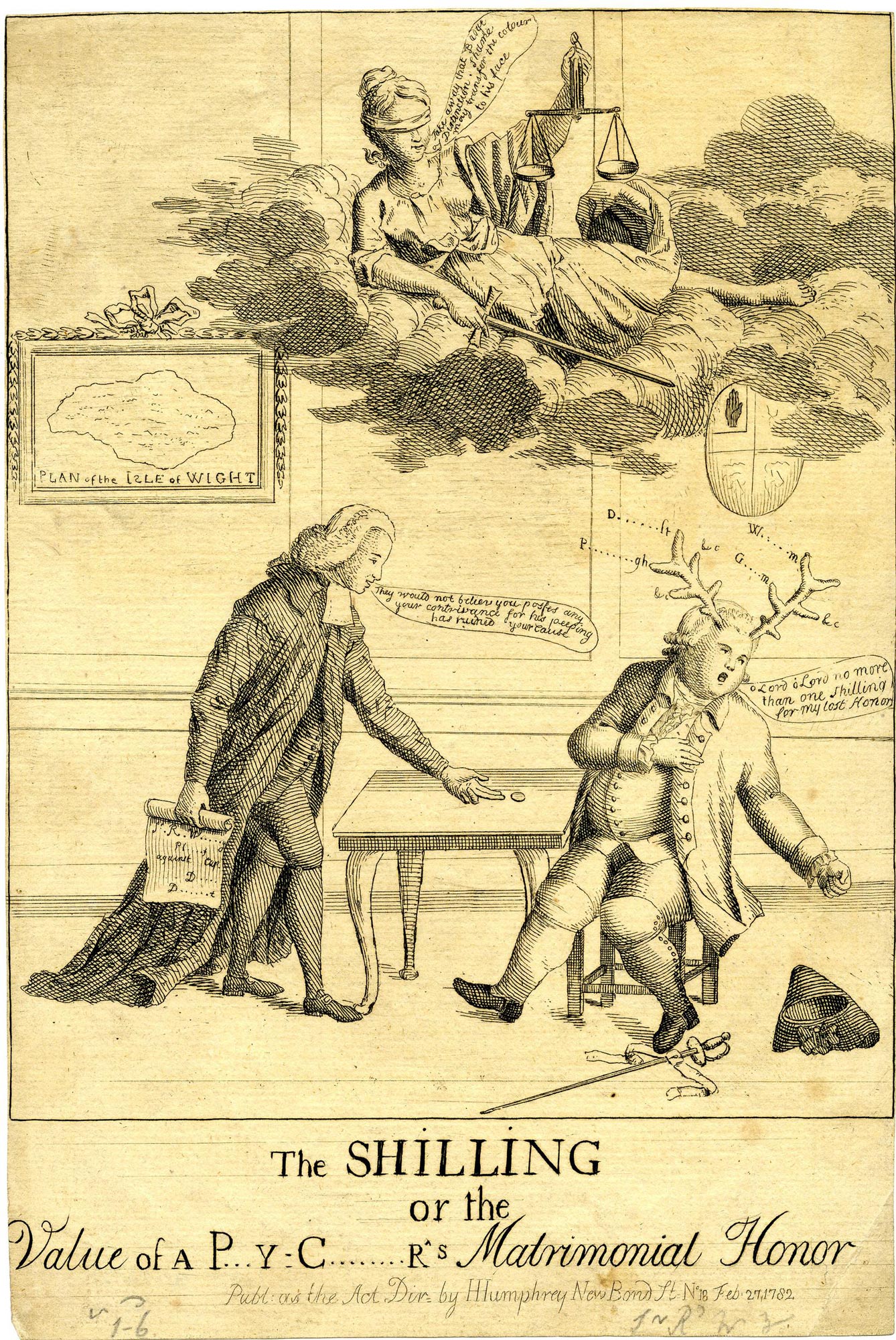 A satirical print from 1782 mocking the humiliating verdict of one shilling in damages handed over to Lord Worsley.
Etching published by Hannah Humphrey.
© The Trustees of the British Museum.
The effect was just the opposite – furious at the public betrayal by a friend, Worsley sued Bissett for what was called Criminal Conversation, a civil suit for damages in compensation for the seduction of one’s wife. He also refused to grant Seymour a divorce and demanded the unprecedented sum of £20 000, which would have ruined Bissett financially. Worsley seemed to have an open-and-shut case, with letters and witnesses, but Seymour was not one to be defeated so easily. She adopted the novel if somewhat reckless defence of exposing intimate details of the couple’s private life during the trial, with witnesses recounting episodes of Sir Richard’s voyeurism and encouragement of his wife’s infidelities. She succeeded: instead of £20 000, the jury awarded Worsley the humiliating sum of one shilling, and he became the mockery of all England, forcing him flee the hounding of the popular press through an extended journey to the Middle East.
But Seymour also became a social pariah. No one in the polite British society of the time could associate with someone who had so openly publicised their scandalous acts, and she found herself shunned by many of her former friends and family. Once again Seymour refused to bow to her fate, however, and along with other ladies in a similar position, she became a member of the demi-monde who met socially under the name of the “New Female Coterie”. Bissett eventually left her, as there was no possibility of marriage – Worsley did not even sign a separation agreement until six years after the trial, with the clause that Seymour leave England for four years. She moved to Paris, where women of her reputation were more socially accepted, but within a year of her arrival the Revolution broke out. Swept up in the Reign of Terror, Seymour probably spent some time in a French prison before finally returning to England in 1797, very ill and in a precarious financial situation.
 Attributed to Sir Thomas Lawrence (1769–1830).
Portrait of John Lewis Fleming (1779–1836).
Oil on canvas. 76.5 × 63.8 cm.
Sold for CHF 25 000
Sometime during this period, Seymour met and fell in love with John Louis Hummell (born Cuchet), a Geneva-born musician who had been somewhat of a child prodigy, even performing for King George III and Queen Charlotte at the age of nine. Their age difference was considerable, but there seems to have been a real affection between the two. When Worsley died in 1805 and Seymour finally came into possession of his estate, they married and Hummell changed his name to John Lewis Fleming; Seymour also took back her maiden name. The present portrait was most likely commissioned by Seymour from the most fashionable portrait painter of the day as a sort of advertisement of her new husband’s arrival in society (the musician, although at ease in upper social circles, was not nobly born).
Two years after Seymour’s death in 1818, Fleming – who had inherited Seymour’s fortune – married a French noblewoman, Ernestine Jeanne Marie de Houdetot (1796–1836). Their daughter married a Bernese patrician, Dyonis Bernhard Friedrich von Graffenried (1815–1886), and so the painting came to Switzerland, where it has remained in the same family ever since. John Lewis Fleming’s last wish was to be buried next to his first wife, Seymour Dorothy Fleming, in Père Lachaise cemetery in Paris.
“Le goût Rothschild” in a time capsule
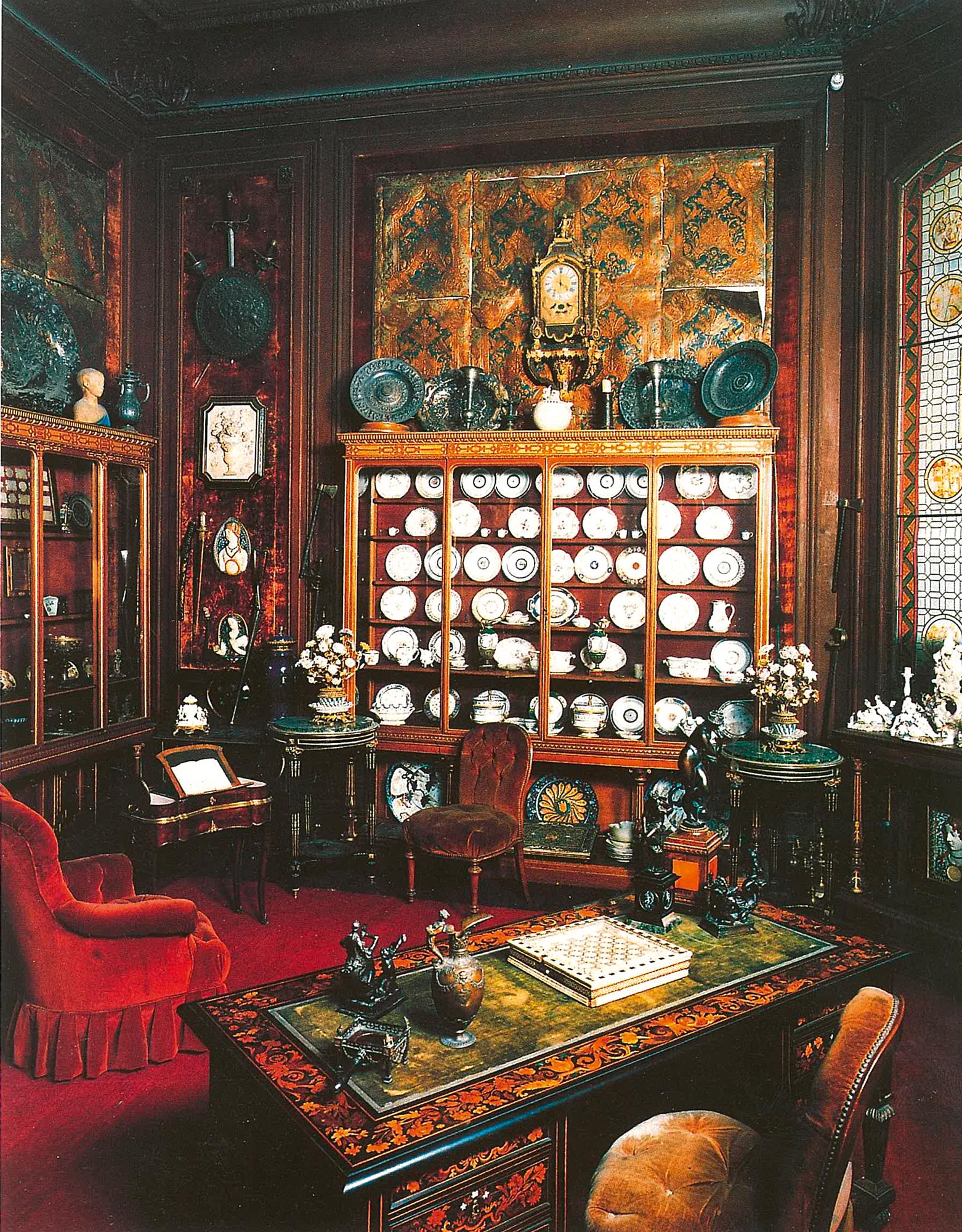 A view of the interior of the Hôtel Salomon de Rothschild. The present table is visible in the center left.
The “table d’accouchée” to be offered in our 24 September auction (lot 1050), belonged to Adèle de Rothschild (1843–1922), a member of one of the most fabulously wealthy families in history. The Rothschild family, whose wealth derived from banking and finance, were avid collectors, and their collecting preferences and decorating style became known in the latter half of the 19th century as “le goût Rothschild” (the Rothschild taste). Their Renaissance-style palatial homes filled with the finest selection of (mostly French) antiques, gilding, heavy fabrics and carved boiseries set a new standard, and were emulated by later generations of high-wealth individuals such as the Rockefellers, Vanderbilts, Duponts and Gettys.
In Paris in 1862, Adèle de Rothschild wed her cousin, Salomon de Rothschild (1835–1864), who died of a heart attack just two years later. Salomon’s impetuosity and financial extravagance often caused difficulties with the rest of his family, but he was also a dedicated and passionate collector, amassing an impressive number of high-quality books, photographs, paintings, sculpture, decorative arts and Middle Eastern art, especially during the two years following his marriage to Adèle. After her husband’s death, Adèle, aged twenty-one, led a somewhat reclusive existence for the next half-century, although there is some evidence – not least invoices for significant amounts of cognac and cigars – that she continued to lead an active, if highly selective, social life within her residence. She supported the arts throughout her lifetime, and was an early patron of Alphonse Mucha, for example, sponsoring his first visit to the United States in 1904.
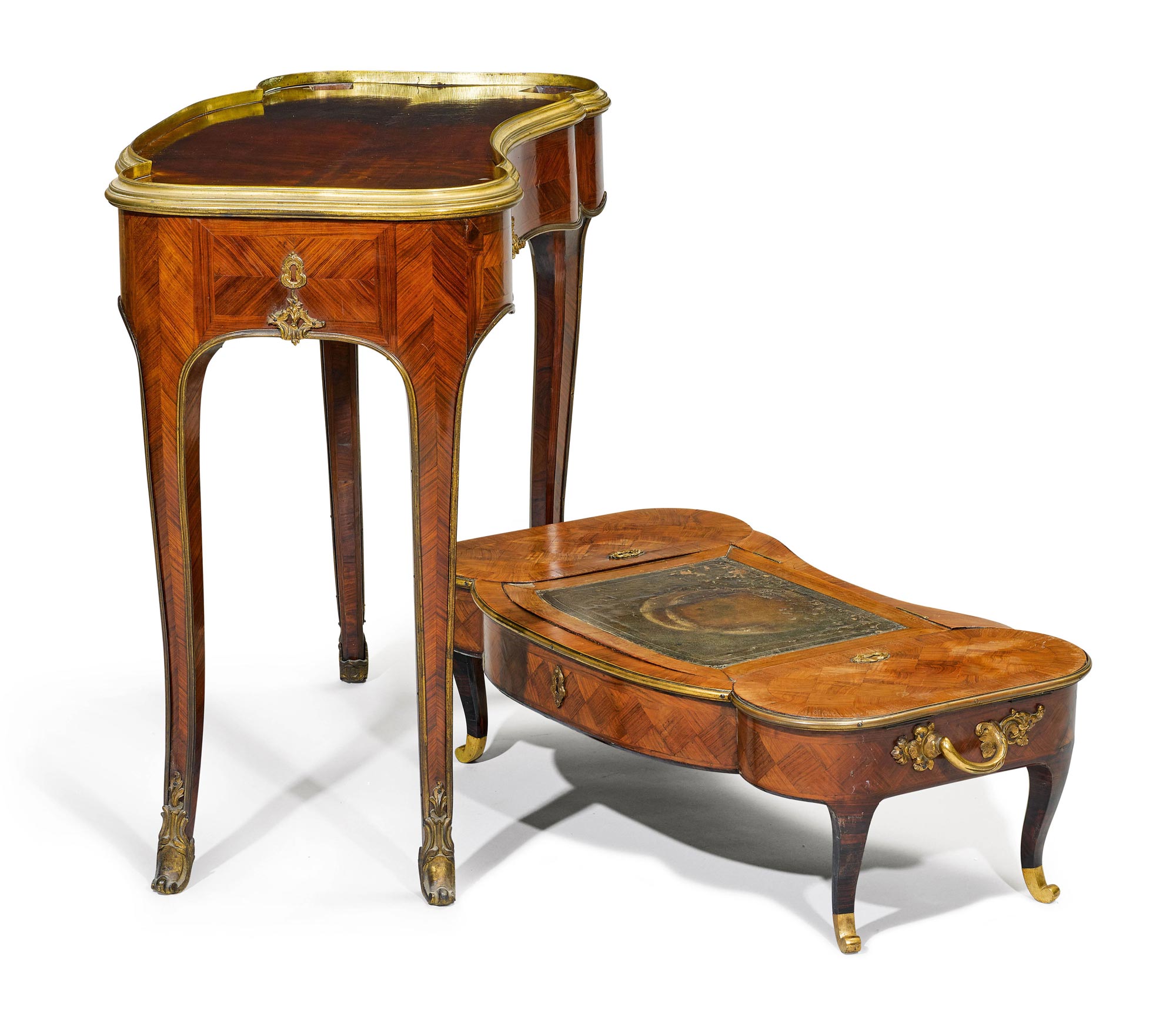 A Louis XV rosewood and pupleheart marquetry
"table d'accouchée". Paris, circa 1750/60.
From 1872 Adèle oversaw the construction of a large mansion in the Monceau district of Paris, the Hôtel Salomon de Rothschild, designed to house and display the collections of her late husband as well as those of her father, Mayer Carl von Rothschild. The present table was a part of the sumptuous décor of the Hôtel Rothschild and is a typical example of the fine quality of the family’s legendary furniture collections. The “table d’accouchée” is one of several French furniture forms invented in the mid-18th century which corresponded to a shift during the period of Louis XV from the quite exposed manner of living at Versailles under the previous reign towards more intimate private apartments. The upper section lifts off and is designed to be used while reclining in one’s bed, as a lectern, writing desk or dining tray.
Today, according to the wishes of Adèle de Rothschild, the Hôtel Salomon de Rothschild houses a foundation dedicated to artists and the arts, and one room has been carefully preserved and is open to the public, the Cabinet of Curiosities. Containing over 400 works of art, it is an excellent example of the “goût Rothschild” and a fascinating time capsule from a period when collectors with means could fully satisfy their passion for extraordinary works of art.

25 TREES FOR SWISS YOUTH
The Association of Swiss Youth Parliaments is celebrating its 25th anniversary by leaving a lasting mark: 25 trees will be planted, symbolising 25 years of the promotion of political participation and political education of children and young adults.
Take part in the auction of the 25 trees via Koller Auctions and support Swiss youth politics! Bidding begins on 5 October 2020, on our “ibid online only” auction page. The sale closes on 23 October 2020.
