
A FASCINATION
WITH FAÏENCE
PREVIEW OF THE AUCTION OF THE DR PETER DUCRET COLLECTION ON 17 SEPTEMBER 2026
‘Passion’ is a word often used to describe collectors – yet sometimes it fails to capture what truly motivates them. For some collectors, it’s more of a calling, a vocation. Peter Ducret, the son of the internationally renowned porcelain collector and specialist Siegfried Ducret, grew up immersed in a world of collecting. Although collecting is by no means an inherited trait, Peter embraced it early on, gathering snails, shells and fossils. His parents encouraged this, especially his mother, who gave him natural specimens, and later, pieces of faïence.
These gifts would spark a lifelong fascination with faïence. He would later travel the world, and in every place he went, he would search for unusual pieces. Peter Ducret’s daughter writes in the catalogue introduction: ‘Time and again, we accompanied our parents on their forays through antique shops and flea markets. I didn’t speak French back then, but the phrase
“Est-ce que vous avez de la faïence du 18ᵉ siècle?”
rolled effortlessly off my tongue’.
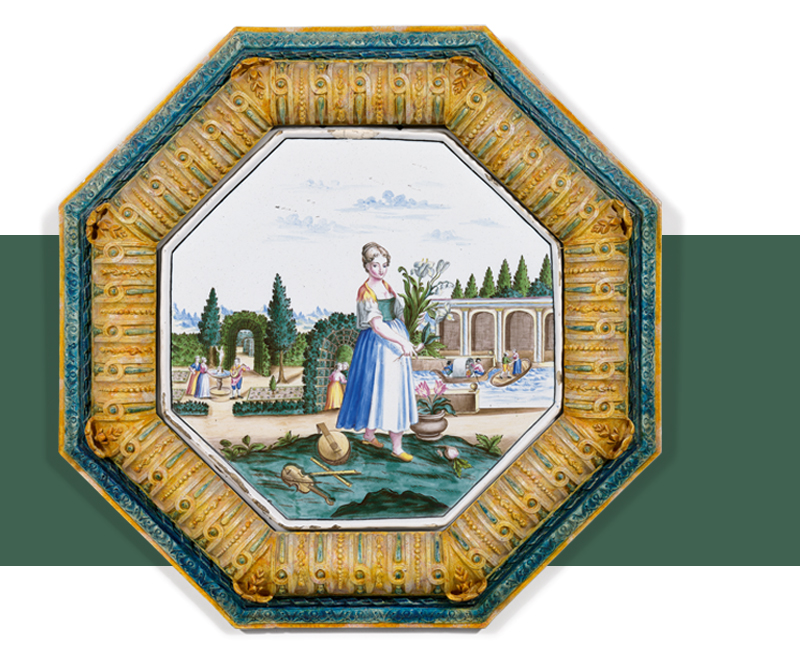
AN IMPORTANT FAÏENCE PLAQUE WITH AN ALLEGORY OF THE MONTHS
Künersberg, ca. 1760
Painted in ‘petit feu’ colours. D 38 cm
Estimate: CHF 20 000/30 000
Peter Ducret’s collecting provided him not only with satisfaction, but also lasting friends and acquaintances that he might not otherwise have had. His scientific mind led him to be interested in all aspects of the pieces he collected: their techniques, history, provenance, and place within Europe's cultural heritage. His extraordinary openness to exchanging ideas, sharing his knowledge and welcoming anyone with a genuine interest in his collection made him a central figure among fellow enthusiasts. Faïence and its study became not merely a pastime but a source of personal fulfilment and a means of enriching others.
A HIGHLY IMPORTANT FAÏENCE PLAQUE
Fulda, ca. 1741–44
Painted by Adam Friedrich von Löwenfinck
Overglaze decoration. 18.5 cm × 15.2 cm
Estimate: CHF 30 000/40 000
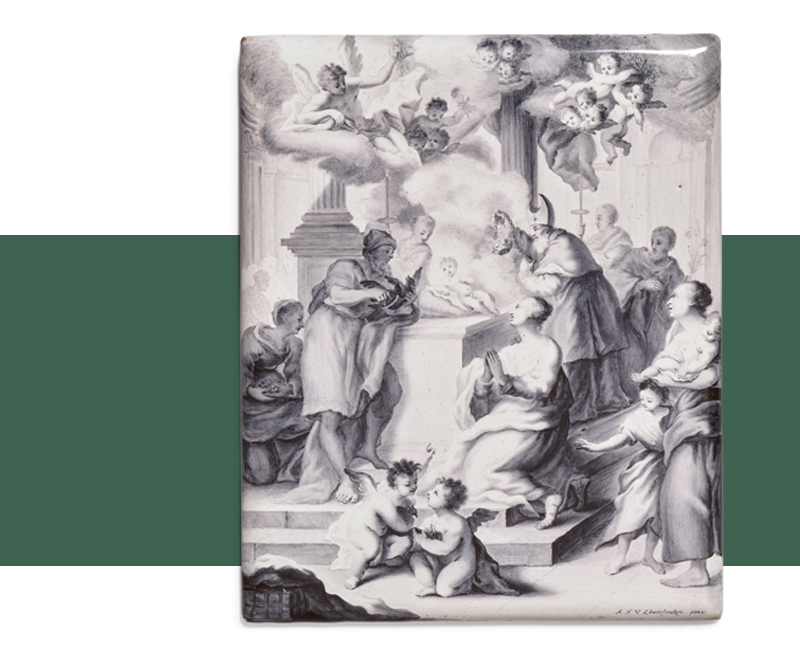
A HIGHLY IMPORTANT FAÏENCE PLAQUE
Fulda, ca. 1741–44
Painted by Adam Friedrich von Löwenfinck
Overglaze decoration. 18.5 cm × 15.2 cm
Estimate: CHF 30 000/40 000
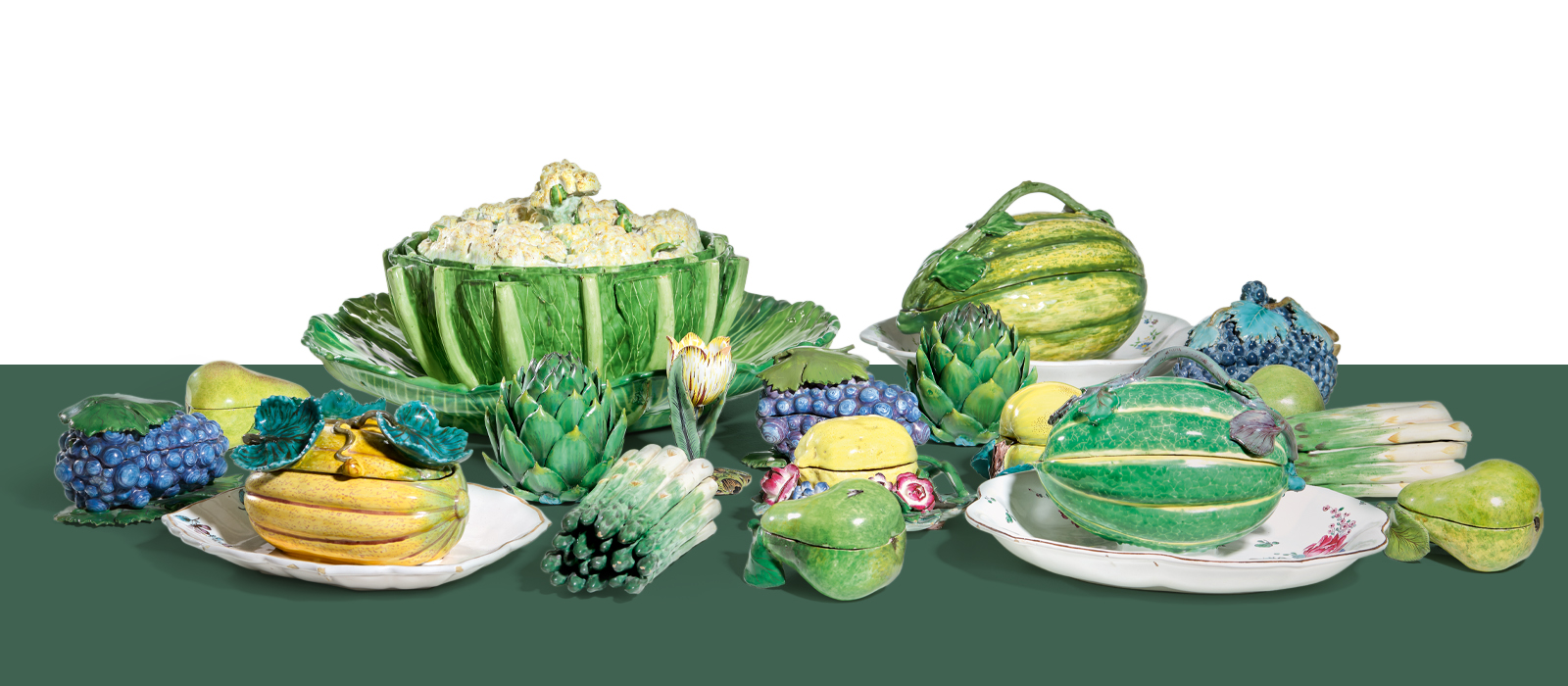
The Ducret collection covers an extraordinary range of 18th-century faïence in all its forms, but trompe l’oeil faïence occupies a place of honour. From the French for ‘deceive the eye’, trompe l’oeil objects purport to be something they are not: a cauliflower, a duck, or a bundle of asparagus. What caused this fashion in the courts of Europe? Few things were more dreaded by Europe's 18th-century aristocracy than boredom. They pursued all sorts of entertainment, such as dancing, theatre, gambling, gossip and intrigues, to relieve the monotony of courtly existence. But above all, they delighted in anything that surprised or inspired wonder. Elaborate fireworks displays, automatons, conjurors – all were sure to please. And trompe l’oeil ceramics answered this appetite for novelty. On richly laid tables, tureens fashioned as vegetables, fish or birds concealed soups of the very creatures they depicted – or, more delightfully still, an entirely unexpected sweet dessert.
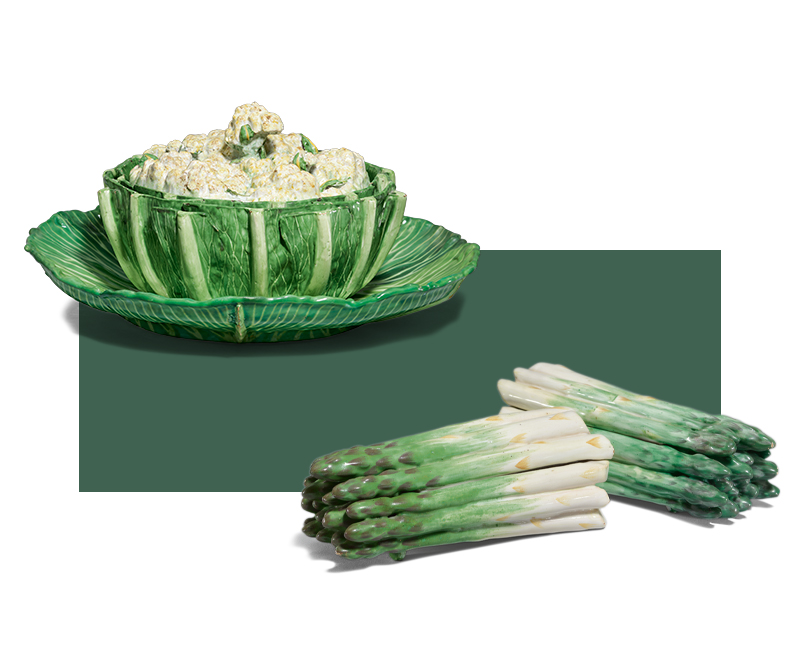
A TROMPE-L'OEIL CAULIFLOWER TUREEN AND STAND
Strasbourg, Paul Hannong period, ca. 1754–60
Tureen Ø 27.5 cm, H 18.5 cm, Stand Ø 41 cm, H 7 cm
Estimate: CHF 8 000/12 000
A PAIR OF TROMPE-L'OEIL ASPARAGUS BUNDLES FROM THE CLEMENSWERTHER SERVICE
Strasbourg, Paul Hannong period, 1751
Each L 16.5 cm; H 6.5 cm
Estimate: CHF 4 000/6 000
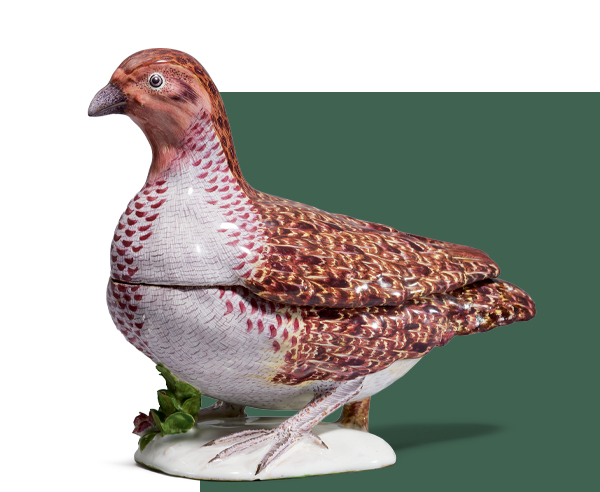
It is perhaps no surprise that these ingenious creations captivated Peter Ducret more than two centuries later. His collection contains many rare and fine examples of this art, many of which are from the celebrated workshop of the Hannong dynasty in Strasbourg. A pair of duck-form tureens, a pigeon serving dish, tureens in the shape of bundles of asparagus and artichokes, and a two whimsical butter dishes in the shape of tortoises, all attest not only to Peter Ducret’s unfailing eye for quality and rarity, but also to his ambition to assemble a representative survey of this remarkable branch of faïence production, one that could be studied and appreciated by historians and collectors alike. In doing so, Peter Ducret brought together two of his deepest interests: nature and faïence.
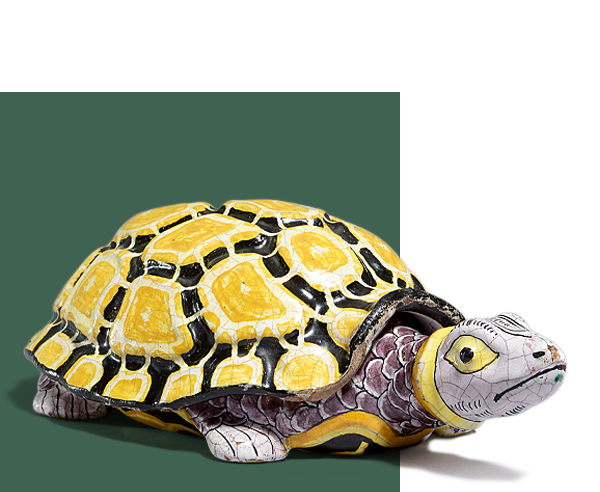

A TORTOISE-FORM
BUTTER DISH
Probably Fulda, ca. 1750
L 25 cm, H 7.5 cm, W 11.5 cm
Estimate: CHF 5 000/7 000
A PAIR OF
TROMPE-L’OEIL ARTICHOKES
Strasbourg, Paul Hannong period, ca. 1750–54
Each circa D 10.5 cm; H 11 cm
Estimate: CHF 4 000/6 000
A PAIR OF TROMPE-L’OEIL PARTRIDGES FROM THE CLEMENSWERTH SERVICE
Strasbourg, Paul Hannong period, ca. 1745–54
L 21.5 cm; H 18 cm and L 20.5 cm; H 18.5 cm
Estimate: CHF 12 000/22 000

CONTACT FOR
ENQUIRIES AND
CONSIGNMENTS:
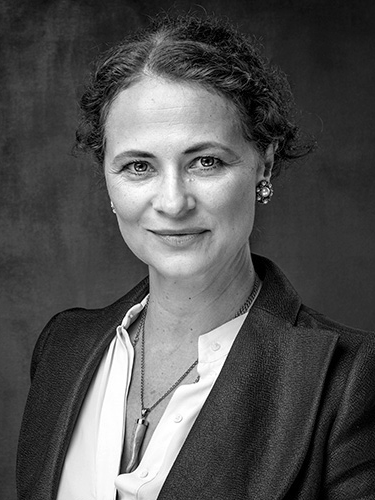
SABINE NEUMAIER
Head of DepartmentEuropean Porcelain & Ceramics
neumaier@kollerauktionen.ch
+41 44 445 63 42