
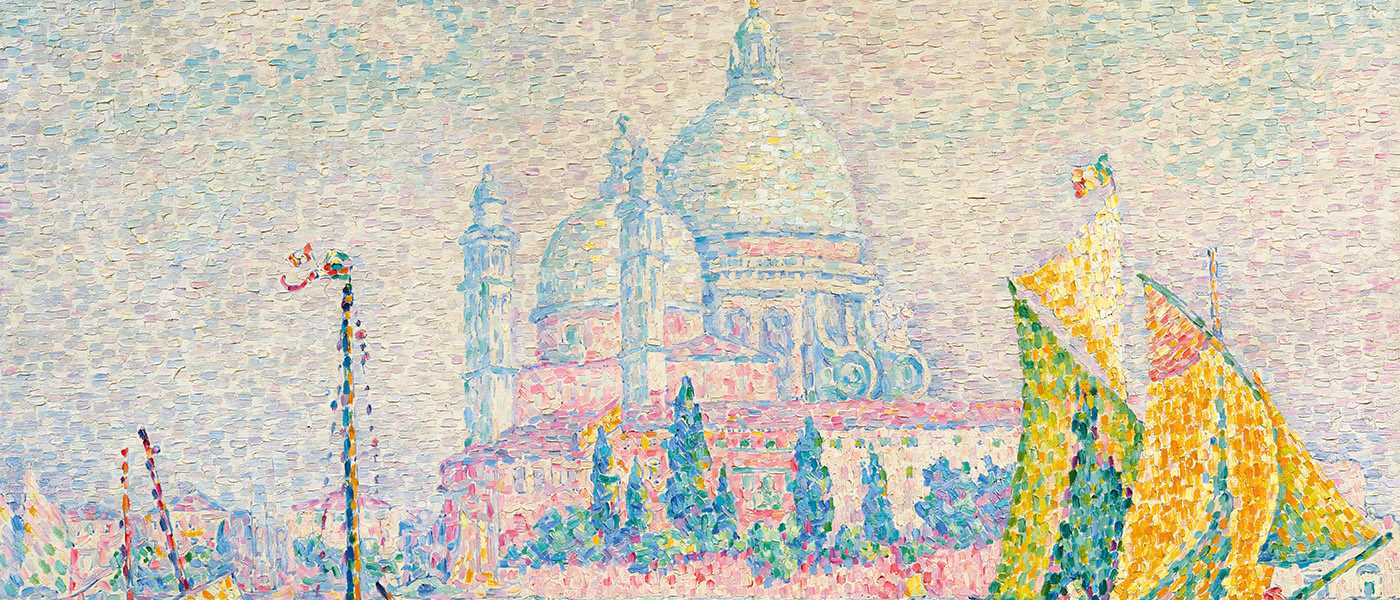
Sails dipped in gold
Preview of the Impressionist & Modern Art auction on 26 June 2026
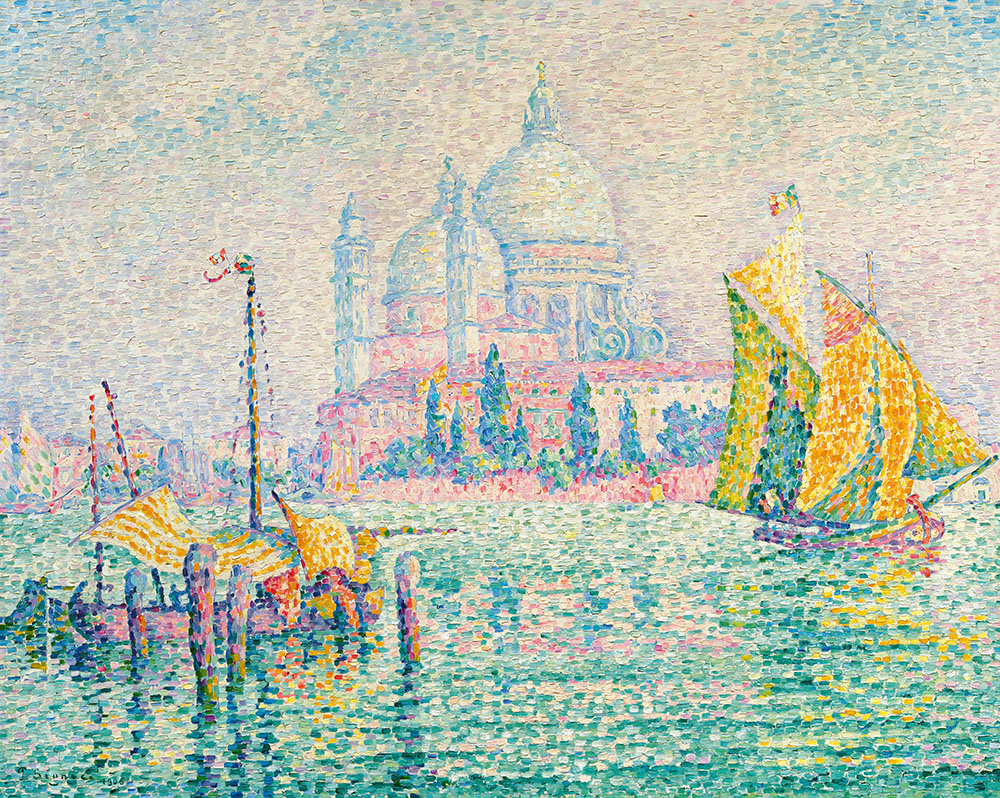
In this painting, executed in 1906, Paul Signac presents Venice not as a physical city, but as a shimmering apparition of light and colour. The restless waters of the lagoon flow through the composition like a quiet pulse, guiding the eye towards the silhouette of the votive church Santa Maria della Salute. Its famous double dome and flanking campanili rise in the distance, not as sharply defined architecture, but as a vibrating constellation of delicate pinks, blues and violets. The church seems less constructed than dissolved within the haze itself.
For the passionate sailor Paul Signac, this place represented a threshold between city and sea, a ‘gateway to Venice’. In the foreground, boats with radiant golden-yellow sails animate the scene. They structure the composition, establish rhythmic accents and lend spatial depth to the view towards the basilica. Their presence infuses the painting with a buoyant sense of movement that continues across the water’s surface.
Paul
Signac
La Salute (Venise). 1906.
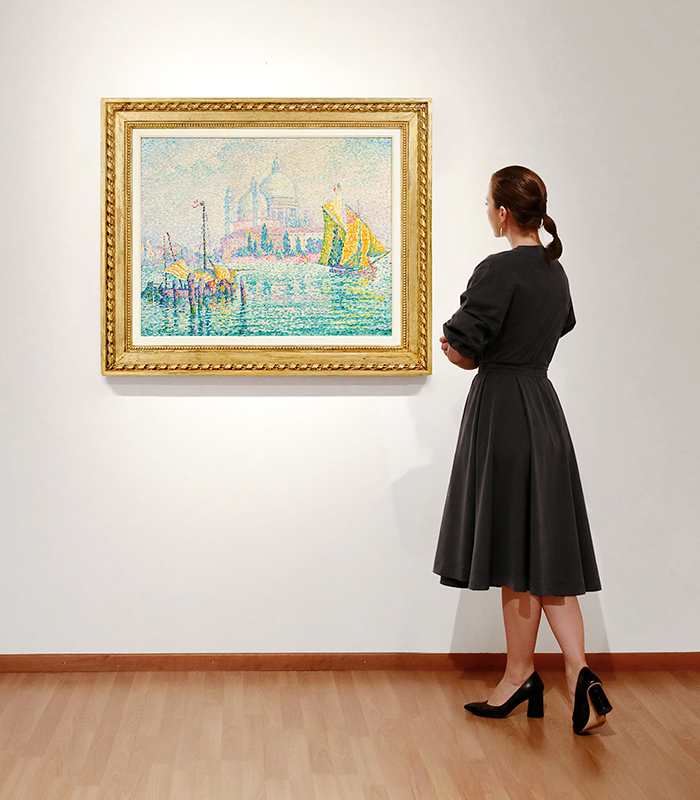
Oil on canvas. 73 × 92 cm.
Estimate: CHF 2 000 000/3 000 000
The composition follows a carefully balanced order. The poles and boats in the foreground, the expansive stretch of water in the middle ground and the architecture in the distance are all connected through a finely calibrated network of dabs of colour. The water itself is not rendered as a naturalistic depiction, but as the result of deliberate construction. Small strokes of unmixed colour, placed side by side, create a flickering surface that coalesces only in the viewer’s eye. Together with Georges Seurat, Signac developed the Divisionist technique of Neo-Impressionism, in which pure colours are not blended but juxtaposed so as to intensify one another’s luminosity. This is especially evident in the interplay between the warm yellows and oranges of the sails and the cool greens and blues of the lagoon. Such subtly balanced contrasts set the composition into a state of vibrant optical motion. Signac himself described this separation of tones as a means of seeking ‘the strength and harmony of colour’.
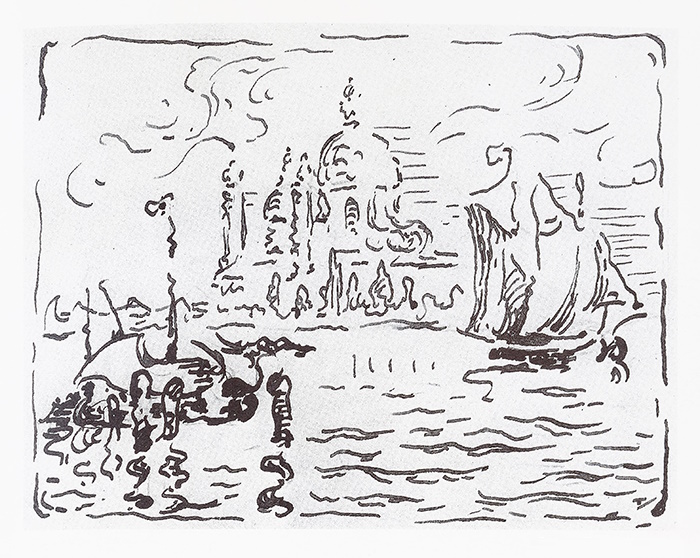
Signac's sketch after his painting 'La Salute'.
Les Archives Paul Signac.
Around 1904, Paul Signac reached a particular maturity in his Venetian paintings. His brushwork became broader and freer, his palette lighter and more transparent. Architecture loses its solidity and is transformed into light. Unlike Claude Monet or William Turner, who conceived water primarily as an atmospheric space, Signac turns it into a structured field of colour and rhythm. This shift marks a decisive step towards modernism, in which colour no longer merely describes, but becomes the bearer of the pictorial idea itself. Works from this period are today counted among the highlights of major museum collections, including the Bührle Collection in Zurich, the Toledo Museum of Art in the United States and the Neue Pinakothek in Munich.
The present work occupies a special position within Signac’s oeuvre. For many years, it was known only through a pen-and-ink sketch (see ill.) and was considered lost. Its rediscovery offers a renewed perspective on the Venice series and underscores the consistency with which Signac transformed perception into an autonomous pictorial order. The fact that the painting, acquired in Paris in 1913, has remained in the same family collection for more than a century lends it additional significance. Now emerging once again into public view, it demonstrates with remarkable clarity how the fleeting impression of a lagoon could be transformed into an enduring image of luminous structure and inner movement.


CONTACT FOR
ENQUIRIES AND
CONSIGNMENTS:
JARA KOLLER
Head of DepartmentImpressionist & Modern Art
jara.koller@kollerauktionen.com
+41 44 445 63 08