

Lot 1011* - A216 Works of Art & Decorative Arts - Thursday, 26. March 2026, 01.30 PM
A MONUMENTAL COPTIC WALL HANGING
Coptic, Egypt, probably found in Sheikh Abadeh, ca. 5th–7th century AD.
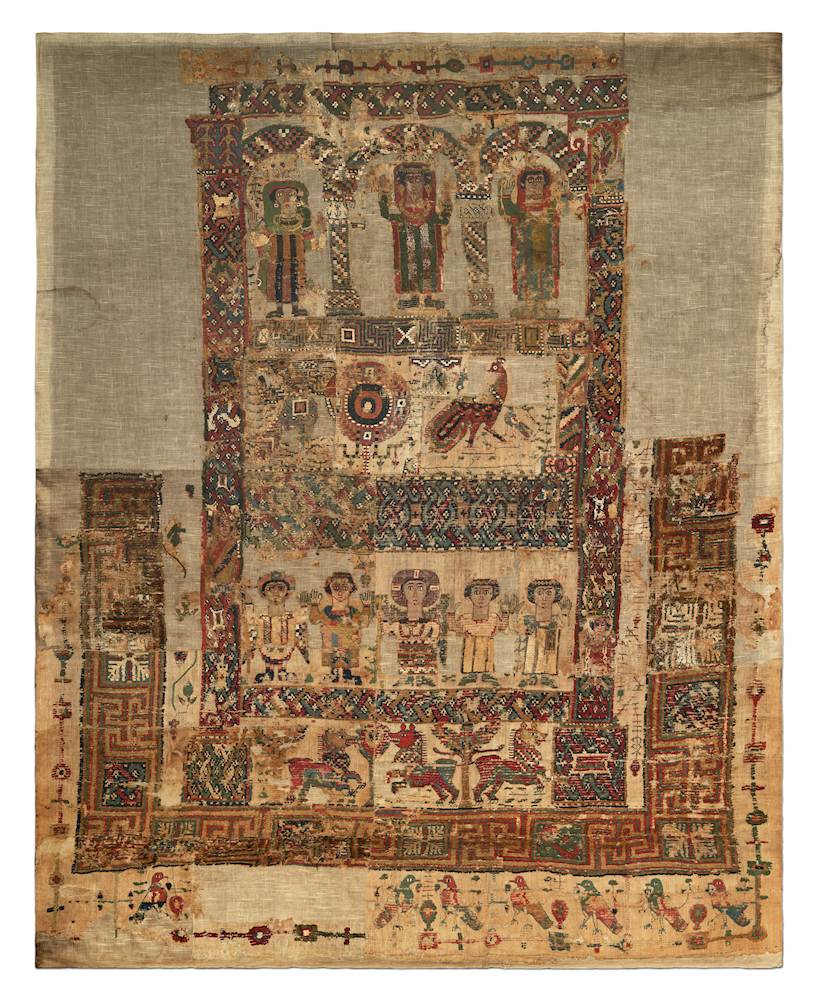
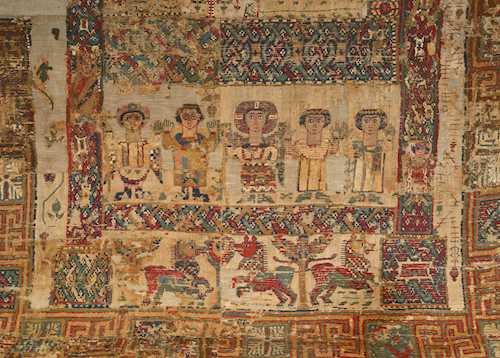
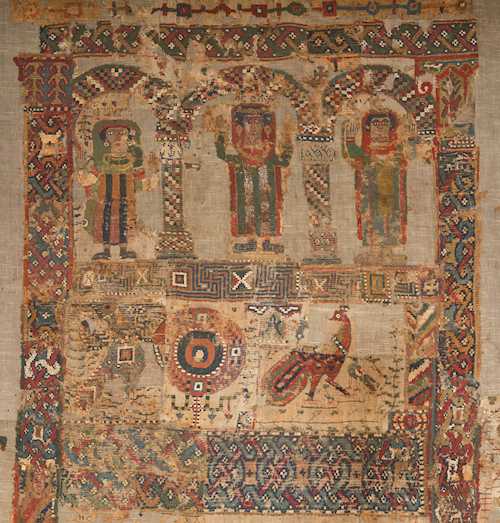
Linen ground with polychrome wool threads. The upper depiction with three worshippers standing under round arches, their hands raised in prayer. The left and middle figures are probably female, wearing elaborate necklaces and earrings, the middle one also wearing elaborate hair ornaments. Above their heads are remnants of Greek inscriptions. Mosaic decoration on columns and arches. Below this is an image segment with a round medallion, probably a sun symbol, flanked by two birds, the left one probably an eagle, the right one a peacock. Below this is an image segment with five standing figures, the left and middle ones with wings, possibly representing angels, their hands also raised in prayer. The central figure has a halo and a staff. The figure on the far left also has a staff. Again with remnants of Greek titles. The lowest image zone shows leaping lions between trees. The four image zones are bordered by four horizontal strips with geometric, partly offset patterns. On the left and right, the four image zones are lined by two column-like vertical strips, with a head visible in each of the lower areas. An additional wide border with geometric meander band decoration frames the lower half of the scene. An additional lower strip shows a flock of birds, probably doves, with a stylized geometric garland of flowers.
Ca. 405 × 310 cm.
Various fragments joined together. Partially supplemented. Restorations. Tears.
Provenance:
- Munich Art and Antiques Trade Fair, 1960 (according to a copy of a letter from Dr. Klaus Parlasca dated 23 May 1963).
- By inheritance, in the current South German private collection, acquired at the above trade fair.
The term “Coptic textiles” refers to fabrics produced in Egypt between approximately the 3rd and 10th centuries AD. Their exceptionally good state of preservation is mainly due to the country's climatic conditions. Textiles play an important role in research into Coptic art and late Ancient Egyptian art. The term “Coptic” is not primarily to be understood in a Christian denominational context, as it is etymologically derived from the Greek word “aigyptioi” and entered modern usage via the Arabic ‘quibt’/“quodt.” So while “Copts” still refers to the Christian population of Egypt today, the adjective “Coptic” in an art and cultural history context primarily refers to geographical origin and a historical epoch.
Despite modern scientific methods, the chronological classification of Coptic textiles is often fraught with uncertainty. Even radiocarbon dating (C14) provides relatively broad dating ranges, which makes precise chronological determination difficult. Stylistic comparisons therefore remain relevant as a supplement for dating.
Most of the surviving Coptic textiles come from tombs. These are mainly items of clothing and liturgical vestments belonging to the deceased. The most common finds are fragments of tunics in various styles, headdresses, footwear, and remnants of cloaks. A second group, known as furnishing textiles, must be distinguished from these and includes the wall hanging on offer. This second group includes wall hangings, curtains, blankets, cushions, and cloths. Their use is often interpreted as a textile substitute or supplement to wall paintings, especially in the interiors of churches and monasteries, where they played a representative and functional role.
The textile fragment on offer is characterized by its extraordinary monumentality. Such large, coherent textile surfaces from this period are rarely preserved. Although the object is composed of several fragments, it conveys a cohesive overall image of high aesthetic and museological quality. The good condition of the original, ancient parts is also remarkable.
The richness of detail and the complex imagery with figurative representations, ornaments, floral and faunal motifs point to an early phase of Christian iconography, in which the imagery was only gradually beginning to become canonized. Comparable fabrics with such a dense and multi-layered imagery are extremely rare.
There is a particularly close stylistic and iconographic relationship to a curtain fabric in the Abegg Foundation in Riggisberg in the canton of Berne (cf. Sabine Schrenk/Abegg Foundation (ed.): Textiles of the Mediterranean Region from Late Antiquity to Early Islamic Times. Riggisberg 2004, p. 51, No. 8). That specimen was acquired by Werner Abegg on 2 May 1959, at Ars Antiqua in Lucerne (Lot No. 28) and donated to the Foundation in 1963. In the Ars Antiqua auction catalog from 1960, the wall hanging on offer is described as a counterpart to the curtain fabric sold the previous year and acquired by Werner Abegg.
Another important comparison is a fragmented register hanging from the Landesmuseum Württemberg (Inv. No. 1984–103) measuring 208 × 243.5 cm. This object is considered an outstanding example of the so-called register hangings, which owe their name to the zone-like structuring of the decoration. Characteristic motifs such as the round arch architecture, a bird frieze with a hanging structure in the lowest register, and lion figures in the middle zones can also be found in a similar form on the register hanging on offer. In addition, a Coptic curtain fragment in the Detroit Institute of Art (Inv. No. 46.75) is noteworthy, which, similar to the wall hanging on offer, shows a single female worshipper under a round arch. A curtain fabric from the Benaki Museum in Athens (Inv. No. ΓΕ 7145) shows striking parallels: the posture of the figures, their gestures, the shape of their faces with distinctive eyebrows in the form of a continuous monobrow, and the mosaic-like design of the round arches are all similar.
A stylistically different but iconographically similar example can be found in the Cleveland Museum of Art (Inv. No. 1982.73). The relatively large-format curtain fabric shows a round arch architecture with three worshippers in a similar posture in the lowest register. Peacock motifs also appear, but are rendered more realistically, while the figures as a whole appear somewhat more caricatured. Nevertheless, certain decorative elements, such as the knots in the column area, are similar.
Of particular importance for the question of provenance and the workshop is a copy of a three-page letter from 1963, which shows that the object was examined by Dr. Klaus Parlasca (1925–2020). Dr. Klaus Parlasca was a renowned classical archaeologist and art historian whose research focused on ancient portraiture, Roman portraits, mummy portraits (especially Fayum portraits), and the visual and social history of Roman Egypt. Based on his research into the then anonymous previous owner, the presumed place of discovery was determined to be Sheikh Abadeh in Middle Egypt. Parlasca also suspected a close relationship with the above-mentioned curtain fragment in the Detroit Institute of Art and, based on numerous matching individual motifs, considered it likely that both textiles were created in the same workshop – possibly even as originally matching counterparts.
CHF 300 000 / 500 000 | (€ 309 280 / 515 460)
Sold for CHF 646 400 (including buyer's premium)