
Lot 1076 - A218 The Dr Peter Ducret Collection - Thursday, 17. September 2026, 02.00 PM
RARE TABATIÈRE
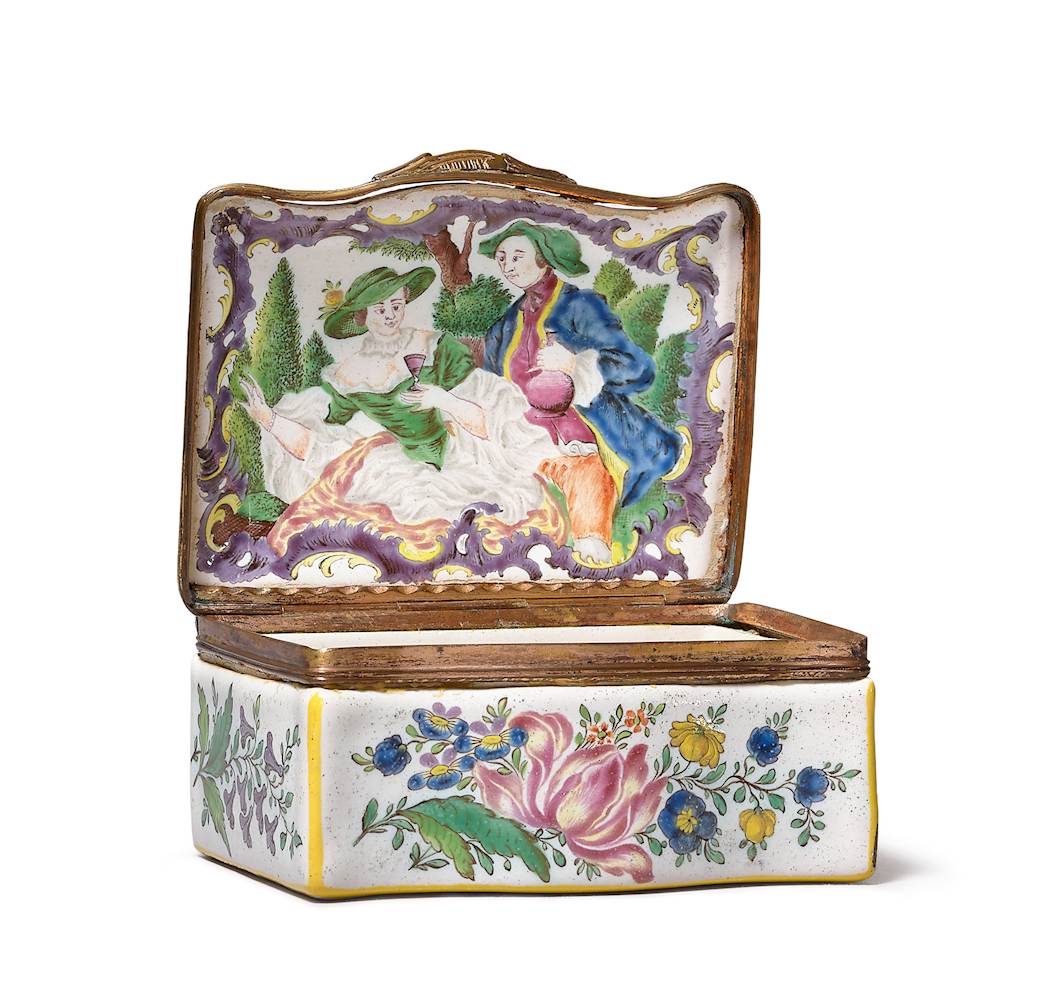
Crailsheim, circa 1757. The painting is attributed to Johann Heinrich Klug.
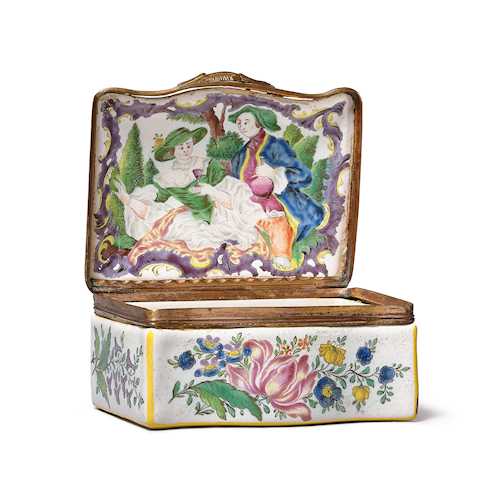
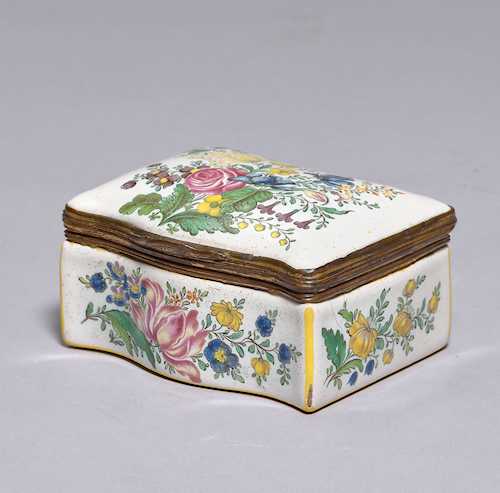
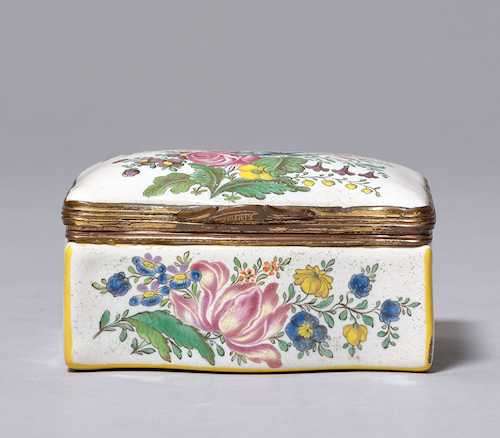
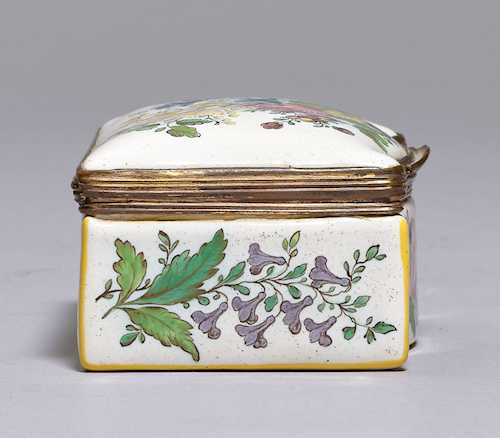
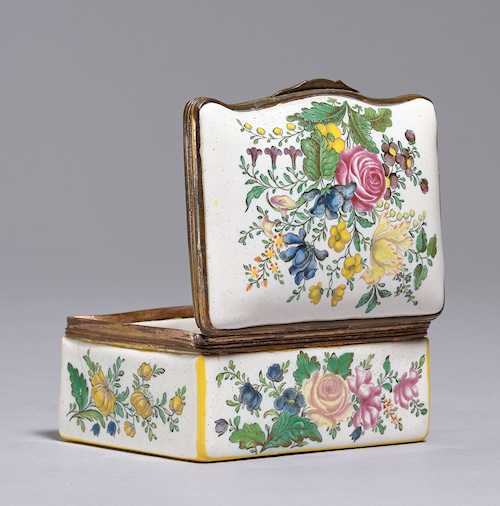
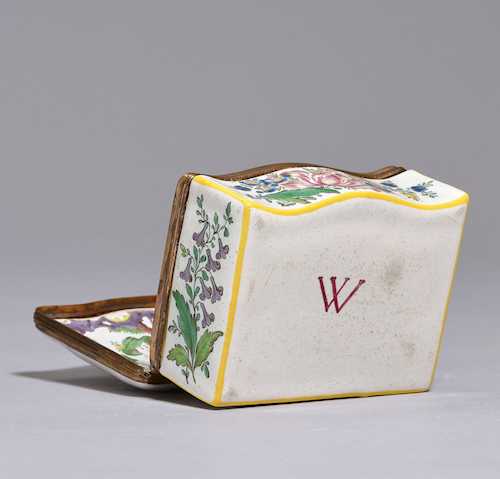
Faience decorated in overglaze enamels. Rectangular form with a shaped front and domed cover. Painted with floral decoration and yellow-edged borders. The inside of the cover painted with a pastoral scene of a couple drinking wine in a park landscape, framed by a purple rocaille border. With gilt-copper mounts. Marked "W" in purple on the underside.
8.1 × 6.1 cm.
Hairline crack on the side.
Provenance:
- Antique Porcelain Company, London.
- Helmut Joseph Collection, Berlin.
- Peter Ducret Collection, Kilchberg; acquired from the above in 1981.
Literature:
After a print published by Johann Michael Probst in Augsburg circa 1750. The "W" mark is more likely an owner’s mark than a manufactory mark (ibid.).
The Crailsheim Manufactory (1732–1827 (?))
Crailsheim formed part of the Margraviate of Brandenburg-Ansbach, and the potter Georg Veit Weiss made the first attempts to produce faience there as early as 1715. It is not known when he received the privilege to manufacture faience, although his enterprise was described as a "Porcelain-Fabrique" in 1732/33. The factory flourished under the founder’s son, Johann Georg Weiss (1714–1769), and subsequently under his son (1738–1800). His widow married Johann Friedrich Schäfer, who continued to operate the factory until his death in 1827.
The manufactory enjoyed a widespread reputation, with markets extending as far as Hanover in one direction and Switzerland in the other. It achieved a high standard in overglaze enamel decoration, due in part to Johann Wolfgang Meyerhöffer, who came from Ansbach in 1740. Among the factory’s finest products are the wares of the so-called "famille jaune" (by analogy with the Ansbach "famille verte"), characterized by the extensive use of yellow tones and decoration often resembling that of Ansbach.
CHF 1 500 / 2 500 | (€ 1 550 / 2 580)
Sold for CHF 1 875 (including buyer's premium)