
TWO BROTHERS,
TWO PAINTINGS
PREVIEW OF THE OLD MASTER PAINTINGS AUCTION ON 18 SEPTEMBER 2026
Pieter Brueghel the Younger and his younger brother Jan Brueghel the Elder belonged to one of the most important artistic dynasties in early 17th-century Flanders. Each followed their own path in the footsteps of their celebrated father, Pieter Brueghel the Elder (ca. 1525/30–1569), whose work represents one of the high points of Flemish painting. Pieter Brueghel the Younger remained closely engaged with his father’s subjects and style, carrying forward his artistic innovations and establishing his own reputation through new versions of his compositions. Jan Brueghel the Elder, on the other hand, soon moved away from his father’s example and developed a distinctive, finely detailed style of his own. By the end of his long and prolific career, he ranked among Antwerp’s foremost painters of cabinet pictures.
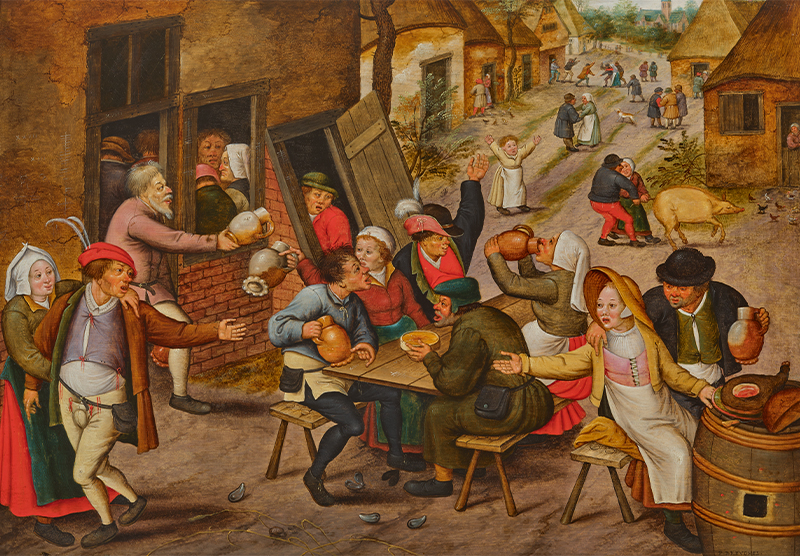
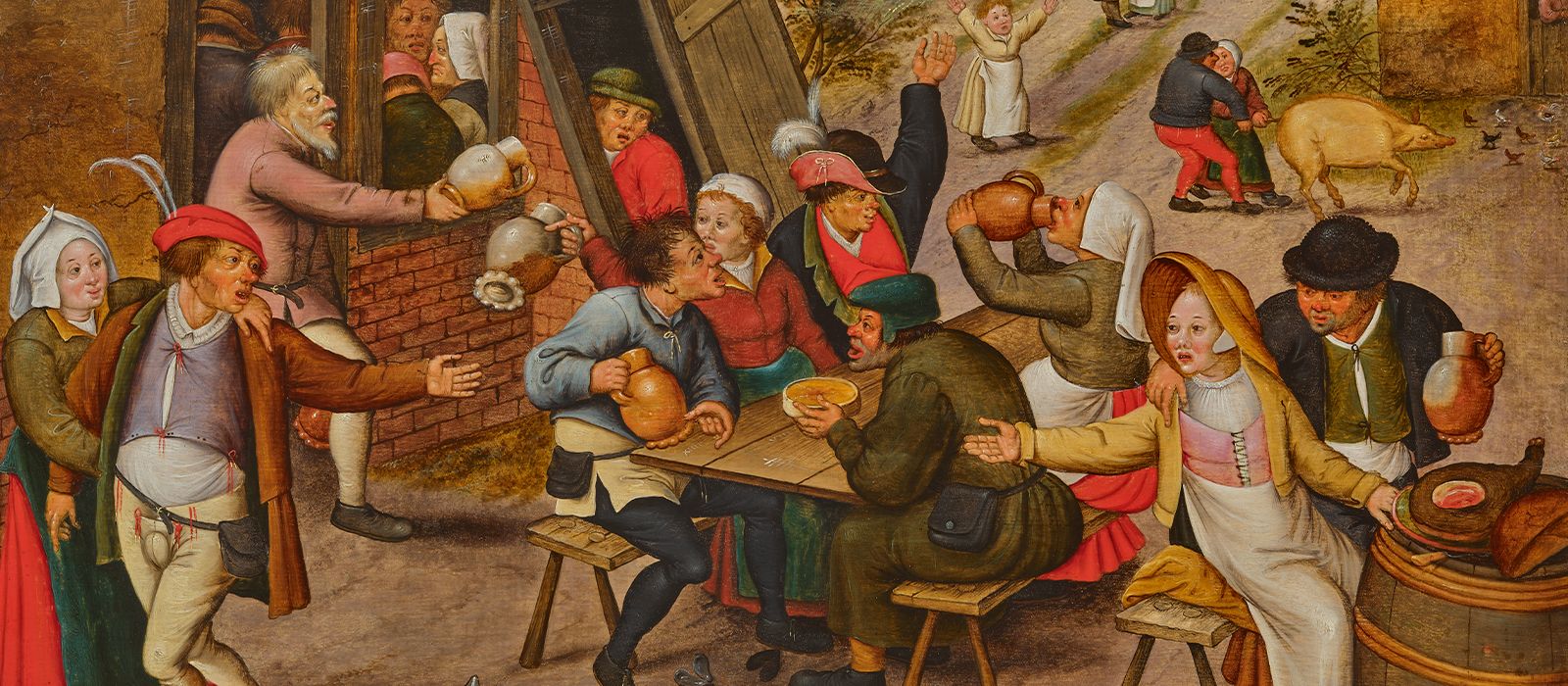
PIETER
BRUEGHEL THE YOUNGER
The Swan Inn, ca. 1626
Oil on panel, 44 × 62.8 cm
Estimate: CHF 600 000/900 000
Pieter Brueghel the Younger’s village festival, painted circa 1626 and set in and around the Swan Inn, is a wonderfully vivid piece of storytelling. A wealth of small, brilliantly observed episodes captures the exuberant mood of the festivities: everyone has dressed for the occasion, the drink is flowing, arguments break out and even a pig makes its escape. Particularly striking is Brueghel’s exuberant use of colour, above all in the figures’ clothing. Set against a village rendered in varied shades of brown, the brightly dressed revellers stand out with remarkable intensity and immediately draw the eye.
Alongside the artist’s signature – he used the spelling ‘Breughel’ from 1616 onwards – an important clue to painting’s origins is provided by the panel maker’s mark on the reverse: that of Michiel Vrient (1615–1637), who was admitted as a master to the Antwerp panel makers’ guild in 1615.

Jan Brueghel the Elder’s landscape with travellers can be dated with far greater precision: the artist not only signed the painting but also dated it 1606. The composition belongs to a small group of paintings in which figures are shown within idealised landscapes. In the work on copper offered in our September auction, people from different levels of society cross paths, and Brueghel’s extraordinary gift for rendering the finest details is on full display. As with his brother’s painting, a maker’s mark on the support provides further insight into the work’s creation. Copper panels made by Peter Staas (1565–1616) were among the finest available to painters in Antwerp at the time.
JAN
BRUEGHEL THE ELDER
The road to market, 1606
Oil on copper, 29.5 × 44 cm
Estimate: CHF 350 000/500 000
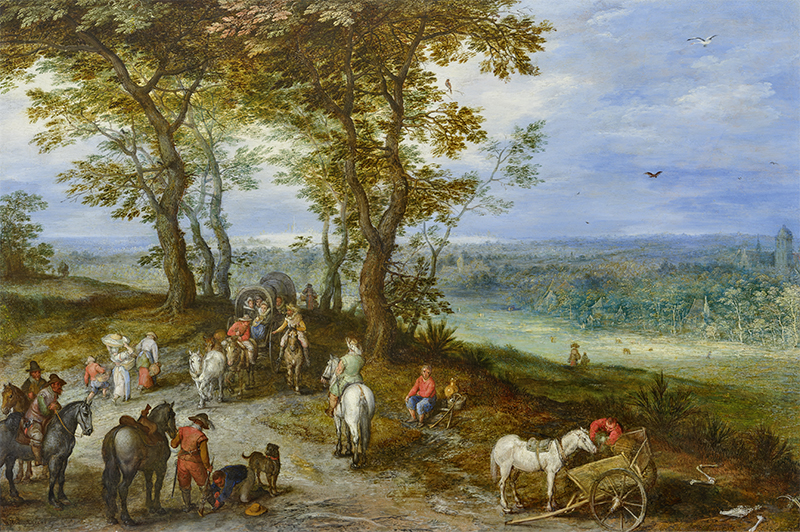
JAN
BRUEGHEL THE ELDER
The road to market, 1606
Oil on copper, 29.5 × 44 cm
Estimate: CHF 350 000/500 000
Both brothers were members of the Antwerp Guild of St Luke, and their paintings were highly sought after by wealthy collectors. Pieter carried on his father’s legacy and, with a large body of work, appealed to a comparatively broad market. Jan, meanwhile, absorbed new influences, particularly during a journey to Italy. Many of the buyers of his exclusive and costly paintings, which included landscapes and flower pieces as well as mythological scenes and allegories, belonged to the European aristocracy. Today, works by both brothers can be found in many of the world’s greatest collections, from the Hermitage in St Petersburg to the Prado in Madrid, and from the National Gallery in London to the Metropolitan Museum of Art in New York.


CONTACT FOR
ENQUIRIES AND
CONSIGNMENTS:
KAROLINE WESER
Head of DepartmentOld Master Paintings
weser@kollerauktionen.com
+41 44 445 63 35