
Lot 857* - A207 Out of This World - lundi, 04. décembre 2023, 16h00
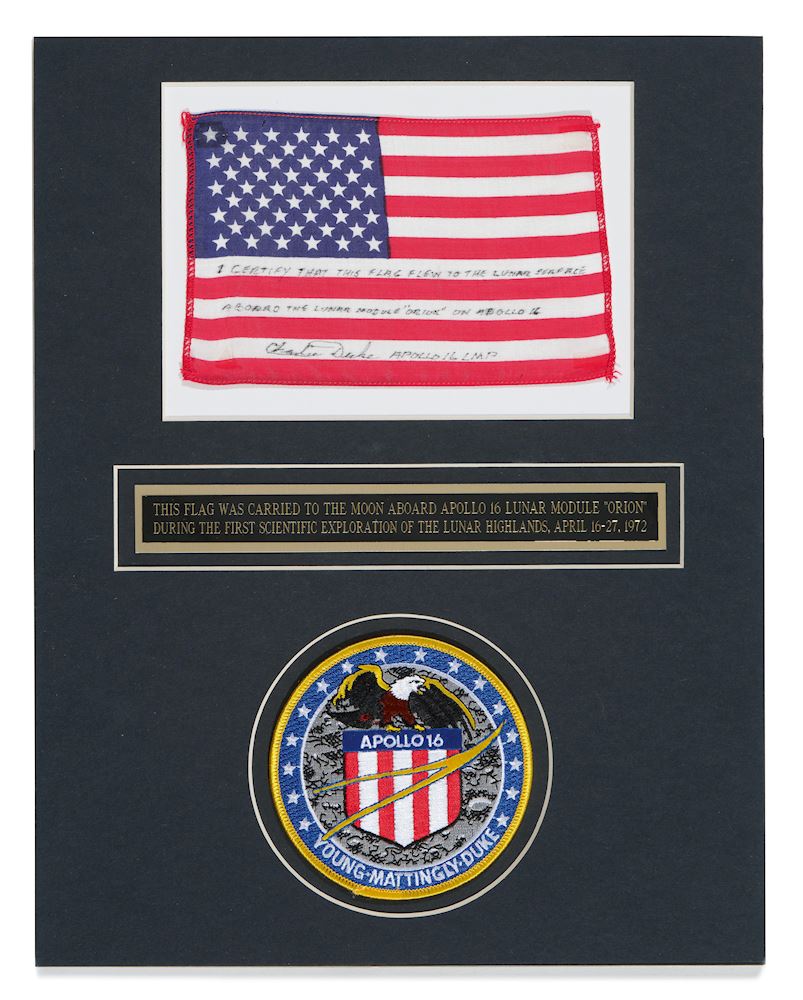
APOLLO 16 LUNAR SURFACE-FLOWN US FLAG
U.S. flag, moon-flown
Florida, USA
1972
Textile
10 × 15 cm
Florida, USA
1972
Textile
10 × 15 cm
Provenance: German private collection
‘Carry the flag into the Future as a remembrance of the Apollo Era. May it serve as a symbol to remind future generations that, God willing, there is no goal or dream that is impossible to achieve, or as Rene Descartes says: “There is nothing so far removed from us that we cannot reach it, or so hidden that we cannot discover it.”’–Charlie Duke
America in the 1960s was a nation with one common goal, bringing the first men to the surface of the moon. This so called ‘space race’ played a significant part in the Cold War as the Americans and Soviets competed to prove their technological and intellectual superiority by becoming the first nation to travel into space. From start to finish, this contest captivated the world press, as well as the general public. Therefore, American space travel was never only about scientific fascination, but also an act of patriotism.
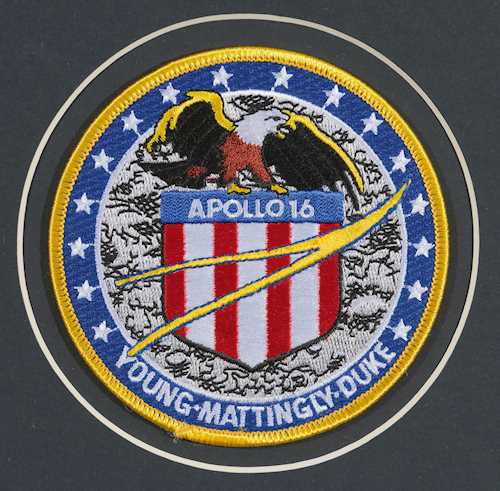
Apollo 16 was the tenth crewed mission in the United States Apollo space program and the fifth, second to last, to land on the moon. It was the second of Apollo’s ‘J missions’, with an extended stay on the lunar surface, focusing on science, and using the Lunar Roving Vehicle. The mission was crewed by Commander John Young, Lunar Module Pilot Charles Duke and Command Module Pilot Ken Mattingly. Apollo 16 launched from the Kennedy Space Center in Florida on 16 April 1972.
After flying the lunar module to the moon's surface on 21 April, Young and Duke spent 71 hours on the lunar surface, during which they conducted three extravehicular activities or moonwalks. Apollo 16 returned safely to Earth on 27 April 1972.
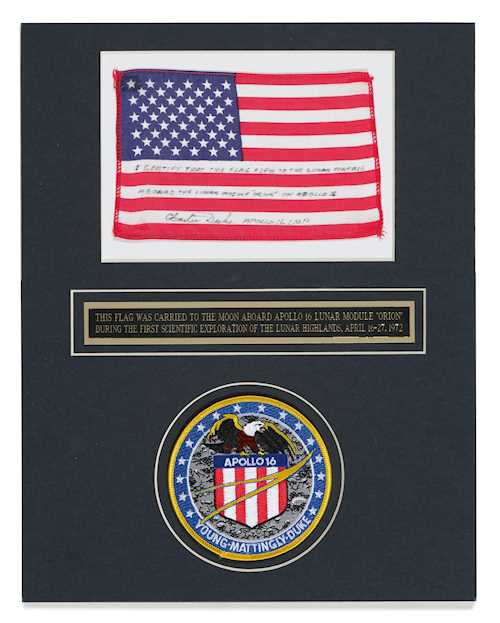
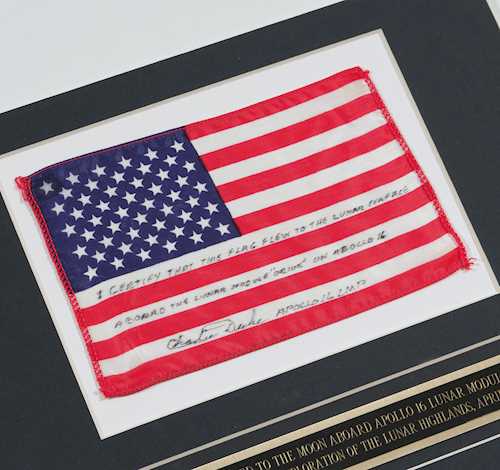
On 21 April 1972, the American flag presented here was carried to the surface of the moon with the Apollo 16 mission, on board the Lunar Module Orion by its pilot Charlie Duke. It is in fantastic condition, signed by Duke himself, is framed and comes with a COA from Space Authentications Zarelli.
CHF 8 000 / 12 000 | (€ 8 250 / 12 370)
Vendu pour CHF 15 000 (frais inclus)