
Lot 1244 - A212 Decorative Arts - jeudi, 27. mars 2025, 13h30
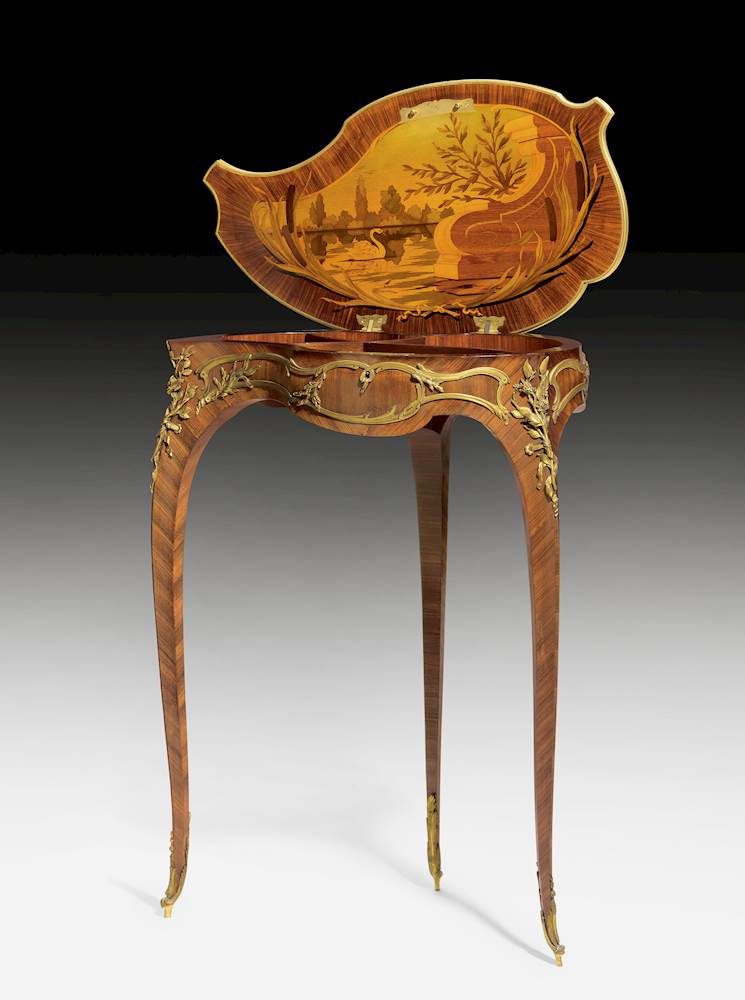
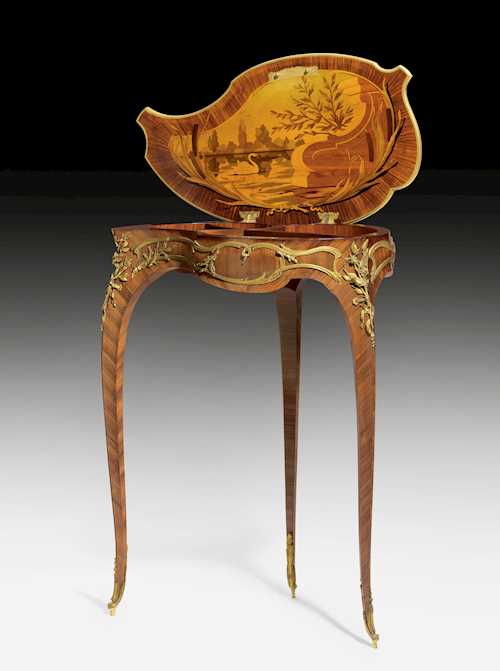
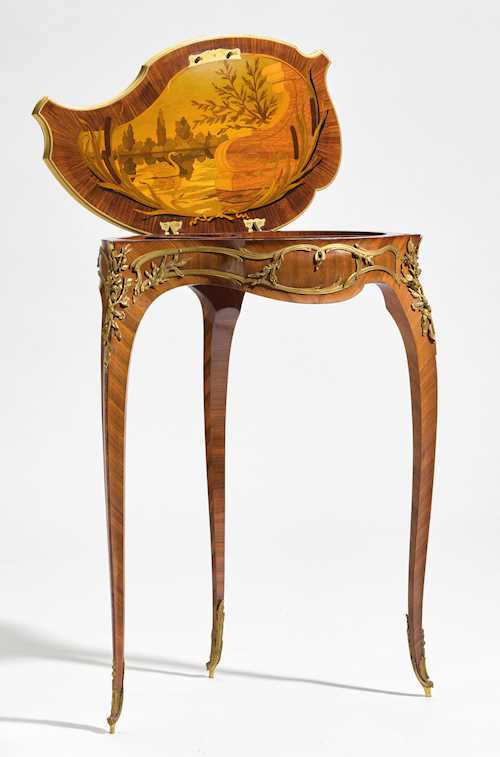
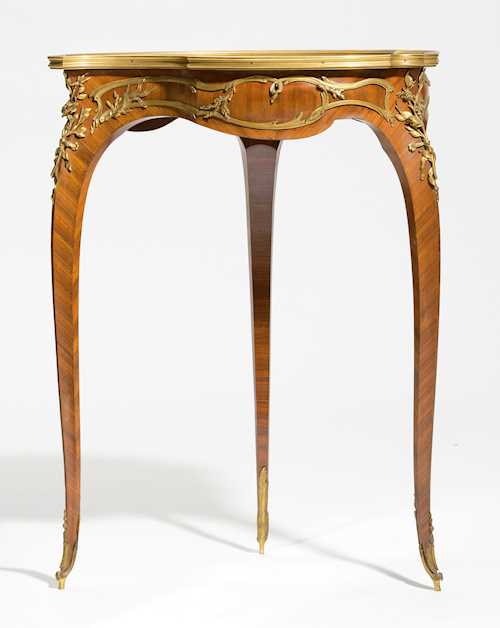
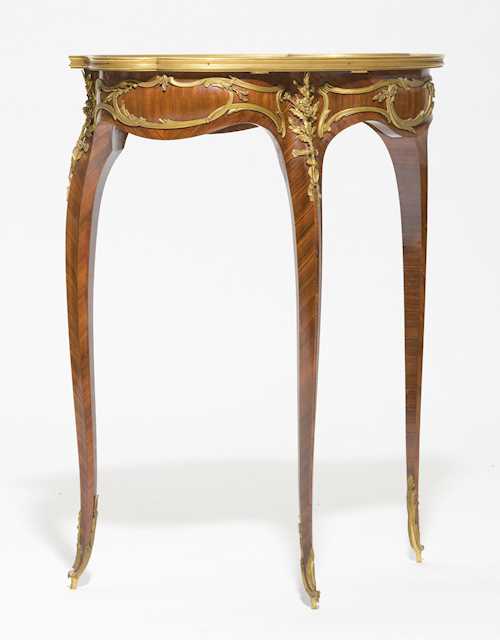
SIDE TABLE, SO-CALLED “TABLE À OUVRAGE”
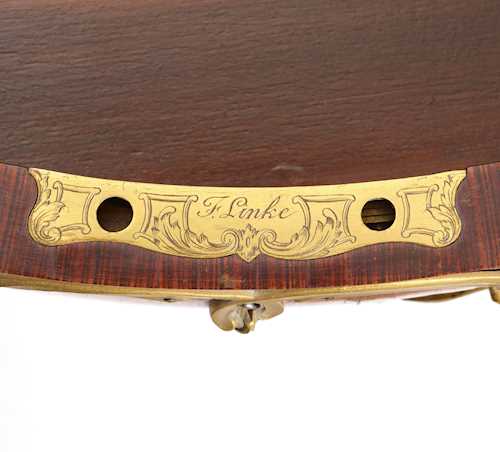
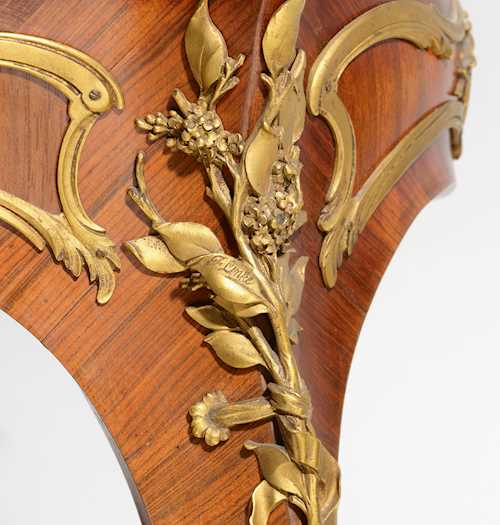
By François Linke (1855–1946). Paris, 1900–1907. Signed F. Linke on the lock and on a bronze.
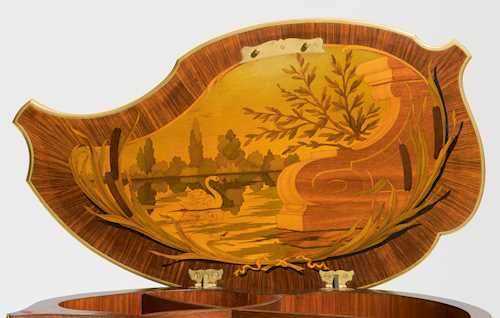
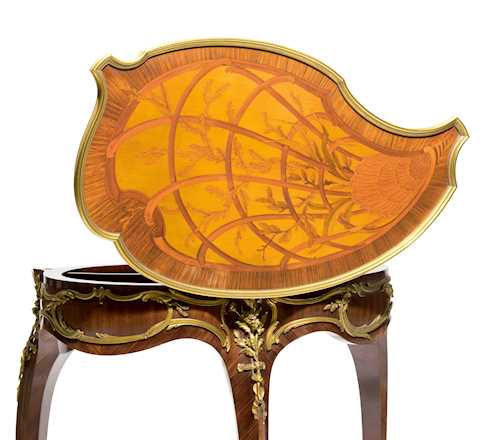
Purpleheart, satinwood, beech and other woods, in part stained, inlaid in opulently curved reserves and fillets. The leaf intricately inlaid in the shape of a shell, branchwork and lattice. The inside inlaid with a park landscape, a swan floating on the water, reeds and architectural elements. The cut-out leaf edged with a brass gallery mounted on a cut-out frame with three curved sabre legs with sabots. The leaf opening onto a compartment with curved sub-compartments (supplemented). Gilt bronze applications designed as flowers, leaves and scrolls. Finely engraved and signed lock plate. 1 key.
55 × 33.5 × 74.5 cm.
Provenance:
- Swiss private collection, acquired from the estate of the above.
Literature:
In good restored condition. Some of the wood has faded. The compartment divisions have probably been replaced. The bronzes are slightly tarnished.
Few pieces of furniture illustrate the stylistic elements of the Belle Époque as well as this delicate side table by François Linke. The Parisian luxury furniture maker ingeniously combines traditional stylistic elements of Louis XV with the new formal and decorative language of the emerging Art Nouveau. The elaborate and detailed marquetry work on the table top and the inside is particularly masterful. In typical Art Nouveau style, basic geometric patterns combine with organic, natural forms, as is the case with the shell marquetry on the table top. Fauchon and Béranger, who worked for the company from around 1900 to 1920, were responsible for the marquetry. This side table is a prime example of the division of labor and the collaboration of a wide range of specialists in François Linke's workshop. In his monograph on Linke Drouin, Christopher Payne mentions the involvement of Valadier, Champagne and Goujon in the high-quality bronze applications; Komarek, Finck, Marseiller and Toulang, on the other hand, were responsible for the wooden construction of the little table (Christopher Payne: François Linke. The Belle Epoque of French Furniture. England 2003, p. 138). Even the so-called “piqués”, the engraving templates for the inlay makers, were discovered by Payne. They were in the possession of the Immauville family in Paris and show the high complexity of the inlay pattern (ibid. appendix, p. 377).
Christopher Payne's monograph on Linke also tells us that the piece of furniture known as the “table à ouvrage” with the index no. 554 sold well at the 1900 Paris World's Fair. The model was so popular that Linke produced at least 21 copies between 1900 and 1939. We also find an important clue for dating the table on offer in Linke's register, since in 1907 the production costs were reduced from the original 860 francs to 587.80 (ibid. p. 138). The reason for this was that the swan marquetry was no longer used from 1907. Based on the swan marquetry on the table on offer, we can assume that it was produced between 1900 and 1907.
Tables of the same model have been sold at the following auctions, among others, for very high prices:
- Auction Artcurial Paris, 12/15/2009, Lot 146.
- Auction Sotheby's Paris, 4/9/2019, Lot 177 (directly from the estate of François Linke).
- Auction Sotheby's Paris, 6/25/2019, Lot 30.
- Auction Sotheby's Paris, November 19, 2020, Lot 178.
CHF 28 000 / 38 000 | (€ 28 870 / 39 180)
Vendu pour CHF 35 000 (frais inclus)