

Lot 1175 - A210 Decorative Arts - jeudi, 19. septembre 2024, 14h00
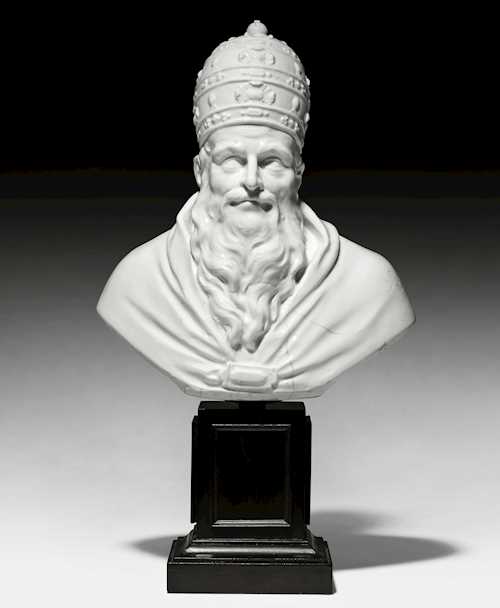
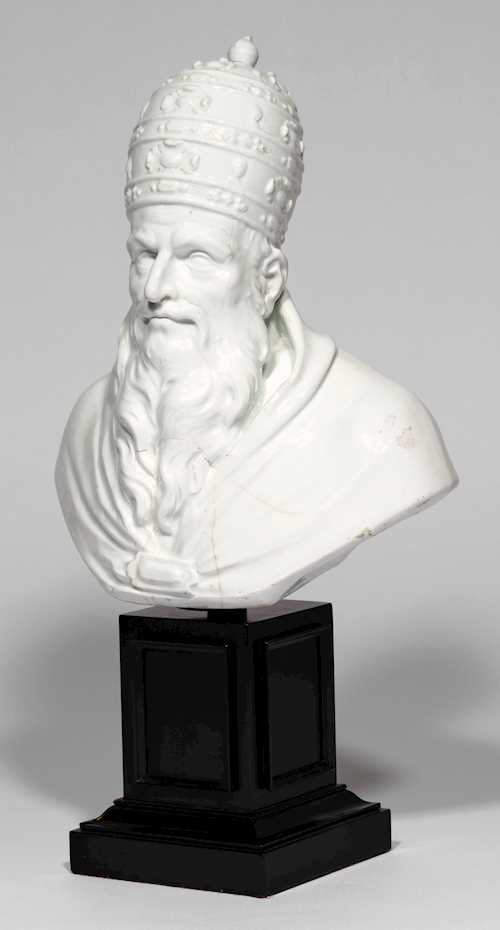
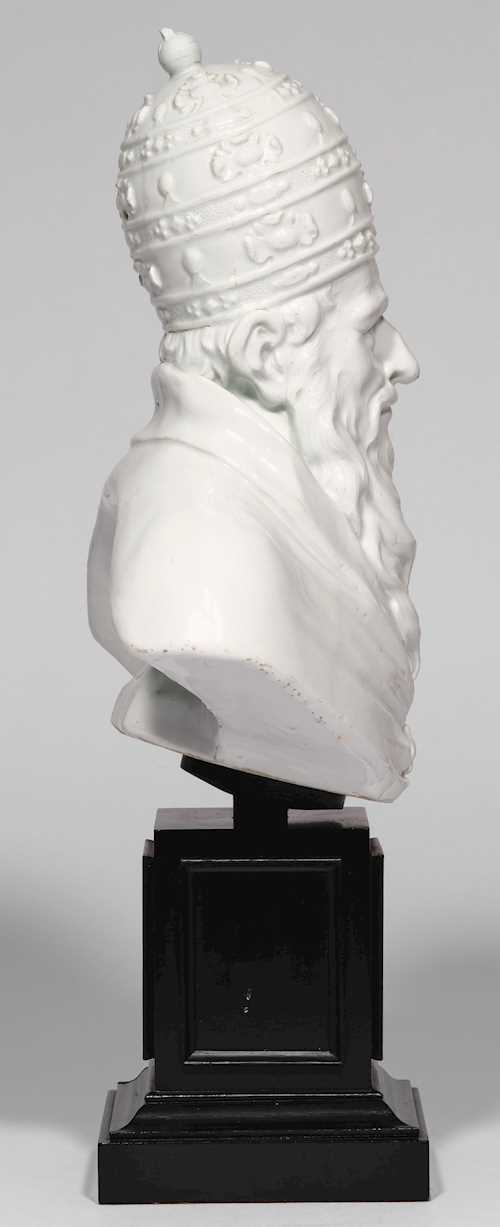
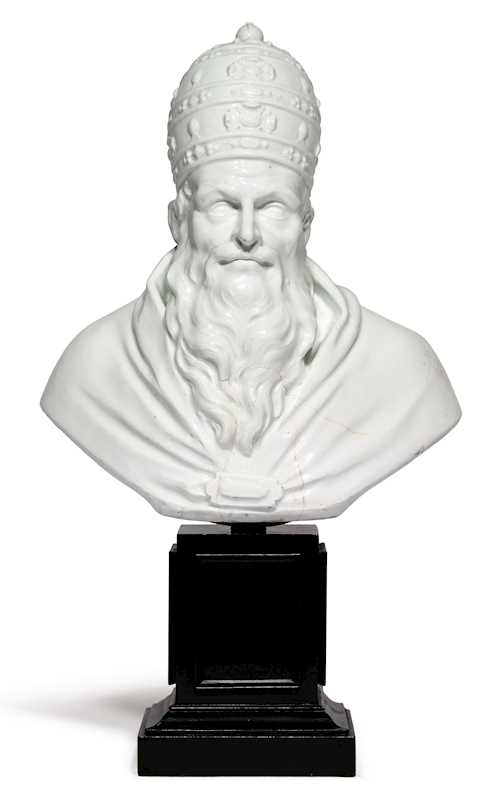
A BUST OF HIS HOLINESS POPE PIUS V. (1504-1572)
Meissen, ca. 1743, model by J. J. Kändler and J. F. Eberlein.
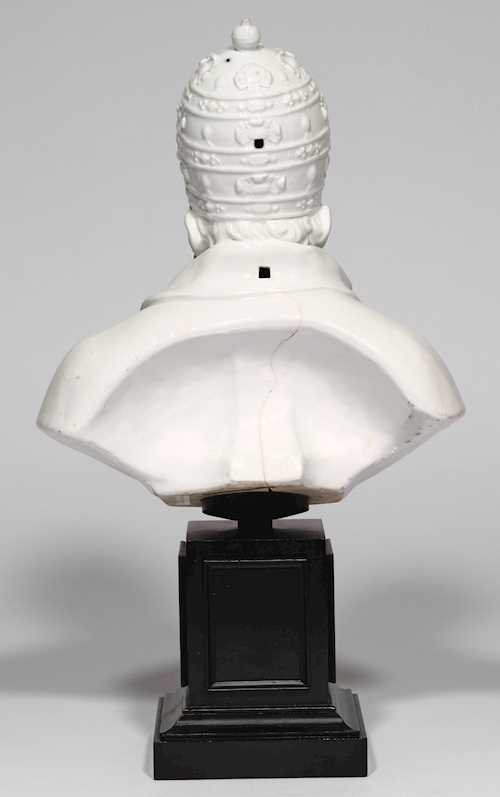
Unpainted bust of the pontiff wearing a papal tiara and a cassock, held together by a brooch in the front of his chest. Pierced twice on the back, mounted on a wooden base. Traces of a blue sword mark on the unglazed underside, impressed numeral.
H 35 cm (53 cm).
tip of cross on the tiara chipped, firing- and hairlinecracks
Provenance:
Private collection, Lugano.
Comparable objects: Dresden State Art Collections, the Porcelain Collection Inv. No. PE 392; Museum Dixon Gallery and Gardens Memphis, USA (Cassidy-Geiger, Fragile Diplomacy, 2007, p. 235 Fig.10-55b); Sotheby's, Fine British and European Ceramics and Glass, 15 July 2004, Lot No. 31.
The model on offer was made in 1743-44 together with a series of papal busts commissioned by Cardinal Annibale Albani (1682-1751). (Zimmermann, Meissner Porzellan, Leipzig 1926, p. 175, fig. 50, Dresden Museum of Applied Arts).
Pope Pius V (reigned from 1566 to 1572) was considered a pious ascetic and distinguished himself as an exemplary reformer of the clerical administration. Pope Clement XI Albani, who sought to strengthen the piety of the church during his pontificate, therefore canonized him in 1712. For the execution of the commission, the model master craftsman Kändler was assisted by Johann Friedrich Eberlein, who in his work report for February and March 1743 described the work on the “Brust-bild von dem heil. Papst Pio ¾ Ellen hoch, vor den Cardinal Albani” (Pietsch, Die figürliche Meißner Porzellanplastik von Gottlieb Kirchner und Johann Joachim Kaendler, Porzellansammlung Staatliche Kunstsammlungen Dresden, 2006, p. 114).
The Albani collections of Antiquities were among the most important of the 18th century and, with their sales, which are documented as early as the 1720s, formed the basis for the establishment of the great European museums, including the Capitoline Museums in Rome. Under Cardinal Allessandro Albani, a patron of the arts of the time, ca. 30 sculptures were also sold in 1728 to Augustus II. King of Poland, Elector of Saxony for his collection in Dresden - relations with Rome were close due to the Saxon Elector's conversion to Catholicism as a candidate for the Polish throne. This was to remain the case after his son August II, born Protestant, converted to Catholicism in 1712 and married Maria Josepha of Austria, and thus into the highly Catholic Habsburg dynasty in 1719. (Clarke, Die Römische Bestellung - Die Meissener Altar Garnitur, die August III. dem Kardinal Annibale Albani im Jahr 1736 geschenken, Keramos 86/1979, p. 12, p. 49 Annotation 18).
CHF 10 000 / 15 000 | (€ 10 310 / 15 460)
Vendu pour CHF 12 500 (frais inclus)