

Lot 3645 - A217 Estampes & Multiples - jeudi, 25. juin 2026, 10h00
ANDY WARHOL
(Pittsburgh 1928–1987 New York City)
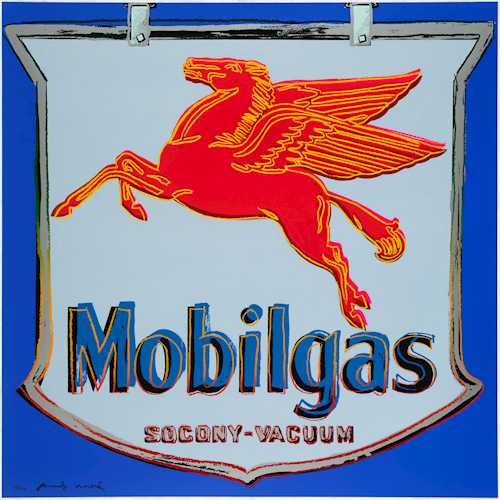
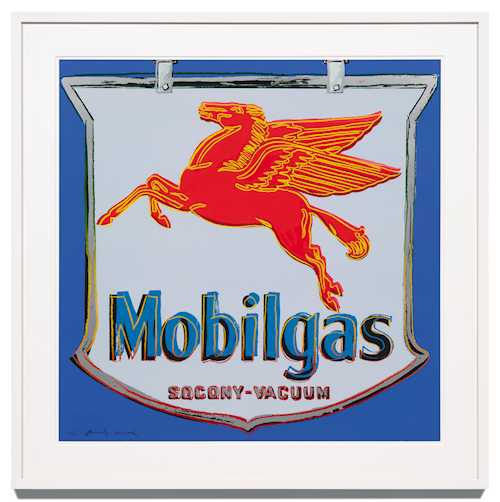
Mobil, 1985
Sérigraphie couleurs, 169/190
Edition Ronald Feldman Fine Arts, Inc., New York City. Impression Rupert Jasen Smith, New York City
Issu du portfolio "Ads"
96,3 × 96,3 cm
Edition Ronald Feldman Fine Arts, Inc., New York City. Impression Rupert Jasen Smith, New York City
Issu du portfolio "Ads"
96,3 × 96,3 cm
Provenance:
- Halcyon Gallery, London (with gallery certificate).
- Private collection, Switzerland, acquired in the above gallery 2013 acquired.
Catalogue raisonné:
Andy Warhol, even before becoming a central figure of Pop Art in the 1960s, was already working as a successful commercial illustrator in New York City. With the series ‘Ads’, one of his late bodies of work, he returns to the visual codes that profoundly shaped his artistic trajectory. Starting from prominent image signs of 20th-century advertising culture – ranging from Chanel to Apple Inc. and Mobil – Warhol compellingly demonstrates the extent to which brand imagery has inscribed itself into the collective visual memory.
Whereas in earlier works he elevated everyday objects through artistic transformation into near-iconic motifs, as exemplified by the Campbell’s Soup Cans, in ‘Ads’ he instead draws on mass-media-established and already widely circulating visual formulas. The colour silkscreen ‘Mobil’ is one of the most striking examples of this strategy.
At the centre of the composition stands the Pegasus emblem of the oil company: the ascending winged horse that, towards the end of the 20th century, was virtually omnipresent in public space. Whether at petrol stations, on billboards or in print media – the red Pegasus constantly reappears, embedding itself in everyday visual culture through repetition.
Through Warhol’s artistic intervention, the sign is lifted out of its primarily functional role as an advertising logo and presented as an autonomous image. At the same time, it remains situated within a productive tension between mythological origin and modern brand aesthetics: while in ancient Greek mythology it symbolises inspiration, speed and intellectual elevation, within consumer culture the winged horse functions as a carrier of associations such as energy, mobility and technological progress. In this semantic shift, the logo becomes readable as a culturally coded sign. Warhol reveals the extent to which visual formulas structure our perception: the familiar Mobil Pegasus emblem functions as a kind of visual shorthand, condensing complex meanings into immediate readability.
Art-historical approaches, particularly the concept of the ‘pathos formula’ coined by Aby Warburg, can be productively applied to Warhol’s approach. What Warburg describes as recurring expressive forms that transmit emotional intensity across historical periods finds a contemporary counterpart in Warhol’s chosen image signs. In this sense, the Pegasus can be understood as a modern pathos formula: a visual condensation that mediates between ancient pictorial tradition and contemporary consumer culture, bundling collective imaginaries into a concise form.
‘Mobil’ thus proves to be not merely an artistic appropriation of an advertising emblem, but a sophisticated reflection on the circulation, transformation and efficacy of images in the 20th century. Warhol makes visible how meaning is constituted, shifted and recoded within the tension between myth, brand and media reproduction – and how a widely circulated corporate logo can assume the status of a culturally charged image sign.
CHF 40 000 / 60 000 | (€ 41 240 / 61 860)
Vendu pour CHF 68 750 (frais inclus)