


Lot 3221 - A217 Art Impressionniste & Moderne - vendredi, 26. juin 2026, 16h30
CLAUDE MONET
(Paris 1840–1926 Giverny)
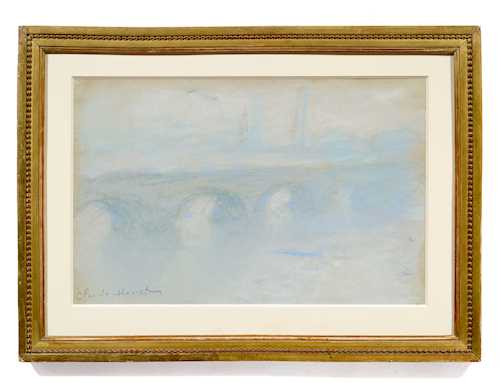
Waterloo Bridge, 1900/01
Pastel sur papier
Signé en bas à gauche : Claude Monet
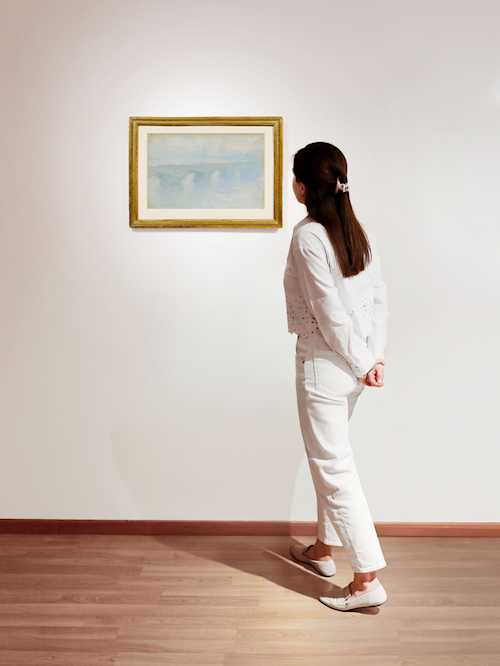
31,7 × 48,3 cm
Provenance:
- Lucas Lichtenhahn, Bâle, acquis en 1949 directement auprès de ce dernier
- Collection privée, Suisse, acquis le 14.8.1956 auprès de ce dernier et transmis par héritage aux propriétaires actuels
Exhibited:
Literature:
- Wildenstein Plattner Institute: Claude Monet. The Revised Catalogue Raisonné. The Pastels, no. CMIUDV P97 (online catalogue raisonné: https://digitalprojects.wpi.art/monet/artworks/detail?a=75612-waterloo-bridge).
Claude Monet first visited London in the winter of 1870/71 to escape the Franco-Prussian War in France. He was immediately taken with the city, yet it would be another 30 years before he returned. On September 15, 1899, Monet arrived in the British capital with his wife and stepdaughter. The trip served both to visit his son Michel, who was in London for a language course, and to realize a long-cherished plan: the creation of a series of paintings of the royal city. Monet returned again in the following two years to work on his famous "Vues de Londres".
During each of these stays, Monet lodged on the fifth floor of the elegant Savoy Hotel, situated on the banks of the Thames between Waterloo Bridge and Charing Cross Bridge, with a view of the Houses of Parliament. Inspired by this privileged vantage point, Monet set up an entire room in his suite as a studio. The London series would become his most extensive body of work, comprising over 100 paintings. The majority of these works focus on the three principal motifs mentioned above. For the two bridge subjects, Monet painted directly from his hotel room, either in his studio or "en plein air" on the balcony. He developed his own rhythm by painting the same view often at the same time of day: Waterloo Bridge facing east in the morning, Charing Cross Bridge facing south in the late morning and afternoon, and the Houses of Parliament—requiring him to leave the hotel—in the late afternoon.
In both painting and pastel, Monet devoted himself most intensively to Waterloo Bridge. Especially during his stay in 1900, but also at the end of 1901, he focused almost exclusively on this motif. In total, he produced 40 paintings and 16 pastels of the bridge, opened in 1817, which connects the affluent city center with the industrial factories and shipyards on the south bank, offering Monet a dynamic compositional subject filled with the vibrant life of the metropolis.
"Waterloo Bridge" is a wonderful example of the fleeting pastel works Monet created to capture specific light conditions directly. Because of the constantly changing light, it was impossible for him to work on a canvas for more than a few minutes, which is why he often completed his London paintings later at home in Giverny. The pastels, by contrast, are immediate impressions of a particular atmosphere that Monet sought to preserve in order to translate them into paintings later on. In these views, he focused strongly on the architecture of the bridge in combination with the light conditions over the river. The deep, dark arches, the massive stone piers, and the factory chimneys and warehouses rising behind the bridge seem to have particularly fascinated him. Yet the true protagonist of the image is the fog.
Monet once said to the art dealer René Gimpel: "I love London! But I love it only in winter; without the fog, London would not be a beautiful city. It is the fog that gives it its magnificent breadth. Its uniform, massive blocks become grand in this mysterious veil." (Monet, quoted in Gimpel, Diary of an Art Dealer, 1966).
This atmosphere is beautifully conveyed in the present pastel: the various shades of blue and white merge into a powdery unity, evoking the moist, dense air of a foggy morning. The blue veil envelops the bridge, the buildings rising behind it, and even the boat in the foreground, gently gliding along the Thames. Monet proves himself a master of such effects and succeeds, like few others, in capturing this distinctive Impressionist essence.
Most of the 16 London pastels were either sold or given away by the artist. Some are now held in major museum collections, such as the Kunst Museum Winterthur (Hahnloser/Jaeggli Foundation), the National Gallery of Art in Washington and the Musée d’Orsay in Paris. Only a few remained in the possession of the artist’s family, including the present work, which came directly from Michel Monet’s collection to Switzerland and is now being offered on the market for the first time.
CHF 350 000 / 450 000 | (€ 360 820 / 463 920)
Vendu pour CHF 1 061 200 (frais inclus)