
Lot 3464* - A217 Post-War & Contemporary - jeudi, 25. juin 2026, 15h00
DAN FLAVIN
(1933 New York City 1996)
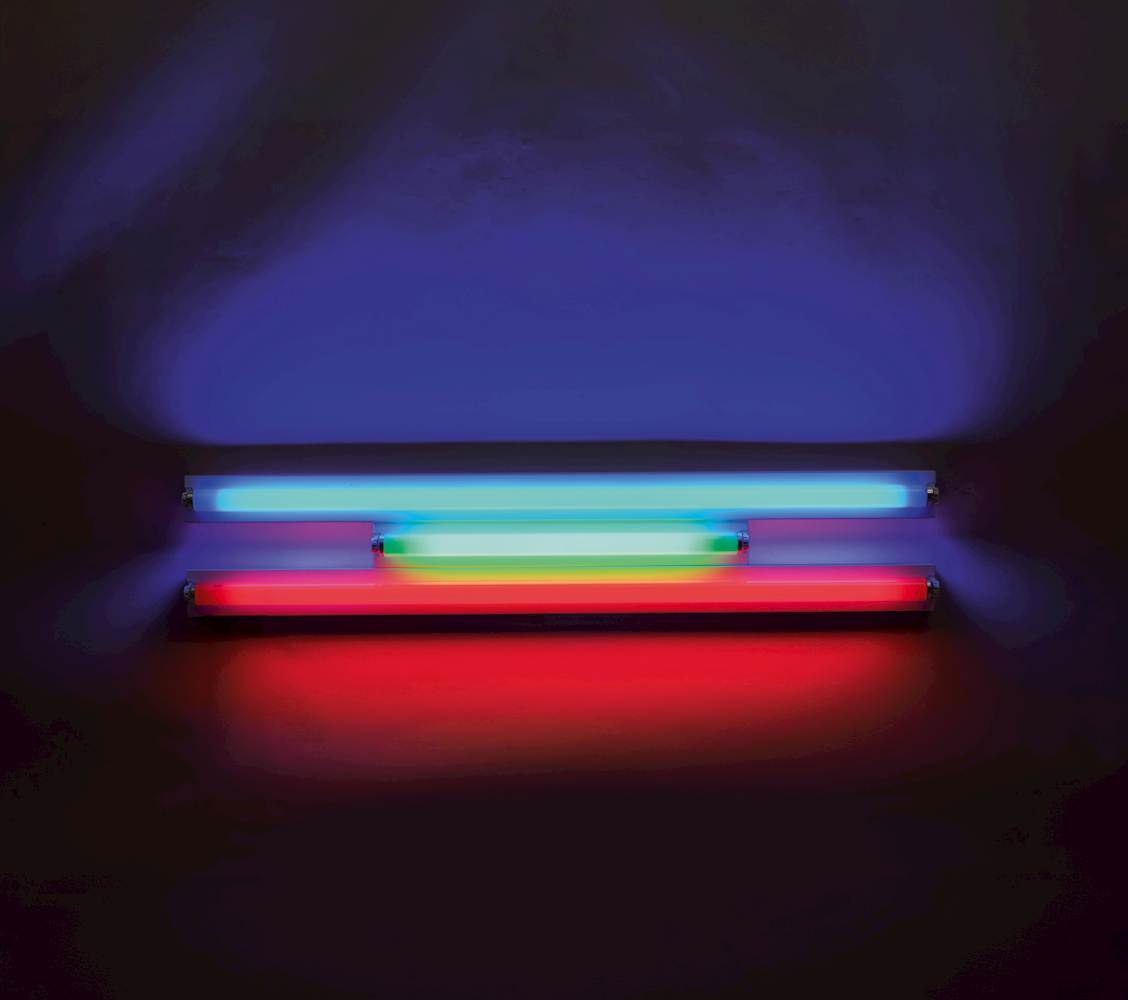
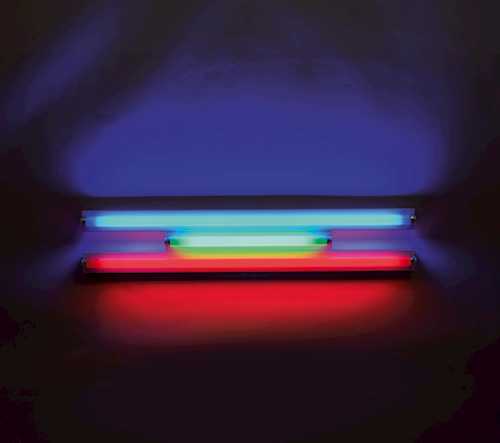
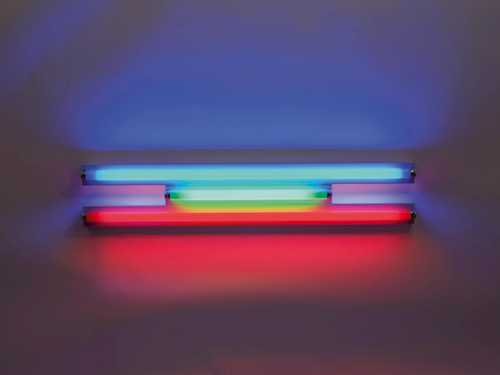
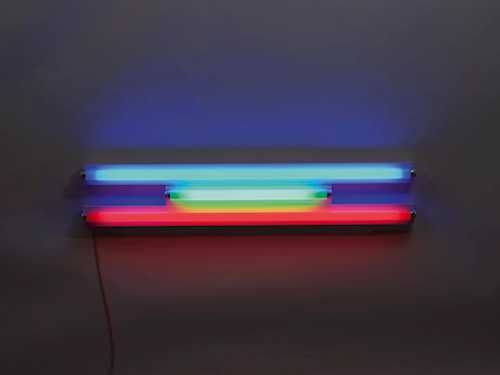
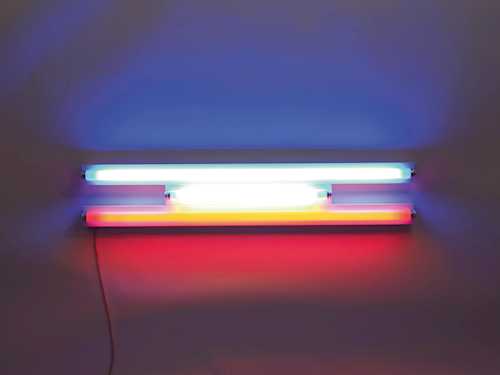
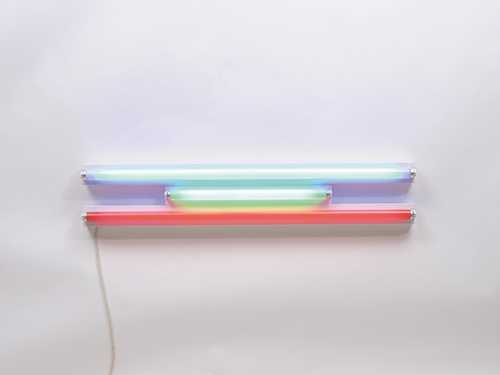
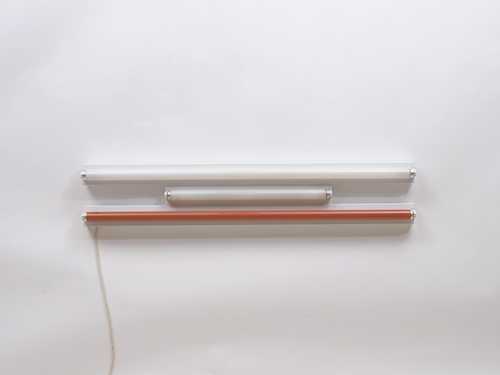
Untitled. 1995.
Blue, green and red fluorescent light tube. 3/5.
Signed on the artist’s certificate: Dan Flavin.
23 × 122 cm × 9.5 cm.
Certificate:
Provenance:
- Private collection Germany, acquired directly from the artist in 1995.
Exhibited:
- London 1996, Dan Flavin: New Works, Karsten Schubert Gallery, 21 June–3 August 1996.
- Rio de Janeiro 1998, Dan Flavin, Centro Cultural Light, 14 May–5 July 1998. Cat. p. 9, p. 13 (each with ill.).
- London 2000, John Chamberlain. Dan Flavin. Donald Judd, Bernard Jacobson Gallery, 3 March–1 April 2000.
Literature:
- Richard Kalina: In another light, in: Art in America 84, no. 6, June 1996, p. 70 (with ill.).
When Dan Flavin mounted a commercially available fluorescent tube at a 45-degree angle on the wall of his studio in 1963 – and promptly declared it art – it was a radical gesture. Today, he is regarded as one of the key representatives of Minimal Art, which revolutionised the post-war art world. His redefinition of sculpture, the dissolution of boundaries between artwork, space and viewer, and the establishment of light as an independent, immaterial medium make him a pioneer of a new artistic movement that sought expression beyond traditional means.
From the early 1960s onwards, Flavin worked with fluorescent tubes, initially arranging them in so-called ‘situations’ and later developing them into series and large-scale spatial installations. The colours and material properties were determined by industrial production. Through the light, viewers themselves become part of the work: space and the objects within it enter into relation with one another and merge into immersive experiences. In this way, Flavin liberated colour from the two-dimensionality of painting, extending it into space and enabling a poetic, almost spiritual experience arising from the ‘asceticism’ of industrial form.
‘Untitled’ (1995) belongs to a group of works that consistently address a central issue of post-war art: the erasure of an individual hand, of a characteristic painterly gesture, through the replacement of traditional artistic media with industrially produced materials. This decision must be understood in the context of an artistic generation that, in parallel with Donald Judd, Robert Morris and Carl Andre, turned against the expressive subjectivity of Abstract Expressionism in favour of objectivity, seriality and material fact.
Flavin himself formulated this position succinctly: ‘It is what it is and it ain’t nothing else’. This often-quoted statement underlines his rejection of metaphorical or illusionistic readings. The materials used – standardised fluorescent tubes in predetermined colours and lengths – remain recognisable as such and are not transformed. Nevertheless, works such as ‘Untitled’ (1995) generate a complex visual situation that can be experienced holistically by the viewer. The decisive shift lies precisely here: Flavin does not simply replace the traditional artistic gesture with industrial means, but relocates the work into the realm of perception itself. The true ‘material’ is not the tube, but the light it emits. It unfolds its effect through the concrete, physically perceptible presence of light – transient, technically mediated, and yet of immediate visual intensity.
CHF 100 000 / 150 000 | (€ 103 090 / 154 640)
Vendu pour CHF 112 500 (frais inclus)