

Lot 3041 - A217 Art Suisse - vendredi, 26. juin 2026, 14h00
FERDINAND HODLER
(Berne 1853–1918 Genève)
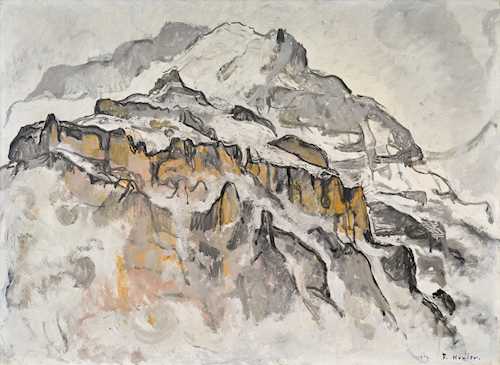
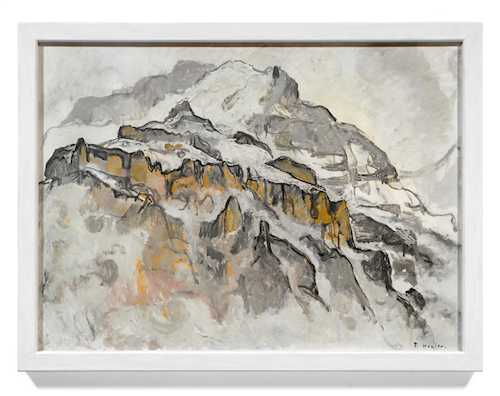
Le massif de la Jungfrau vu depuis Mürren, 1914
Huile sur toile
Daté et signé en bas à droite : 1914. F. Hodler
63 × 86 cm
Provenance:
- Galerie Römer, Zürich, 1986.
- Collection Ernst Burkhalter, Uitikon, 1986, acquis auprès de la galerie susmentionnée.
- Succession d'Ernst Burkhalter, jusqu'en 1990.
- Collection privée suisse, depuis 1994.
Exhibited:
- Karlsruhe 1925, Grosse Schweizer Kunstausstellung, Städtische Ausstellungshalle, 19 July–30 August 1925, no. 205, as 'Jungfrau im Nebel, 1914'.
- Brussels 1928, L'art suisse au Palais des Beaux-Arts de Bruxelles. Le paysage au XIXème siècle. Quelques artistes contemporains, Palais des Beaux-Arts, 1928, no. 34, as 'La Jungfrau dans le brouillard'.
- Bern 1938, Ferdinand Hodler-Gedächtnisausstellung. Veranstaltet zur Ehrung des Meisters bei Anlass der zwanzigsten Wiederkehr seines Todestages, Kunstmuseum Bern, 19 May–26 June 1938, no. 152, as 'Mettenberg und Jungfrau im Nebel, 1914' (verso with label).
- Probably Solothurn 1950, Hundert Jahre Malerei aus Solothurner Privatbesitz. Ausstellung zur Hundertjahrfeier des Solothurner Kunstvereins, Kunstmuseum Solothurn, 23 September–26 November 1950, no. 110, as 'Aufsteigender Nebel, 1914'.
- Bern 1953, Die Hauptmeister der Berner Malerei 1500–1900. Jubiläumsausstellung, Kunstmuseum Bern, 29 May–20 September 1953, no. 415, as 'Die Jungfrau mit Neuschnee von Mürren aus, 1914'.
- Cologne, Munich and Hamburg 1954, F. Hodler, Kunsthaus Lempertz, 7 July–8 August 1954; Kunstverein München, 18 August–26 September 1954; Kunstverein Hamburg, 30 September–31 October 1954; no. 66, as 'Jungfrau im Nebel, 1914' (verso with label).
- Biel 1955/56, Ferdinand Hodler 1853–1918, Städtische Galerie Biel, 17 November 1955–31 January 1956, no. 63, as 'Jungfrau mit Schwarzmönch, 1914' (verso with label).
- Zurich and Biel 1964, Ferdinand Hodler. Landschaften der Reife und Spätzeit, Kunsthaus Zürich, 22 February–5 April 1964; Städtische Galerie Biel, 17 April–24 May 1964, no. 88, as 'Schwarzmönch und Jungfrau, 1914'.
- Solothurn 1975, Schweizer Kunst in der Sammlung Josef Müller. 125 Jahre Kunstverein Solothurn, Museum der Stadt Solothurn, 15 June–7 September 1975, no. 9, as 'Schwarzmönch und Jungfrau, 1914'.
- Zurich 1986, Hodler. Ölbilder und Zeichnungen aus der Sammlung Josef Müller sowie aus Schweizer Privatbesitz, Galerie Römer, 12 June–31 July 1986, no. 45, as 'Jungfrau und Schwarzmönch im Nebel, 1914'.
- Solothurn and Frankfurt 1996/97, Freundschaft und Kunstsinn. Die ehemaligen Solothurner Ferdinand Hodler-Sammlungen, Kunstmuseum Solothurn, 15 June–22 September 1996; Schirn Kunsthalle, 2 October 1996–5 January 1997, as 'Schwarzmönch und Jungfrau, 1914'.
- Riehen 2013, Ferdinand Hodler, Fondation Beyeler, 27 January–26 May 2013, no. 55 as 'Das Jungfraumassiv von Mürren aus'.
Literature:
- Exh. cat. Grosse Schweizer Kunstausstellung, Karlsruhe 1925, p. 13, no. 205.
- Exh. cat. L'art suisse au Palais des Beaux-Arts de Bruxelles. Le paysage au XIXème siècle. Quelques artistes contemporains, Brussels 1928, p. 18, no. 34.
- Werner Y. Müller: Die Kunst Ferdinand Hodlers. Gesamtdarstellung. Reife und Spätwerk 1895–1918, Landschaftskatalog, Zurich 1941, vol. II, no. 511.
- Exh. cat. Die Hauptmeister der Berner Malerei 1500–1900. Jubiläumsausstellung, Bern 1953, p. 45, no. 415.
- Exh. cat. F. Hodler, Cologne, Munich and Hamburg 1954, p. 15, no. 66, plate XIV (illustrated).
- Exh. cat. Ferdinand Hodler 1853–1918, Biel 1955/56, no. 63.
- Max Huggler: Das Lauterbrunnental in der Malerei, Bern 1978, p. 71.
- Exh. cat. Ferdinand Hodler. Ölbilder und Zeichnungen aus der Sammlung Josef Müller sowie aus Schweizer Privatbesitz, Zurich 1986, p. 73, no. 45 (illustrated).
- Exh. cat. Max Buri und seine Zeitgenossen. Cuno Amiet. Giovanni Giacometti. Ferdinand Hodler. Edouard Vallet, Studen 2002, p. 59, no. 19 (illustrated).
- Oskar Bätschmann and Paul Müller: Ferdinand Hodler. Catalogue raisonné der Gemälde, ed. Schweizerisches Institut für Kunstwissenschaft, vol. II, Die Landschaften, Zurich 2012, vol. II-2, p. 406, no. 507 (illustrated).
- Exh. cat. Ferdinand Hodler, Riehen 2013, p. 55 (illustrated).
The present painting ranks among the most significant alpine landscapes from the late oeuvre of Ferdinand Hodler. Around 1911, and again in 1914, the artist repeatedly turned to the subject of the Jungfrau Massif and developed it in several versions into an increasingly concentrated and monumental pictorial form. Important comparative works from this group are today held in the Kunsthaus Zürich, the Kunstmuseum Bern, as well as in closely related versions in the Musée d’art et d’histoire and the Kunstmuseum Solothurn (both 1914) (cf. Figs. 1 and 2).
At the beginning of the 20th century, the mountain landscape established itself as one of the central subjects of painterly Modernism. Far more than a natural backdrop, the alpine landscape became an autonomous subject. Traditional panoramic landscape depiction increasingly gave way to a concentrated pictorial conception in which a single subject determines the entire pictorial space. Against this background, the present work appears remarkably modern.
Through a subtle shift of viewpoint and a conscious simplification of the visual structure, Ferdinand Hodler achieves a pronounced monumental frontality. The masses of rock coalesce into a rigorous equilibrium, while all anecdotal description recedes in favour of a clearly articulated pictorial structure based upon proportion, order and symmetry – central principles of the theory of Parallelism developed by the artist.
The landscape no longer appears as a topographical view, but as a consciously constructed pictorial order in which observation of nature and artistic construction become inseparably intertwined. Particularly in the late mountain paintings, this attitude leads to an extensive emancipation from the representational in favour of an autonomous pictorial reality.
At the same time, comparable developments may be observed elsewhere in Europe. While Hodler monumentalises the alpine landscape and reduces it to a rhythmic order of masses and horizontals, Georges Braque undertakes a similar deconstruction of the natural subject. In both artists, the landscape ceases to be a purely visual representation and becomes an autonomous pictorial construction revealing the enduring structures of the visible world. Although their approaches emerged within different artistic contexts, they are united by a common European endeavour to transcend immediate impression and attain an essential truth of form.
Works by Paul Cézanne may likewise come to mind in this context. Although direct influences can scarcely be proven with certainty, Hodler’s late oeuvre occupies a historical threshold: between the experience of a long artistic development and the beginnings of the avant-garde movements that would culminate in Cubism. Two epochs encounter one another here – the mature synthesis of a great solitary artist and the emergence of Modernism.
CHF 1 200 000 / 1 800 000 | (€ 1 237 110 / 1 855 670)
Vendu pour CHF 1 807 000 (frais inclus)