


Lot 3072 - A216 Tableaux de Maîtres Anciens - vendredi, 27. mars 2026, 14h00
FRANÇOIS BOUCHER
(1703 Paris 1770)
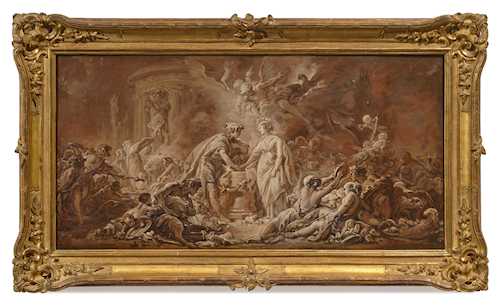
The marriage of Ariadne and Bacchus on the Island of Naxos (Grisaille).
Oil on canvas.
41 × 80.5 cm.
Provenance:
- Probably auction of collection of Jacques-Germain Soufflot, Paris, 20 November 1780, lot 13 (with the companion piece "The Triumph of Neptune and Amphitrite").
- Probably collection of Jean-Baptiste-Pierre Lebrun (1748–1813), Paris.
- Collection of Louis Watel Dehaynin (1885–1972) and Antoinette Céleste Watel-Dehaynin (née Lasson, 1890–1962), Normandy, France.
- Collection of Fanny (1917–2023) and Bernard Watel (1909–2000) after 1972, Lausanne.
- Thence by descent.
Literature:
With an art-historical analysis by Dr Françoise Joulie (18 January 2026), to whom we are grateful. Dr Joulie will include this painting in her upcoming publication on the wall tapstries of the Manufacture de Beauvais.
This exceptional painting comes from a private collection in Switzerland, where it has been in the same family for several generations, and constitutes a major rediscovery for French painting. It depicts a scene from Greek mythology with the wedding of Ariadne, daughter of King Minos, and Bacchus, the god of wine. Ariadne, abandoned by Theseus in spite of her declarations of fidelity, subsequently fell in love with Bacchus. Before an ancient temple and surrounded by a cheering crowd, the newlyweds appear as a youthful and idealised couple. Numerous motifs typical of bacchanals enrich the depiction: a satyr pours wine into a large chalice, another holds a Thyrsus rod on the left, maenads accompany the celebration with music, putti hover over the scene, and the two leopards that traditionally pull Bacchus' chariot can be made out in the right half of the picture.
François Boucher was one of the most versatile artists of the 18th century and was active as a painter, engraver, draughtsman and decorator. His virtuosity is very much in evidence in the present work. As with many of his designs, the monochrome execution in grisaille shows that Boucher first devised the composition and lighting before introducing colour. Characteristic elements of his style, such as the foreshortening, bold accentuation and simplified volumes, are clearly recognisable here. The dynamic composition of this picture points to the artist's mature creative phase around 1750.
During this period, Boucher was closely associated with the Parisian manufactory of Beauvais, which was under the protection of the king, and for which he created numerous carpet designs. Around 1747, he was commissioned to design a cycle on the loves of the gods based on ‘Ovid's Metamorphoses’ and the ‘Ars Amatoria’. One of the proposed themes was the marriage of Bacchus and Ariadne, although in the end a slightly modified design focusing on Bacchus' triumphal procession was carried out. Further evidence that Boucher was actively exploring the theme of the wedding of Ariadne and Bacchus in the years 1747–48 is his design for a fan in which the same ancient temple, the satyrs, Bacchantes and the accompanying leopards appear (see fan design with Ariadne and Bacchus, Ottawa, National Gallery of Canada, inv. no. 9071).
The research carried out by Françoise Joulie points to a remarkable provenance. A grisaille with the Triumph of Venus and Neptune of similar dimensions (48 × 89 cm) to the work offered here was sold at auction on 20 November 1780, together with its companion piece, an allegory of a wedding, from the collection of the architect Jacques-Germain Soufflot (1713–1780) (see Ananoff 1976, p. 200, no. 528). Soufflot and Boucher had a close friendship; both frequented the circle of the Marquis de Marigny, Director General of the Royal Buildings and brother of Jeanne-Antoinette Poisson (1721–1764), Marquise de Pompadour and Duchess of Ménars. It is quite conceivable that Soufflot acquired both paintings directly from the artist after he had settled permanently in Paris in 1755. At the Soufflot auction, the lot came into the possession of the art dealer Lebrun for his private collection. The two sketches subsequently parted ways: while the work discussed here was soon sold on, the Triumph of Neptune reappeared in the Lebrun auction of 1791 under no. 302 and was reacquired by his son.
CHF 200 000 / 300 000 | (€ 206 190 / 309 280)
Vendu pour CHF 275 000 (frais inclus)