

Lot 1043* ♣ - A216 Works of Art & Decorative Arts - jeudi, 26. mars 2026, 13h30
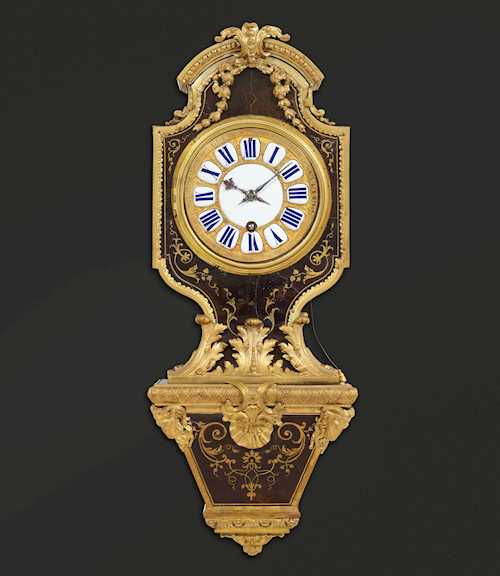
SMALL CARTEL CLOCK “D'ALCOVE” ON PLINTH
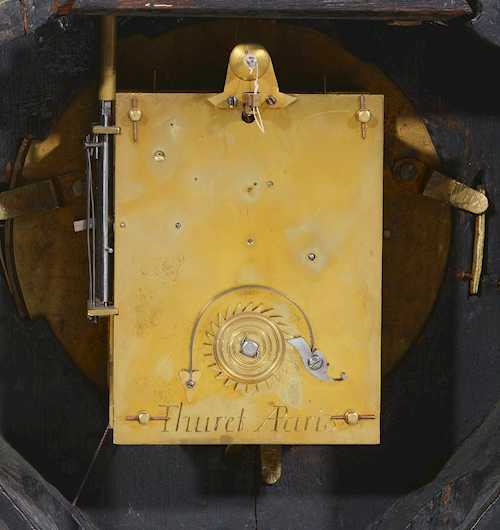
Louis XIV, Paris, 1690–1700. Attributed to André-Charles Boulle (1642–1732), signed Thuret (Isaak Thuret, 1649–1706, or Jacques Thuret, 1669–1738).
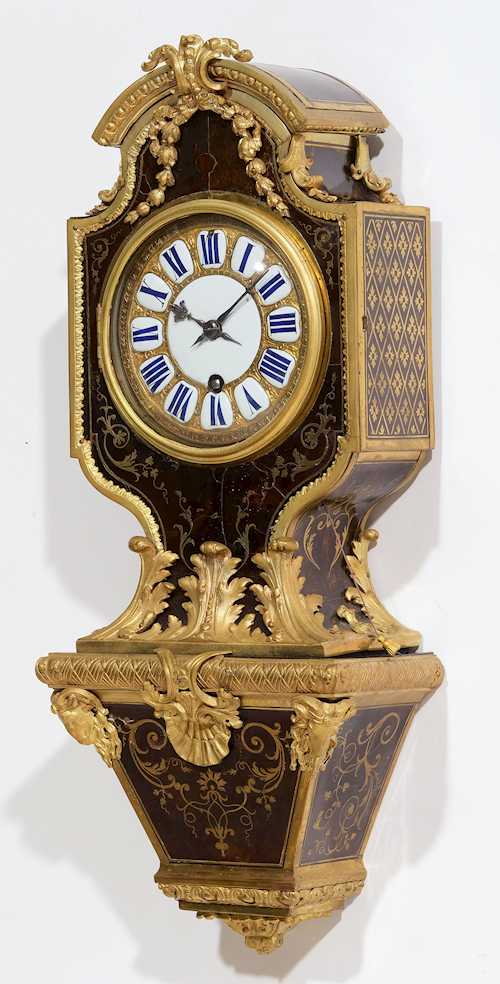
Wooden case with Boulle marquetry of brown-backed tortoiseshell and fine engraved brass inlays in the form of arabesques and hanging bellflowers (some of the internal engravings are worn). The sides feature a diamond pattern with stylized flowers. Rectangular case with recessed top and bottom and an arched crown on a pyramid-shaped console. Bronze decoration in the form of acanthus leaves, decorative friezes, garlands, shells, and ram heads (some with breaks) Bronze dial in relief and with white enamel cartouches, Roman hour markers. The outer ring of the dial is engraved with Arabic minute markers, 1-60. Movement with verge escapement, thread suspension with fine adjustment. Striking mechanism on three bells, available on request. 1 key.
23 × 15 × 58.5 cm.
Losses to the case and marquetry, originally possibly with a figural finial. Medallion in the center above the dial probably missing. Movement and striking mechanism require repair, pendulum fork incomplete. Back door replaced.
Certificate:
Provenance:
Both the fine design and craftsmanship and the exquisite workmanship of this pendule suggest that it was made by royal artisans in Paris around 1700. Prof. Dr. Hans Ottomeyer sums it up in an expert opinion: “The extreme delicacy and subtle lines of the work could only have been achieved by the king's craftsmen in Paris around 1700. It required the interaction between designers, cabinetmakers, and craftsmen working together.”
Although no design drawings for the pendule are known, it can be attributed to André-Charles Boulle based on its shape and extremely fine workmanship. Boulle is generally considered the inventor of the clock with a wall console. Fixing the clock to a solid wall prevented it from being affected by the vibrations of the parquet floor and ensured greater accuracy.
The clockmakers Isaak Thuret and later his son Jacques worked like André-Charles Boulle in one of the workshops granted by the king in the Louvre. The collaboration between Boulle and the two clockmakers Thuret is documented several times. A comparable “Cartel d'Alcôve” signed by Thuret is illustrated in Kjellberg 1997, p. 56, fig. A, whereas another clock with a very similar base design is shown in fig. B. Another cartel clock from the Kathryn Bache Miller collection in New York was offered by Partridge London in 1999 (French Clocks, Partridge London 1999, cat. no. 1). A “tête de poupée” with a different shape and movement by Isaak Thuret can be seen in H.M. Vehmeyer: Clocks their origin and development 1320–1880. Wilsele 2004, vol. II, p. 994, fig. p. 836. In addition, a design drawing by Gilles-Marie Oppenord (1642–1742) is known for a pendulum clock that is similar in certain design elements to the one presented here (cf. Jean Dominique Augarde: Les Ouvriers du temps. Geneva 1996, p. 125, No. 84).
Cet objet contient des matériaux d'espèces en voie de disparition et est soumis à certaines restrictions commerciales. Les acheteurs potentiels doivent se familiariser avec les réglementations douanières pertinentes avant de faire une offre s'ils ont l'intention de l'importer dans un autre pays.
CHF 6 000 / 10 000 | (€ 6 190 / 10 310)
Vendu pour CHF 7 500 (frais inclus)