

Lot 3007 - A218 Tableaux de Maîtres Anciens - vendredi, 18. septembre 2026, 14h00
16th century follower of MARINUS VAN REYMERSWAELE
(Reymerswaele circa 1493–circa 1546 Goes)
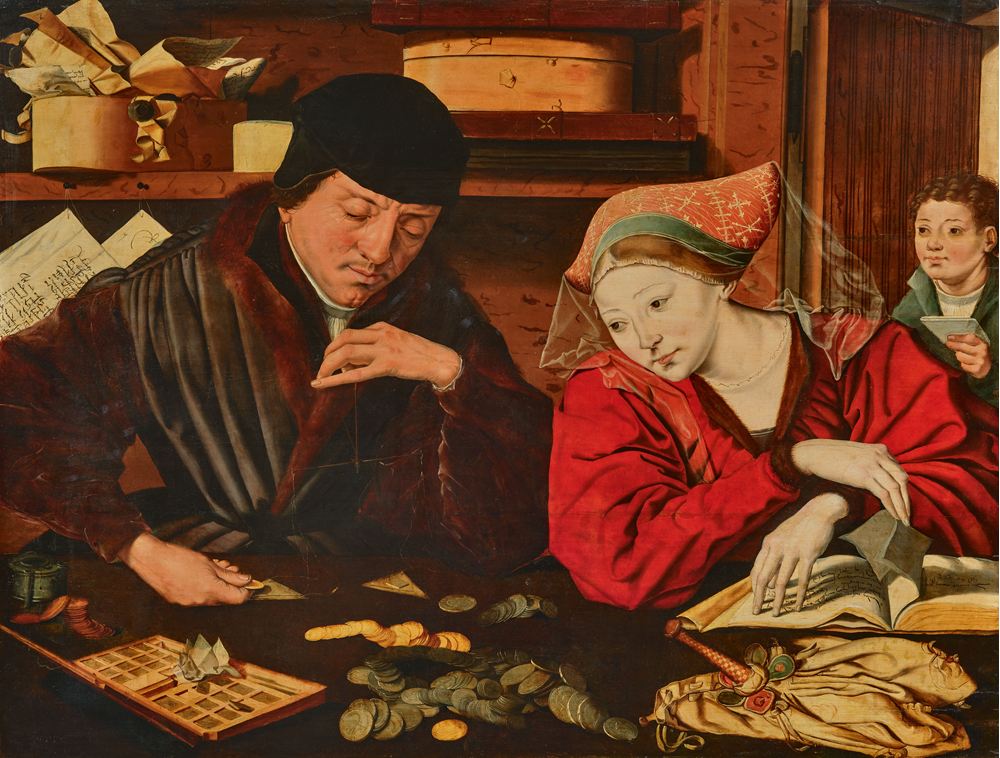
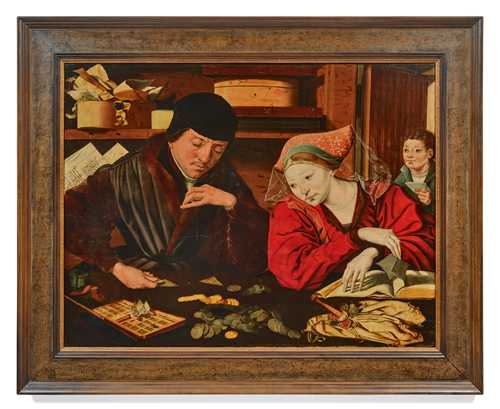
The money changer and his wife.
Oil on panel.
85.7 × 112.4 cm.
Provenance:
- Auction Fischer, Lucerne, 5 September 1922.
- Probably with Schulthess, Basel.
- Privately owned for several generations, Switzerland.
- By inheritance to the present owners, private collection, Switzerland.
Exhibited:
Literature:
- Ausst.-Kat. Gemälde und Zeichnungen alter Meister, Kunsthandwerk aus Privatbesitz, ed. by Berner Kunstmuseum, Bern 1944/45, pp. 9 and 13, cat. no. 52.
This painting is an important rediscovery that remained in a private collection in Switzerland for several decades. The composition refers to a pictorial type popular in the 15th and 16th centuries and was painted by a talented Flemish follower of Marinus van Reymerswaele after a now-lost model.
Marinus in turn drew on compositions by Quentin Massys (1465–1530), known in several variations. Thus, the painting offered here relates to Massys's depiction of the money changer in the Louvre (oil on panel, 70.5 × 67 cm, inv. no. 1444). Another version of the subject by Marinus is in the Museo Nacional del Prado in Madrid (oil on panel, 83 × 97 cm, signed and dated Marinus me fecit a° 1539, inv. no. P2567).
It is unclear whether this composition depicts a money changer, merchant, banker or moneylender together with his wife. The precise rendering of the coins in the foreground enables the identification of various currencies that circulated in the countries of Central Europe. This explains the money changer's task of checking the weight of each individual coin in order to determine its exact value and exchange it at the legal exchange rate. These individuals were also responsible for granting loans and accepting money as deposits, thereby simultaneously fulfilling the role of bankers.
From the 15th century onwards, manuals were published providing information on which foreign coins circulated in a particular territory and at what exchange rate they were traded. Such manuals may have served the painter as models for the depiction of the coins in this painting. (See Christine Seidel: 'The Case of Marinus', in: Ausst.-Kat. Marinus. Painter from Reymerswaele, ed. by Christine Seidel, Madrid 2021, pp. 20–22).
We thank Dr Adri Mackor for his scholarly assistance in cataloguing this lot.
This painting is archived at the RKD, The Hague.
CHF 25 000 / 35 000 | (€ 25 770 / 36 080)
Vendu pour CHF 250 000 (frais inclus)