


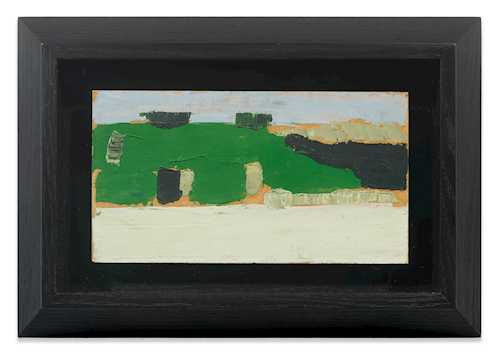
Lot 3417 - A217 Post-War & Contemporary - jeudi, 25. juin 2026, 15h00
NICOLAS DE STAËL
(Saint Petersburg 1914–1955 Antibes)
Gentilly, 1952
Huile sur carton
Verso signed, titled and dated: Staël Gentilly 52.
12 × 22 cm
Provenance:
- Private collection Paris.
- Auction Motte Geneva, 7 November 1969, lot 84.
- Private collection Switzerland, in the same family ownership for three generations.
Literature:
- Françoise de Staël and Jacques Dubourg: Nicolas de Staël. Catalogue raisonné des peintures, Paris 1968, p. 187, no. 380 (with ill.).
- Charlotte Barat and Pierre Wat (eds.): Nicolas de Staël, Lausanne 2024, p. 118 (with ill.).
- In: L'ŒIL, Lausanne 1959, no. 59, p. 16 (with ill.).
Nicolas de Staël was born in Saint Petersburg in 1914 as the son of a general in the Imperial Guard and was uprooted at an early age by the Russian Revolution. Following his flight through Poland and the early death of his parents, he was raised by foster parents in Brussels. These formative experiences of profound upheaval – loss and exile – resonated throughout his life in an underlying melancholic tone and fuelled his restless search for artistic truth. After studying at the Academy in Brussels, journeys across Europe and North Africa eventually led him to Paris, where he rapidly emerged as a central figure of post-war art.
His artistic development unfolded with remarkable speed. Initially shaped by classical modernism and influences such as those of Georges Braque, he turned towards abstraction during the 1940s. Yet de Staël’s path was not a linear progression into non-representational painting. He developed a technique in which colour ceased to function merely as a means to an end and instead became matter in itself. Using a palette knife, he layered oil paint thickly onto the surface, creating a relief-like texture. This technique enabled him not simply to depict light, but to capture it through the structure of the paint itself. In doing so, he consistently moved along the narrow threshold between abstraction and figuration.
The work offered here, ‘Gentilly’ from 1952, appears almost as a direct rendering of nature. The painting depicts the suburban commune south of Paris, characterised at the time by its village-like atmosphere, expansive spaces and distinctive light. During this period, the surroundings were shaped both by the River Bièvre, which formed the valley of Gentilly, and by an architecture suspended between industrialisation and rural tranquillity.
De Staël reduces the landscape to essential planes of colour: rich, saturated green dominates the centre and evokes vegetation, while dark, nearly black accents in the upper section suggest groups of trees or architectural volumes contrasting against the pale sky. The lower half of the composition consists of a broad cream or beige zone that may represent the River Bièvre or a pathway. The artist pushes and smooths the oil paint with a palette knife, causing the edges of the colour fields not to remain sharply defined but rather to merge into one another. Despite the planar technique, a sense of spatial depth emerges.
While many of his contemporaries regarded pure abstraction as the only truly contemporary mode of expression, de Staël demonstrated through ‘Gentilly’ that the representational world could be experienced anew through the lens of abstraction. He reduced nature to its essential elements. The work is therefore not a depiction of Gentilly, but rather a chromatic condensation of the visual experience of the place. It conveys the calm and expansiveness of the landscape on the outskirts of the metropolis and reveals de Staël’s unique ability to construct light and space solely through the physical presence of colour.
CHF 300 000 / 400 000 | (€ 309 280 / 412 370)
Vendu pour CHF 375 000 (frais inclus)