

Lot 1144 - A218 Collection Dr Peter Ducret - jeudi, 17. septembre 2026, 14h00
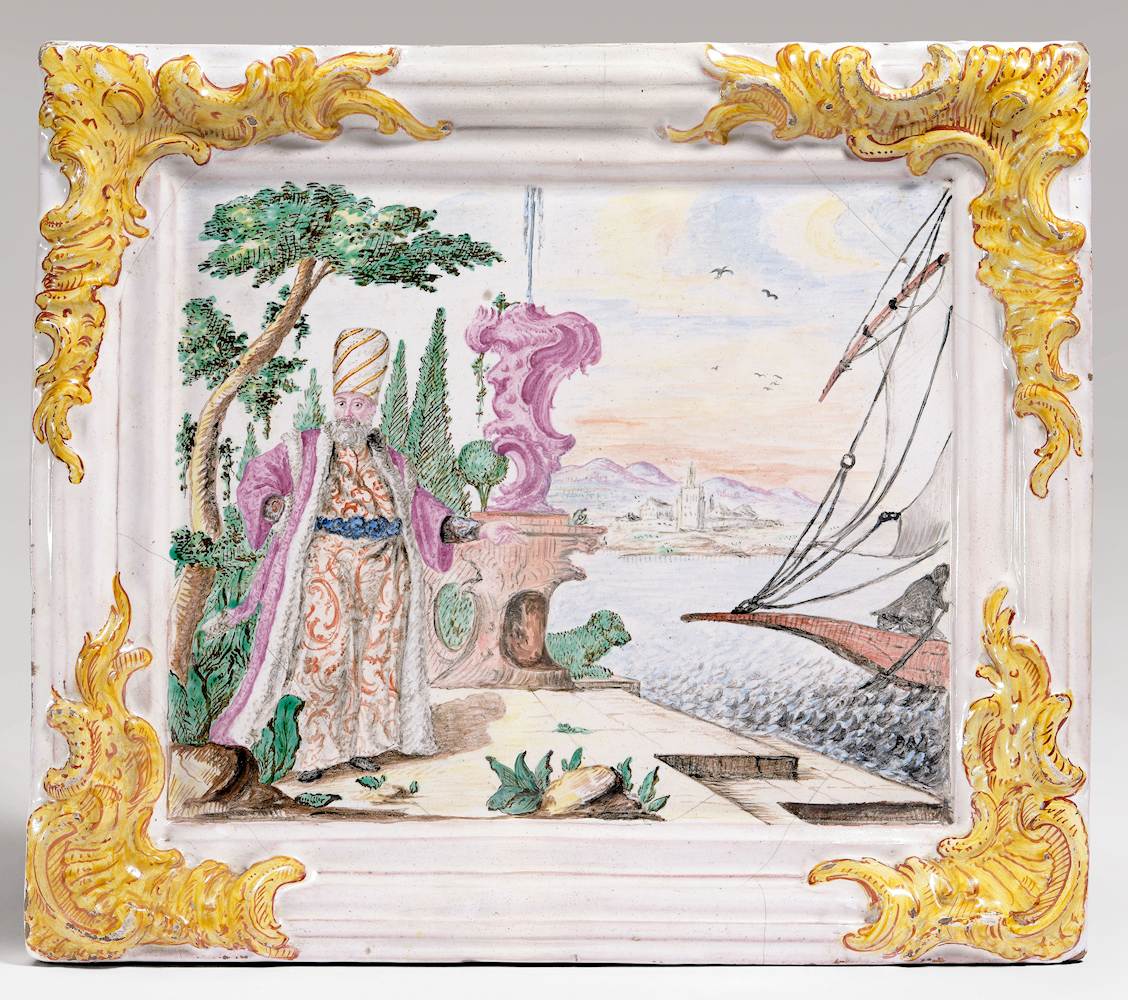
RARE PLAQUE
Schrezheim, circa 1761–64. Painting by Johann Andreas Bechdolff (1734–1807).
Faience decorated in overglaze enamels. Modelled with a rectangular picture frame applied with rocaille reliefs at the four corners, painted in yellow and iron red. The scene depicts an Ottoman dignitary, the "Jannisar-Agasi", a general of the Janissaries, standing in a commanding pose at the left on a terrace with a rocaille vase on a pedestal, before a seascape with the stern of a sailing ship at the right and a fortified tower and buildings on a promontory, with a hilly landscape fading into the distance. Pierced at the upper edge for suspension and twice on each side. Unmarked.
9.5 × 25 cm, frame height 2.5 cm.
Hairline cracks.
Provenance:
- René Simmermacher Art Gallery, Zurich.
- Peter Ducret Collection, Kilchberg, since the late 1980s.
Literature:
- Peter Ducret: "Türken-Darstellungen auf Schrezheimer Fayence Bildplatten von Johann Andreas Bechdolff", Keramos 119/1988, p. 73, plate IV.
The plaques decorated with rocaille reliefs and a wide variety of painted scenes form a highly distinctive part of the repertoire of the Schrezheim faience manufactory. This particular type, painted in overglaze enamels, belongs to the first period of production at Schrezheim, 1752–75. The appealing Orientalist scenes are among the most interesting subjects, typically set on terraces with park sculptures against imaginary landscapes with coastal scenery.
The relatively large number of surviving plaques attests to their popularity. The first comprehensive study was published by Erdner and Nagel (1972, figs. 56a, 56b). Peter Ducret studied the known examples painted by the Ellwangen enamel painter Johann Andreas Bechdolff and compared them with their graphic sources ("Keramos" 119/1988, pp. 69–80).
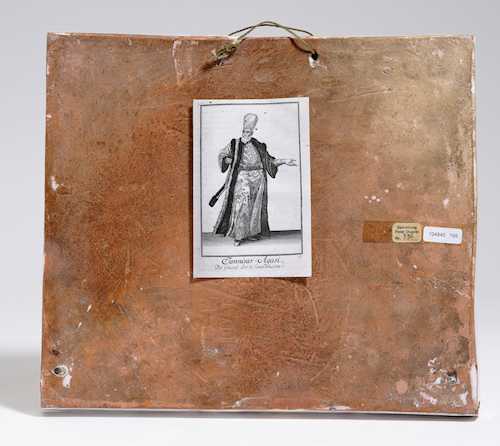
The exotic figures, certainly unusual for an 18th-century South German faience manufactory, were copied in great detail from graphic sources that provided valuable contemporary records based on the impressions gathered by the French ambassador de Ferriol during his embassy in Constantinople in 1707–08. He commissioned the French-Flemish painter Jean-Baptiste Vanmour, who accompanied him, to produce a series of paintings depicting courtly and urban life in distant Constantinople. Following de Ferriol’s return, the paintings served as models for engravings and were published in 1714 under the title "Recueil de cent estampes représentant différentes nations du Levant" (Williams 2014, p. 49). The engravings attracted considerable attention and were reissued several times. In 1719, the Nuremberg publisher Christoph Weigel issued a series with the captions translated into German. These provided models for numerous artists and manufactories, including Closter Veilsdorf (cf. lot 1192): "wahrhafteste und neueste Abbildung des Türkischen Hofes, welche nach denen Gemählden so der Königliche Französische Ambassadeur Charles Comte de Ferriol Zeit seiner Gesandtschafft in Constantinopel im Jahr 1707 und 1708. durch einen geschickten Mahler nach dem Leben hat verfertigen lassen zu finden bey Christoph Weigeln / Nürnberg … 1719" (P. Ducret, "Keramos" 101/1983; Veit-Rothmeier 2016).
The Janissary general depicted on the present plaque likewise follows a model from this series, entitled "Jannisar-Agasi, Der General der Janitscharen". The Janissaries, feared by Europeans, were the elite troops of the Ottoman military and served as the Sultan’s bodyguard. Their commanders held some of the highest positions in the state and enjoyed considerable prestige.
CHF 6 000 / 8 000 | (€ 6 190 / 8 250)
Vendu pour CHF 21 250 (frais inclus)