
Lot 1095* - A214 Works of Art & Decorative Arts - jeudi, 18. septembre 2025, 13h30
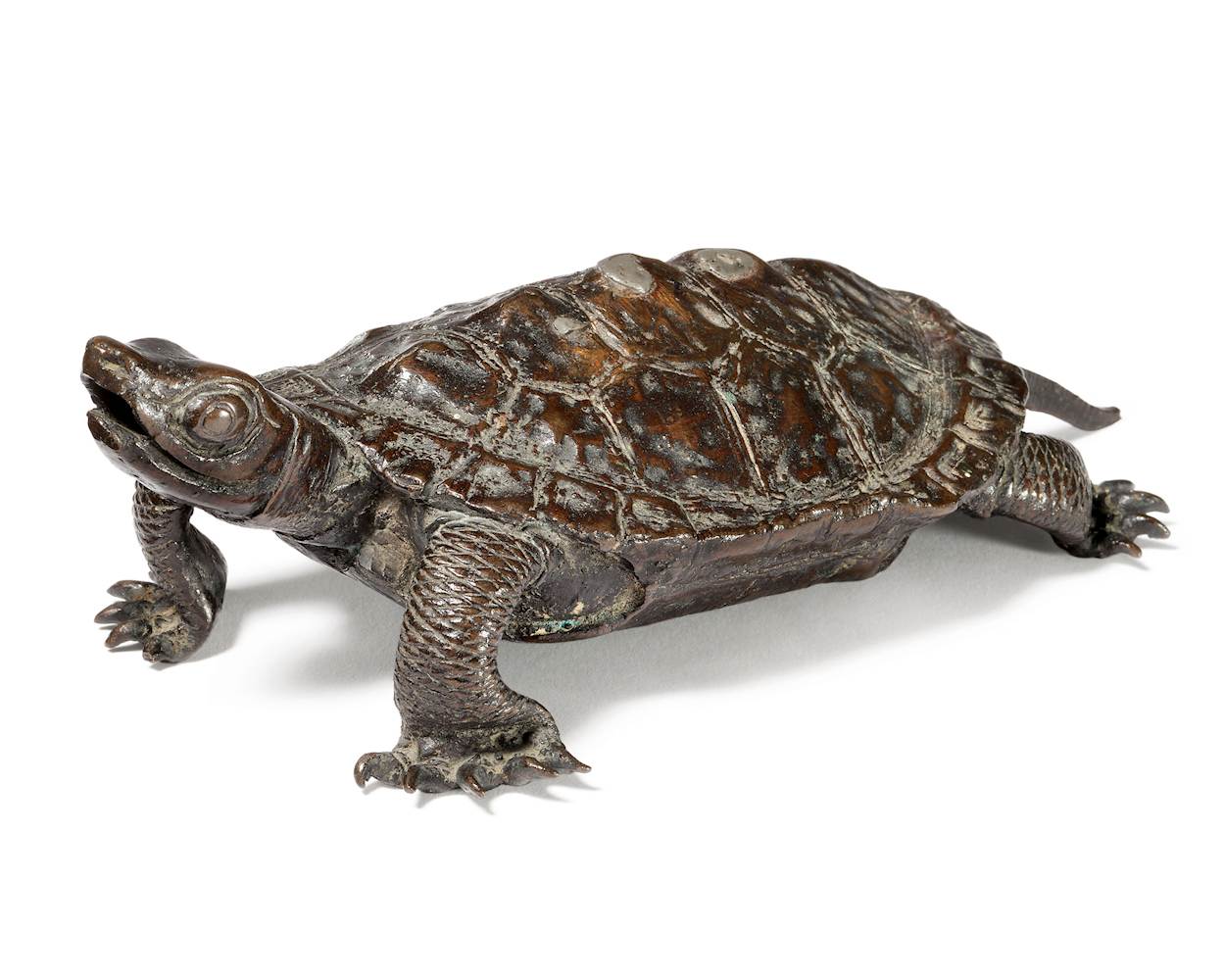
TURTLE - The Embden Collection
Renaissance, Italy, probably Padua, 16th century (?)
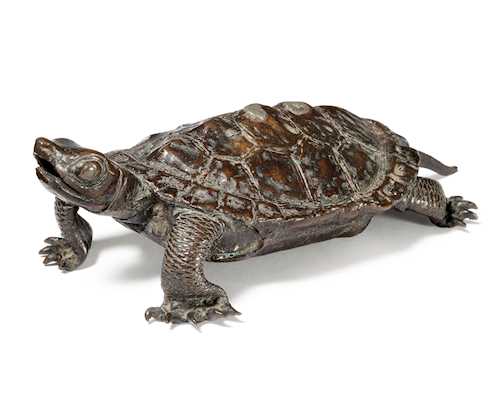
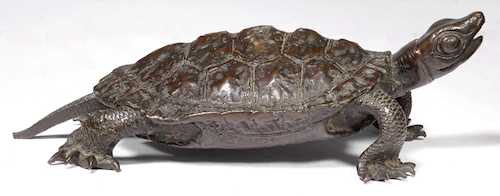
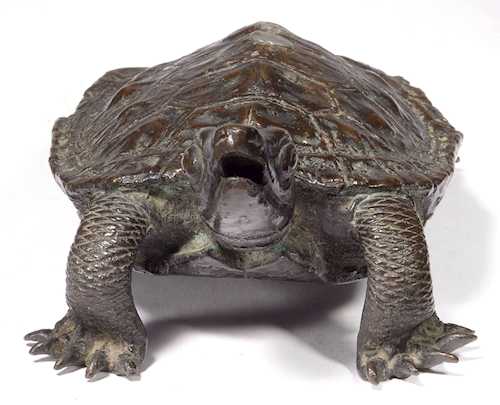
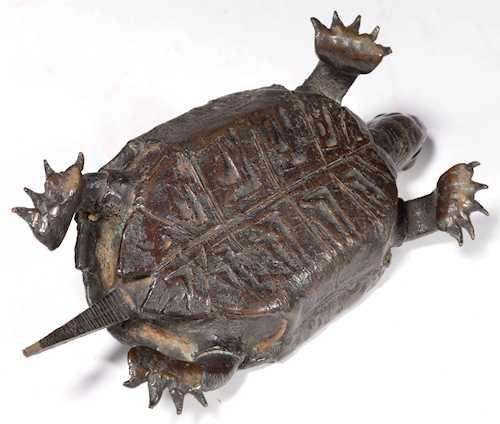
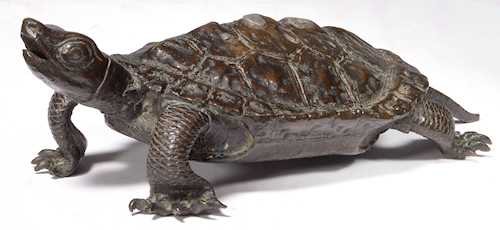
Dark patinated bronze. Fine detailing of the skin and shell structure. The beak is slightly open.
L 20.5 cm, H 6 cm.
Signs of wear. Solder marks.
Provenance:
Bronze figures of animals, especially reptiles, were very popular during the Renaissance. Padua was a center for these figures. Manfred Leithe-Jasper suspects that this was due to the university located there and the scientific interest in nature (see Museo Diocesano tridentino: Rinascimento e passione per l'antico. Andrea Riccio e il suo tempo. Trento 2008, pp. 382/383). So-called “live casts” or “casts from nature” ensured a particular attention to detail and special closeness to the object, whereby the form was modeled directly over the gutted animal and later poured with liquid bronze. This not only reproduced the animal perfectly, but also the irregularities found in nature. The technique of live casts later spread to Germany, where Wenzel Jamnitzer, for example, produced similar works in silver, and to France, where Bernard Palissy integrated animal motifs into his ceramic works.
Corresponding bronze works from the Veneto region are often attributed in literature and the art trade to Andrea Riccio or Severo Calzetta da Ravenna, although it is difficult to attribute live casts in particular and to date them accurately. On the one hand, the animal figures can be found – as in the example on offer – as simple figures or equipped with a function, such as an inkwell or a base for a candlestick. Two solder joints on the back of the turtle on offer could indicate such a context. A purely figurative example of a turtle, also a cast from life, from the Kaiser Friedrich Museum in Berlin is illustrated in Wilhelm Bode: The Italian Bronze Statuettes of the Renaissance. New York, new edition 1980, plate XXXIX, No. 2c. It is listed under the name Riccio and catalogued as “probably Northern Italy, 16th century.” A lamp also attributed to Riccio, depicting a satyr standing on a turtle resting on an eagle's claw, is illustrated on plate XLIX. It is located in the Royal Museum in Copenhagen and is also dated to the 16th century.
Corresponding bronze works from the Veneto region are often attributed in literature and the art trade to Andrea Riccio or Severo Calzetta da Ravenna, although it is difficult to attribute live casts in particular and to date them accurately. On the one hand, the animal figures can be found – as in the example on offer – as simple figures or equipped with a function, such as an inkwell or a base for a candlestick. Two solder joints on the back of the turtle on offer could indicate such a context. A purely figurative example of a turtle, also a cast from life, from the Kaiser Friedrich Museum in Berlin is illustrated in Wilhelm Bode: The Italian Bronze Statuettes of the Renaissance. New York, new edition 1980, plate XXXIX, No. 2c. It is listed under the name Riccio and catalogued as “probably Northern Italy, 16th century.” A lamp also attributed to Riccio, depicting a satyr standing on a turtle resting on an eagle's claw, is illustrated on plate XLIX. It is located in the Royal Museum in Copenhagen and is also dated to the 16th century.
CHF 3 000 / 5 000 | (€ 3 090 / 5 150)
Vendu pour CHF 12 500 (frais inclus)