

Lot 1207 - A212 Decorative Arts - jeudi, 27. mars 2025, 13h30
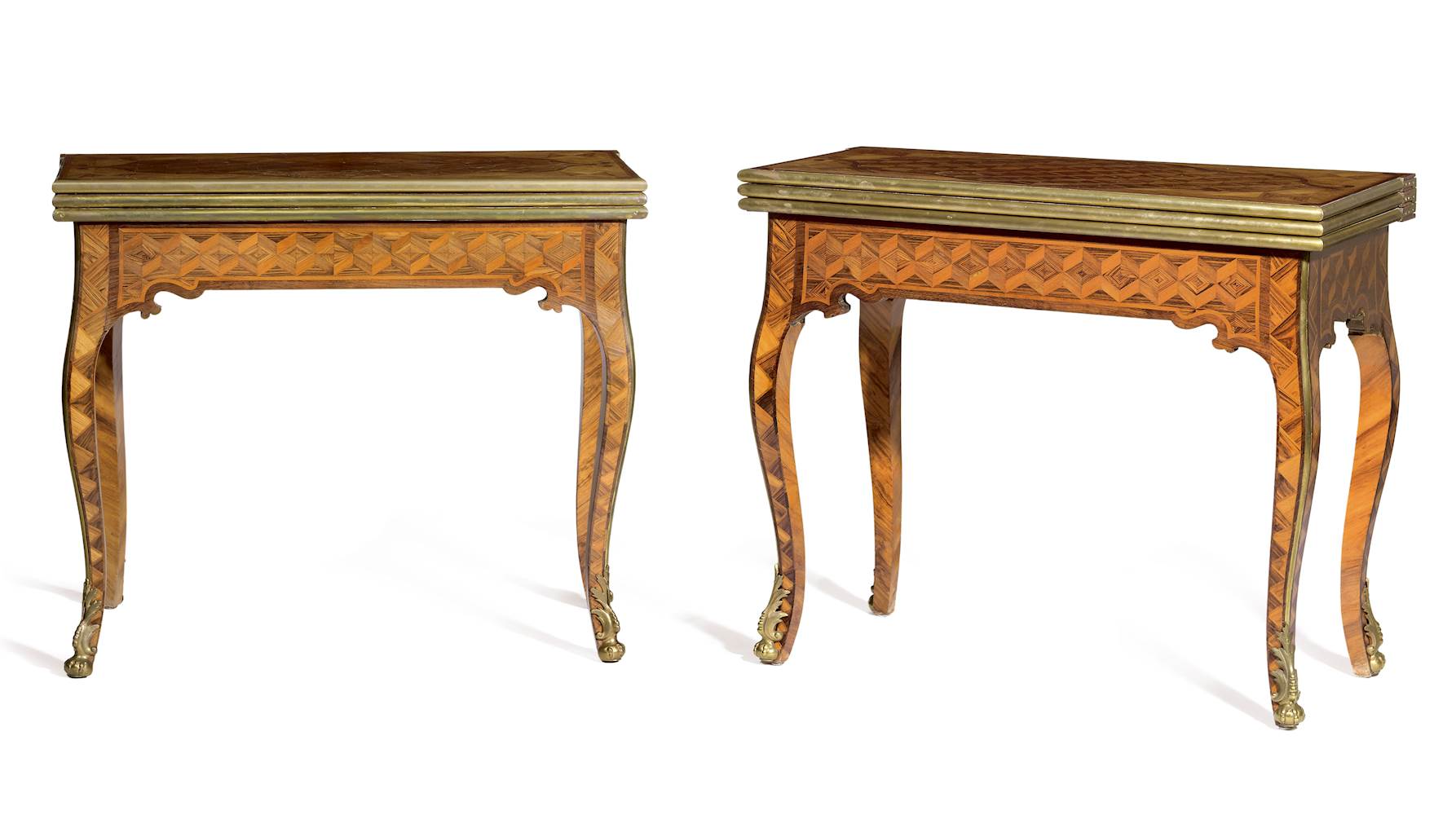
A PAIR OF ROYAL GAMES TABLES WITH TWO PLAYING FIELDS FROM THE GATTSCHINA PALACE
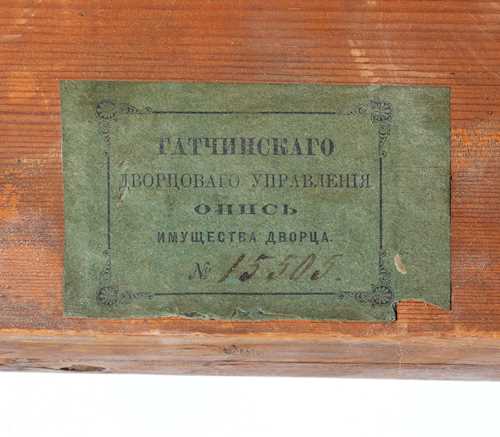
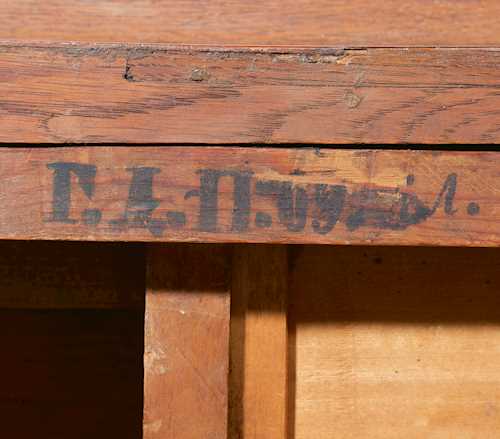
Transition, Russia, St. Petersburg, end of the 18th century. Cyrillic inventory labels and numbers. "Гатчинского дворца правление" (Board of the Gatchina Palace)
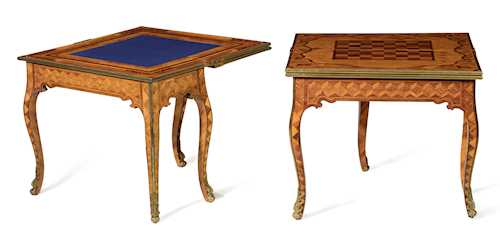
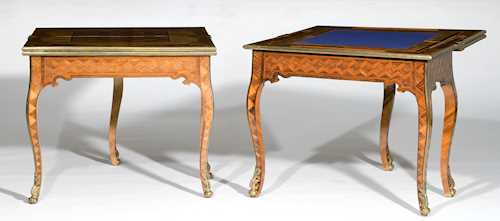
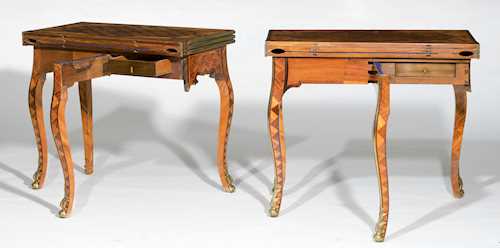
Tulipwood, purpleheart, amaranth and other woods in veneer, inlaid in rectangular reserves and fillets and as geometric decoration. Rectangular double-hinged leaf, edged in brass rod, on a cut-out frame and curved legs, one leg can be swung out. Bronze sabots with ball and claw feet (later). The cover inlaid with a diamond pattern in a matching reserve. When opened once, a corresponding marquetry and a chessboard are displayed, when opened a second time, partly lined with felt, and with recessed cavities for the game pieces at the edges. One hidden drawer.
Table 1: On the underside with various annotations and a paper label in Cyrillic script, numbered 15505 and inventory number G.610. Various pencil annotations inscribed “Restored on May 24, 1977, Christie's carpentry”.
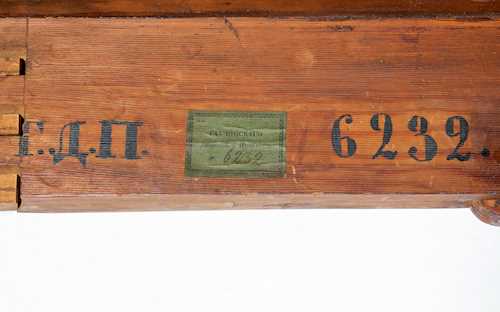
Table 2: Slightly different in construction. Annotation and paper label in Cyrillic script on the underside, numbered 6232 and inventory number G.1358.
Each 91.5 × 45.5 (91) × 78 cm.
Provenance:
- Most likely sold on the European art market on the orders of the Soviet government in the 1920s and 1930s.
- Probably an unknown Christie's auction, before May 1977 (according to a pencil annotation on the underside of a table).
- Auction Sotheby's Zurich, December 10, 1996, Lot 370.
- Important Swiss private collection.
Repairs and restorations (not done at the same time, or by the same person). Small losses to the veneer. The swivel legs restored. Table 2 is more faded and has a later drawer. The top of one table is warped.
The Cyrillic annotations on the underside of the games tables and the inscribed paper label indicate that the place of origin is the Gattschina Palace. Completed in 1781 by order of Catherine the Great, the palace is located near St. Petersburg and was furnished in the taste of Count Grigory Orlov, one of Catherine's favorites. As was conventional at the time, the royal houses were oriented towards French taste. Although the games tables on offer incorporate French stylistic elements of the Transition period, the robust construction and sturdy proportions, as well as the inlay work, are an idiosyncratic, arguably Russian solution. According to a Sotheby's auction catalog, one of the tables is depicted in a watercolor by K.A. Ukhtomsky from 1947, set up in the hall near the armory.
It is unclear how the tables left the palace. It can be speculated whether in the wake of the Russian Revolution from 1917 and the state appropriation of cultural property from the Tsars by the new Soviet government, the games tables were sold abroad. Notorious auction houses, above all “Rudolph Lepke's Kunst-Auctions-Haus”, were allowed to select art objects from Russian palaces directly on-site through their own agents and auction them off in Berlin on behalf of the Soviets. These so-called Russian auctions reached their peak in 1928, when, for the auction house's 60th anniversary, works of art from Russian museums and palaces, including the Gatchina Palace, were sold (see Rudolph Lepke's Kunst-Auctions-Haus: Kunstwerke aus den Beständen Leningrader Museen und Schlösser (No. 2000): Hermitage, Mikhailoff Palace, Gatchina, etc. Berlin, November 6-7, 1928).
CHF 20 000 / 30 000 | (€ 20 620 / 30 930)
Vendu pour CHF 40 000 (frais inclus)