

Lot 3451 - A213 Post-War & Contemporary - jeudi, 26. juin 2025, 15h00
SEUNDJA RHEE
(Jinju 1918-2009 Paris)
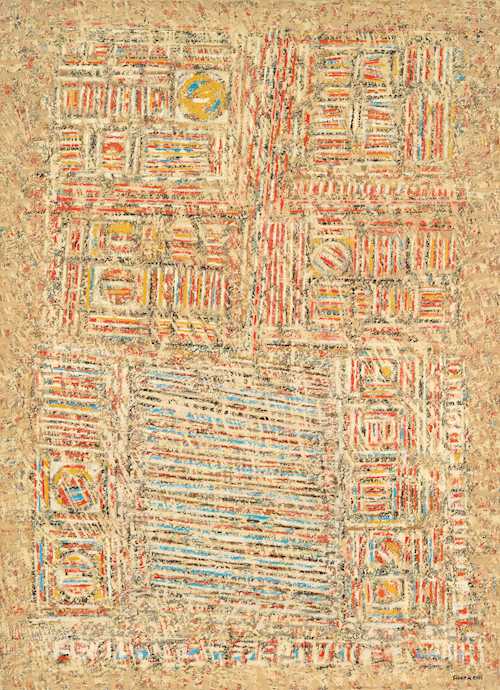
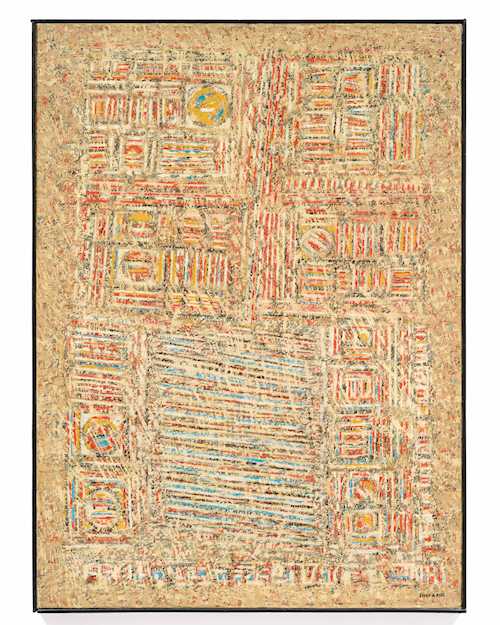
Promesses de la terre. 1961.
Oil on canvas.
Signed lower right: SEUND JA RHEE, as well as signed, titled, inscribed, numbered, with location, Korean characters and illegible stamp on the reverse: 196140P631 SEUND JA RHEE PARIS “PROMESSES DE LA TERRE” 13. Stamp: 196140P631 SEUND JA RHEE PARIS “PROMESSES DE LA TERRE” 13, as well as inscribed on the stretcher: 6140P631.
100 × 73 cm.
Provenance:
- Private collection, Switzerland, acquired directly from the artist.
- Private collection, Switzerland, by descent.
"I don’t know anything except myself being a woman. I only know of the earth that covers fireballs of high temperature with its soil, accepting quietly storms and raging billows, while giving life to all things." Seundja Rhee
Born on 3 June 1918 in Jinju, South Korea, Seundja Rhee was one of the most influential Korean artists of the 20th century. Her works combine traditional Korean art with Western modernism. Rhee studied at the Imperial Academy of Art in Tokyo in the 1930s and focused intensively on Western painting techniques. In 1951, during the Korean War, she emigrated to Paris, where she lived and worked until her death in 2009. From 1953, she continued her artistic training at the Académie de la Grande Chaumière under Henri Goetz and Yves Bayer and developed her characteristic style, which combined abstraction with cultural influences from her homeland.
Her multifaceted oeuvre includes paintings, woodcuts, ceramics, tapestries, mosaics and poetry. She is known for her abstract paintings and sculptures, which are often inspired by traditional Korean art, calligraphy and motifs from nature. Her style is characterised by a harmonious balance between Eastern and Western aesthetics, in which she regarded the Eastern philosophical concept of Yin and Yang as the central foundation of her work. Her works combine visual art with literature and reflect her personal feelings and experiences as a Korean, although she spent most of her life in France.
The present work ‘Promesse de la terre’ from 1961 was created during the ‘Women and Earth’ period (1961-1968), in which Seundja Rhee further developed her artistic style from the representational to the abstract. Characteristic of this phase are organic compositions marked by an emotional intensity and symbolic geometry. In this painting, Rhee combines strict lines and stripes with abstracted geometric forms that address themes such as motherhood and the Earth. The vibrant oil colours are applied in short, impasto brushstrokes with a texture reminiscent of pointillist techniques and traditional Korean weaving patterns. The work reflects both Rhee's personal biography and her cultural influences. Her longing for Korea, for her sons, whom she had to leave behind, and for the comforts of motherhood, merges with the idea of the Earth as a life-giving force. The painting unfolds in layers like a woven textile: each brushstroke acts like a thread, demanding patience and dedication, while the composition as a whole radiates a quiet but unstoppable vitality - a promise of the Earth that continues to exist even amidst the visible traces of time.
CHF 40 000 / 60 000 | (€ 41 240 / 61 860)
Vendu pour CHF 68 750 (frais inclus)