

Lot 3046* - A218 Tableaux de Maîtres Anciens - vendredi, 18. septembre 2026, 14h00
JAN LIEVENS
(Leiden 1607–1674 Amsterdam)
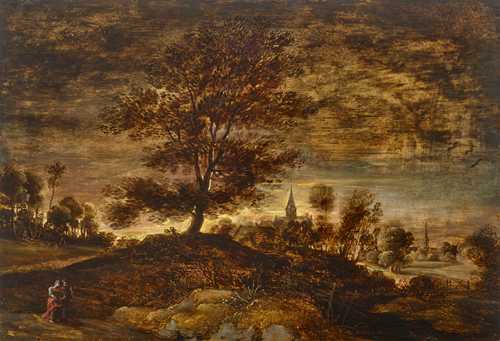
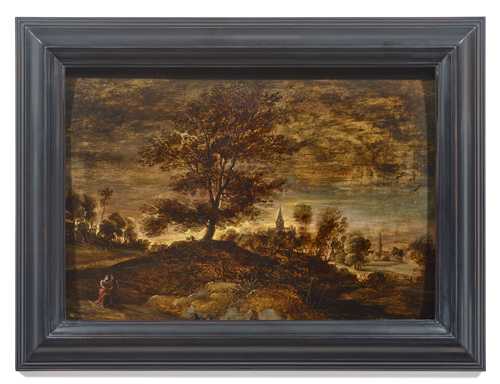
Atmospheric landscape with a village and a church in the background.
Oil on panel.
Verso centre with the brand mark of the Antwerp panel maker Guilliam Gabron (1586–1674?).
24 × 34.7 cm.
Provenance:
- Auction Chorley, Gloucestershire, 23 April 2025, lot 78 (as Follower of Aert van der Neer).
- European collection.
This recently rediscovered landscape represents an exceptional rarity within the oeuvre of Jan Lievens. Not only is the Leiden master's landscape oeuvre limited in scope, but the present work also constitutes an important new discovery within his output. The small-format, high-quality panel was probably painted in the late 1640s. A dendrochronological examination by Dr Peter Klein shows that the oak panel used came from Westphalia or the Netherlands and could have been worked no earlier than 1638 (report dated 29 October 2024). This dating corresponds convincingly with Lievens' stylistic development during his activity in Antwerp from 1634, before he returned to Amsterdam about a decade later, where he worked until his death.
The landscape impressively demonstrates Lievens' lifelong ambition to experiment with different painterly techniques and forms of expression, a characteristic observable in several of his works. The golden twilight has close parallels in the Landscape in the Gemäldegalerie Berlin (inv. no. 816) and in a painting formerly in the collection of the Duke of Westminster (see Exh. cat. Jan Lievens. A Dutch Master Rediscovered, ed. Arthur Wheelock, New Haven/London 2008, p. 152, ill. 1). The free treatment of the sky, the irregularly modelled terrain and the small-scale staffage in the left foreground also recall the Dune Landscape with Trees from the collection of the Boijmans Van Beuningen in Rotterdam (inv. no. 1455(OK)). Dr Arthur Wheelock dated this work to the mid-to-late 1640s, thus to the period after Lievens' return from Antwerp to the Dutch Republic (see ibid., pp. 162–63, no. 43).
The pronounced contre-jour effect also proves to be a recurring motif in his work and can be seen, for example, in the painting from the Frits Lugt collection at the Fondation Custodia in Paris (inv. no. 2787), which in turn was inspired by Peter Paul Rubens (1577–1640) (see Christopher Brown: Making & Meaning Rubens' Landscape, London 1996, p. 51). An example of Rubens' sketch-like manner of painting landscape, comparable with the present landscape, is in the Courtauld Institute Galleries (see ibid., p. 93, ill. 92). Jan Lievens probably had the opportunity to study Rubens' works in the original closely as early as the 1630s.
At the same time, he drew inspiration from a broad spectrum of artistic influences among his contemporaries. The present painting also exemplifies his engagement with Anthony van Dyck (1599–1641), particularly in the compositional emphasis on a central tree motif, as well as with Adriaen Brouwer (circa 1605–1638), whose rough, experimental brushwork resonates here.
In the interplay between an independent hand and varied artistic influences, Jan Lievens is today recognised as one of the outstanding personalities of his generation, a painter of technical versatility. The diversity and experimental nature of his manner of painting can be attributed not least to the heterogeneous expectations of his patrons: he met both the representational demands of his courtly clientele in London in the 1630s, where he worked as a court painter, and the specific requirements of large-format works for public spaces in Antwerp and Amsterdam (see Melanie Clifford, in: Exh. cat. 2008, p. 42).
We thank Dr Lloyd de Witt and Dr Arthur Wheelock for their individual confirmation of the attribution on the basis of a photograph. Dr Lloyd de Witt also examined the painting in the original in March 2025.
CHF 30 000 / 50 000 | (€ 30 930 / 51 550)
Vendu pour CHF 21 250 (frais inclus)