


Lot 3448 - A217 Post-War & Contemporary - jeudi, 25. juin 2026, 15h00
ROBERT RAUSCHENBERG
(Port Arthur 1925–2008 Captiva Island)
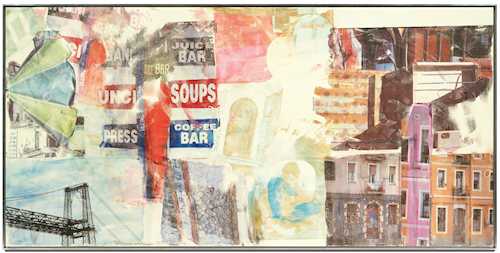
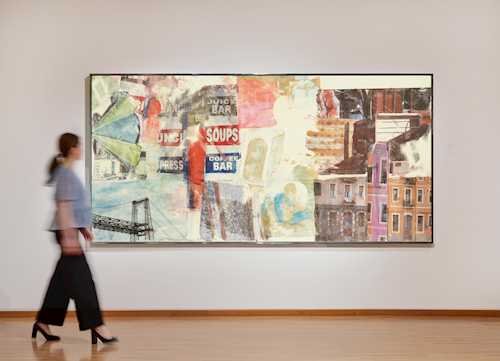
Crosstown [Anagram (A Pun)]. 1997.
Vegetable dye transfer on polylaminate.
In the original artist's frame.
In the original artist's frame.
Signed and dated lower left: RAUSCHENBERG 97, as well as signed and number on the reverse: 97.091 CROSSTOWN.
152 × 310.5 cm.
Certificate:
Provenance:
- Galerie Jamileh Weber, Zurich.
- Private collection Switzerland, acquired in the above gallery in 2000.
Robert Rauschenberg was born in 1925 in Port Arthur, Texas, and began his artistic training after the Second World War. He studied, among other places, at Black Mountain College, where the teaching of Josef Albers had a lasting influence on him, although he deliberately distanced himself from Albers’ strict formal language. He also received decisive impulses through his interdisciplinary collaborations with John Cage and Merce Cunningham. In the 1950s, Rauschenberg developed his so-called ‘Combines’, in which he merged painting with everyday objects, thereby laying the groundwork for an art form that dissolves the boundary between pictorial space and reality.
The present work ‘Crosstown’ from 1997, part of the series ‘Anagram (A Pun)’, belongs to his late period. In the 1990s, Rauschenberg continued and simultaneously expanded his long-developed practice of image montage in order to explore new technical possibilities. The series reflects his sustained interest in fragmentation, linguistic ambiguity and the openness of meaning-making. ‘Crosstown’ thus stands in continuity with his earlier work, while at the same time being characterised by a more detailed and atmospherically denser visual language.
The work’s technique is based on a complex interplay of collaged photographic transfer and painterly intervention. Rauschenberg transfers photographic motifs onto the surface, where they appear softly embedded and partially blurred. In contrast to his earlier silkscreen works, this produces fluid transitions between pictorial elements. Multiple layers of image fragments, paint applications and graphic elements interpenetrate one another, generating an open visual structure that does not establish any clear hierarchy.
The horizontally expansive composition of ‘Crosstown’ interweaves urban visual worlds. Architectural fragments, street scenes and typographic elements such as ‘Soups’ or ‘Coffee Bar’ refer to the visual culture of the metropolis of New York City. These motifs overlap with pictorial quotations and fields of colour that shift between transparency and density. A bridge motif in the left section evokes movement and connection, while façades and interior views in the right-hand part suggest a condensation of urban experience.
The work does not unfold a linear narrative, but instead presents a network of simultaneous impressions. In this complexity, Rauschenberg’s central artistic concern becomes visible: the dissolution of clear boundaries between art and life, and the representation of a reality shaped by layering, fragmentation and mediated imagery.
CHF 100 000 / 150 000 | (€ 103 090 / 154 640)
Vendu pour CHF 450 000 (frais inclus)