
Lot 3436 - A219 Post-War & Contemporary - jeudi, 03. décembre 2026, 15h00
ROBERT RAUSCHENBERG
(Port Arthur 1925–2008 Captiva Island)
Markette (Anagram (A Pun). 1999.
Transfert de pigments végétaux sur polylaminé
Signé et daté en bas au centre : RAUSCHENBERG 99
Numéroté au verso : 99.040
Numéroté au verso : 99.040
244 × 151 cm
Dans son cadre d'origine
Dans son cadre d'origine
Provenance:
- Collection privée, Suisse, acquis en 1999 auprès de la galerie susmentionnée
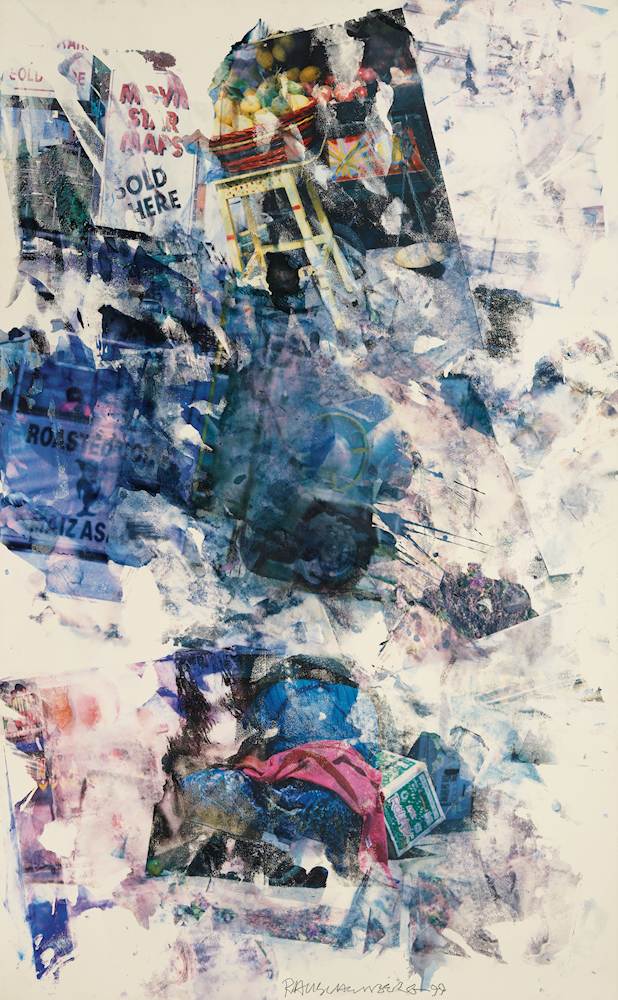
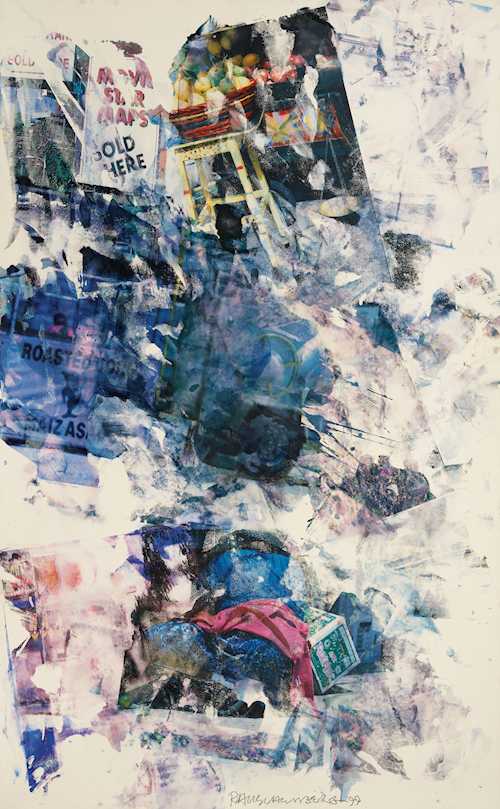
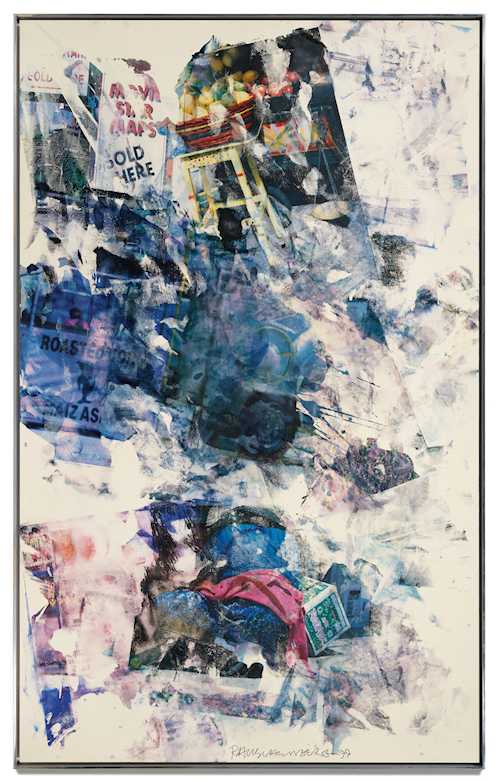
Robert Rauschenberg’s 1999 work ‘Markette’ presents a multilayered pictorial collage combining photographic fragments, lettering and painterly gestures. Its vertical orientation lends the work a striking presence. It appears like a visual archive of everyday life, in which different impressions overlap and partly dissolve again.
The picture surface is characterised by an interplay between light, almost untreated areas and intense concentrations of colour. In the upper section, a market stall displaying fruit draws the eye. Red and yellow accents contrast with dark areas and blurred pictorial traces. Fragments of lettering also emerge, recalling posters and commercial signage. Partly obscured, they become graphic elements of the composition as well as carriers of linguistic meaning.
In the central section, blue, black and grey layers become denser. Photographic subjects are only partly recognisable and combine with painterly traces to create an almost abstract pictorial plane. In the lower section, blue and red forms provide further accents. The gaze moves between recognisable objects and abstract areas, between photographic precision and painterly blurring. The multilayered composition continually reveals new details and connections.
Robert Rauschenberg is among the most important representatives of American post-war art. His work shaped the transition from Abstract Expressionism to Pop Art and influenced the development of conceptual art. As early as the 1950s, he combined painting, photography and real objects in his so-called ‘Combines’, dissolving the traditional separation between art and everyday life.
In Rauschenberg’s works, reality appears as a continuous stream of visual impressions. Photographs, advertising images and subjects from public spaces serve as source material for new pictorial worlds. Images are removed from their original contexts and placed in new relationships.
In the ‘Anagram (A Pun)’ series, produced between 1997 and 2002, Rauschenberg developed this approach further using digital imaging technologies. He drew on photographs from his own archive and transferred them onto transparent supports. Manual working and the transfer process created characteristic blurring, overlapping and material traces, giving the photographic subjects a painterly quality.
The title ‘Anagram (A Pun)’ also refers to rearrangement and wordplay. Applied to the composition, this means that subjects change their original meaning and permit new associations. Viewers are invited to connect the fragments in their minds and establish their own relationships.
CHF 70 000 / 100 000 | (€ 72 160 / 103 090)