

LE CORBUSIER (CHARLES-ÉDOUARD JEANNERET)
Femme endormie. 1945.
Oil on panel.
24 x 33 cm.
Estimate: CHF 80 000 / 120 000
Magritte’s Parisian Provocation
Preview of the Impressionist and Modern Art Auction on 28 June 2019
René Magritte was very angry. The Belgian, who for years had attempted to curry the favour of his fellow artists and the art-going public in Paris, was repeatedly given the cold shoulder. In 1931, he turned his back on the city, the veritable capital of Surrealism. Then, in 1948, he had a unique opportunity to take his revenge. During just five weeks around the turn of the year 1947/48, Magritte created seventeen oil paintings and twenty gouaches for an exhibition at the Galerie du Faubourg in Paris. These works were painted in a fast and somewhat aggressive style that was new to Magritte, inspired by popular sources such as caricatures and comics, along with stylistic borrowings from artists such as James Ensor and Edouard Manet, Henri Matisse and Joan Miró. The shrill, expressive, rebelliously grotesque images added a new facet to Magritte’s oeuvre.

MAX ERNST
Paysage de Corbières. Circa 1949.
Oil on panel.
33 x 23,8 cm.
Estimate: CHF 100 000 / 150 000
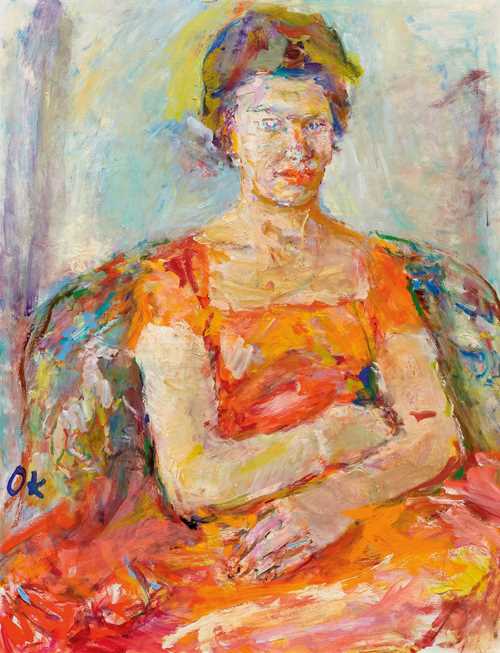
OSKAR KOKOSCHKA
Ann Windfohr. 1960.
Oil on canvas.
91 x 70 cm.
Estimate: CHF 60 000 / 80 000
Biting mockery
The paintings from this brief “Période vache” – to which “Les voies et moyens” (ill. 4) offered in our 28 June auction belongs – contain a visual vocabulary unusual for Magritte, who adopted the Fauvists’ exaggerated colouring to create pictures infused with biting mockery. With this unexpectedly crude style, he ran counter to his own work, and also to modernist painting. The term “Période vache”, which Magritte himself gave to this short but intense creative phase, was ironically intended to allude to the art of the Fauvists, who were pejoratively labelled as “wild animals” because of their intense palette and expressive manner of painting. In French, the word “vache” not only means “cow”, but also “mean” or “unpleasant”, and “vacherie” signifies a nasty trick.
Magritte clearly intended the exhibition as a provocation to the Parisian public. Through more or less subtle allusions, he poked fun at them for their “narrow-minded self-image as a bastion of high culture” and at the same time mocked his French artist colleagues. “They are works of sparkling freedom, in which the most foolhardy thoughts, the individual style, and the illumination make a frightened noise, where flagrancy mixes with esprit, outrage with amazement, violence with tenderness, wisdom with whimsy” (Louis Scutenaire).
Not surprisingly, the gallery did not sell a single work from the show. Nonetheless, Magritte achieved his goal: the Parisians were horrified by the nearly forty works, and the press lambasted the exhibition. All the pictures from the “Période vache” then disappeared from the public eye for decades, before they were re-evaluated as a modern art-critical manifesto and were again shown in solo exhibitions beginning in the 1980s, most recently in 2009 at the Kunsthalle Schirn in Frankfurt.

RENÉ MAGRITTE
Les voies et moyens. 1948.
Gouache and gold on paper.
40,5 x 32,8 cm.
Estimate: CHF 250 000 / 400 000

ALFRED SISLEY
Autour de la forêt, juin. Circa 1885.
Oil on canvas.
54 x 72,7 cm.
Estimate: CHF 700 000 / 1 000 000
En plein air with Alfred Sisley
Preview of the Impressionist & Modern Art Auction on 28 June 2019
Many of Alfred Sisley’s landscape paintings, such as “Autour de la Forêt, Juin” (ill. 1) offered on 28 June, are deeply calm. Instead of describing the drama of nature and the elements, the artist gently takes viewers by the hand, in order to show us something special in the seemingly ordinary.

HENRY MORET
Les Brisants. 1898.
Oil on canvas.
51 x 65 cm.
Estimate: CHF 50 000 / 70 000

HENRY MORET
Falaises, côte de Bretagne. 1910.
Oil on canvas.
64 x 79 cm.
Estimate: CHF 60 000 / 80 000
Like most of Sisley’s paintings from this period circa 1885, “Autour de la Forêt” was certainly created in the open air. With the availability of oil paints in portable tubes, artists were liberated from their Paris studios to paint the picturesque landscapes of nearby Île-de-France outdoors. For Sisley, this meant above all, the representation of the sky: “I always start a picture with the sky”, he wrote. In addition to the light palette, the different treatment of the various parts of the picture is typical of Sisley’s style of those years. While he delicately glazes the summer cloud formations, he renders the plants, paths and meadows with skilfully placed impasto brushstrokes. Thus trees, fields and the tall haystack in the foreground appear more intense and lively. Sisley captures the ephemeral, the atmospheric, and the insubstantial as an “Impressionist” who never denied his enthusiasm for Turner and Constable.
Far away from the Zeitgeist
From the early 1870s, Sisley established himself among the painters Pierre-Auguste Renoir, Claude Monet, Paul Cézanne, Edgar Degas and Berthe Morisot, who were later disparagingly referred to as “Impressionists” or “Intransigeants”. Born in Paris in 1839 to English parents, Sisley was one of the founding members of the Société anonyme des artistes, peintres, sculpteurs, graveurs, whose works had previously been rejected by the conservative Paris Salon. He showed two landscapes in the first Impressionist exhibition, held in the studio of the photographer Nadar in the spring of 1874. In the 1882 catalogue of the group show there were no fewer than twenty-seven of his paintings. In the following years, Sisley withdrew more and more from society. The fact that his close friends Renoir and Monet remained at his side until his early death in 1899 must have been a comfort to him, but relatively few of his other contemporaries, with the exception of his fellow artist Camille Pissarro and the energetic art dealer/gallery owner Paul Durand-Ruel, recognized Sisley’s rank among the painters of light. He did not receive the level of attention accorded the other Impressionists until recently, with exhibitions at the Von der Heydt Museum in Wuppertal, Germany, the Bruce Museum in Greenwich, CT and the Hôtel de Caumont in Aix-en-Provence.
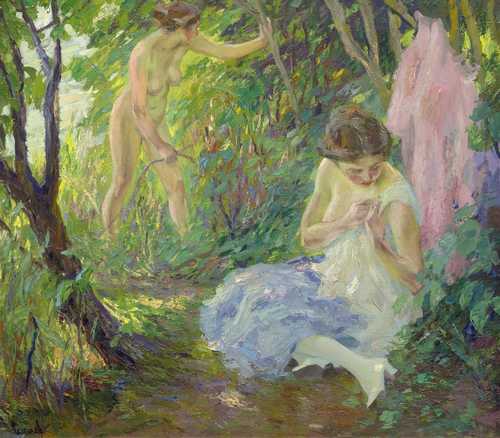
EDWARD CUCUEL
Nach dem Bade (After the bath). Before 1912.
Oil on canvas.
80 x 90 cm.
Estimate: CHF 30 000 / 50 000

GIOVANNI GIACOMETTI
Panorama von Muottas Muragl. 1898.
Oil on canvas.
Total: 67 x 510 cm
Estimate: CHF 2 800 000 / 4 000 000
As far as the eye can see: Giovanni Giacometti’s Engadine
Preview of the Swiss Art Auction on 28 June 2019
Early one October morning in 1897, the painters Giovanni Segantini and Giovanni Giacometti, accompanied by a photographer, set off on foot for Muottas Muragl, a 2453-metre high mountain southeast of Samedan in the Swiss Engadine. The ridge, which ten years later could easily be reached by funicular – the first of its kind in the Engadine – offers a breathtaking view over the Upper Engadine and the Engadine Lake District. The reason for their excursion was to make preparatory sketches for a gigantic circular painting to be presented at the Paris Exposition of 1900. Segantini had conceived a Gesamtkunstwerk in a circular building that would not only evoke the beauty of the Engadine through painting, but also with physical objects such as trees and alpine roses, waterfalls and bridges. The experience would be further enhanced with wind machines, as well as light and sound effects. Giovanni Giacometti, for whom Segantini (his elder by ten years) was a mentor, had enthusiastically promised his cooperation, and Cuno Amiet and Ferdinand Hodler were also invited to participate. However the project, sponsored by local tourism organisations, was abandoned for financial reasons. Segantini eventually showed the triptych “La Vita – La Natura – La Morte” (Life – Nature – Death) as a smaller project in Paris, with “La Natura” reproducing the view from Segantini’s cabin, slightly above Muottas Muragl.

GIOVANNI GIACOMETTI
Skier. 1899.
Oil on canvas.
65,5 x 102 cm.
Estimate: CHF 50 000 / 70 000

GIOVANNI GIACOMETTI
Eagle with the landscape of Engadine. 1898.
Oil on canvas laid on panel
44,5 x 82 cm (semicircle).
Estimate: CHF 60 000 / 80 000
Four motifs for the centrepiece
Giovanni Giacometti was able to use his studies made on Muottas Muragl for another commission: in October 1897, Anna von Planta commissioned paintings from him for her chalet in St Moritz-Bad. Of the ten paintings Giacometti subsequently completed, the four-part panorama of Muottas Muragl (ill. 1), to be offered on 28 June, was the centrepiece of the dining room. The first panel shows the view of the Roseg valley to the south of Muottas Muragl. Between Piz Chalchan on the left and Piz Surlej on the right, the snow-capped Sella group rises with the (then still striking) glacier tongues of the Sella and Roseg glaciers. Giacometti painted the view using the Divisionist technique he had learned from his teacher, Segantini. This is particularly evident in the forest areas, whose rich green is interspersed with complementary red. The rock formations, which are not composed of dull grey but of a rich palette of yellow, green, blue and pink, show the artist to be a master of colour.
In the second panel, a shepherd with a herd looks down on Lake St Moritz with St Moritz and St Moritz-Bad. The 3380-metre high Julier massif rises above it, and to the right the Piz Bever, somewhat bulkier than in reality. In other respects as well, the painter took a number of artistic liberties with the topography in this panel. For example, Lake St Moritz is perceived from Muottas Muragl diagonally rather than horizontally. The deviations from reality may be partly explained by the fact that Giovanni Giacometti executed the paintings in the winter of 1897/98 in Oschwand with his friend Cuno Amiet, and not on-site. Although he asked Giovanni Segantini for the photographs taken on Muottas Muragl at the end of 1897, he was apparently not interested in the slavish reproduction of reality, for he wrote in a letter: “I chose the view of Muottas Muragl as the motif for the composition, at least as far as the mountain range and the woods are concerned”. Commenting on a study, Anna von Planta even suspected that Giacometti placed the foreground approximately at the Hahnensee (Lej dals Chöds) below the Piz Surlej, so that the two villages would be Silvaplana and Champfèr.
The foreground of the third panel is dominated by a shepherd surrounded by his sheep. The view now turns to the west, where Piz Saluver appears at the left edge and Piz Ot to its right, marking the highest point of this area at 3246 metres.
The last panel completes the panorama with the view into the Val Bever. Here the horizon is marked on the left by Piz Üertsch, in the centre by Crasta Mora, and on the right by Piz Blaisun and the towering massif of Piz Kesch. What is striking is the absence of a distant view of Silvaplanersee, Silsersee and the Bergeller mountains – a segment that would actually be expected between the first and second panels. The reasons for this are unknown. In the correspondence with Anna von Planta there is explicit mention of four panels. However, a privately-owned study suggests that Giacometti had initially planned to show the lakes. The break in the continuum of space, however, is hardly noticed by the viewer and in no way diminishes the overall pictorial impression. Giacometti succeeds in this by a creating a unified panorama of the terrain in the foreground, through the horizontal strips of the lakes, as well as by the symmetrical positioning of the sheep in relation to the shepherd in the centre of the composition.
In dialogue with the client
The letters Anna von Planta wrote to Giacometti reflect her great interest in the progress of the works. It seems that the painter took his client’s criticism of the sketches partly into account in the execution of the pictures. Von Planta wrote: “The background of high mountain peaks is very pretty, but the mountain peaks might have calmer forms & less jagged & craggy, more in keeping with the character of our Engadine mountains. With regard to the detail of the foreground, I wouldn’t like to see too many alpine roses. One or two strong, flowering plants in the lower corner of the fourth field would probably suffice”. Anna von Planta also requested goats instead of sheep, but on this point Giacometti did not comply.
A few years after the panorama of Muottas Muragl, Giacometti created another monument to the beauty of the Grisons mountains with the panorama of Flims. The three-part composition was auctioned at Koller in 2016 and can now be admired at the Saner Foundation in Studen.
By Paul Müller, co-author of the catalogue raisonné of Giovanni Giacometti

GIOVANNI GIACOMETTI
Ruscello alpestre. Circa 1917.
Oil on canvas.
61,5 x 51 cm.
Estimate: CHF 150 000 / 250 000

CUNO AMIET
The fruit harvest (produced in preparation for the Wassmer version). 1912.
Oil on canvas.
103 x 115 cm.
Estimate: CHF 600 000 / 800 000
Cuno Amiet from the Loeb Collection
Preview of the Swiss Art Auction on 28 June 2019
The artist Cuno Amiet (1868–1961) and the Swiss department store entrepreneur and art collector Eugen Loeb (1877–1959) formed a close friendship beginning in the 1930s. Loeb – who like his brother (and Loeb department store co-owner) Arthur, had assembled an important art collection including works by Vallotton, Barraud, Varlin and Gubler, as well as Monet, Pissarro and Renoir – bought dozens of paintings and drawings from the artist. Amiet appreciated Loeb’s expertise and his sure hand in selecting the works. “I never want to you to see anything by me that I didn’t think was quite good”, the artist wrote to the collector in October 1936.

CUNO AMIET
Blue landscape. Circa 1910.
Watercolour on paper.
23,5 x 29,7 cm.
Estimate: CHF 10 000 / 15 000
The Loebs’ enthusiasm extended to important works from Amiet's very early years, acquired partly from the artist himself but probably also through the art trade, such as “The fruit harvest” and “Houses in the sun”.
“Liberation from Nature Painting”
Paintings of apples were a recurring theme throughout Amiet’s career. The motif of the apple or fruit harvest entered his pictorial world in 1907, and studies and numerous variations on the theme developed over the course of a few years – until about 1915 – into a distinctive group of works including the large-format oil on canvas entitled “The fruit harvest (Apple harvest in blue and red)” (ill. 1) to be offered on 28 June. The figure in the landscape exemplifies the artist’s iconographic references to paintings by Cézanne, Gauguin and Matisse. His choice of intense red – “the brightest and at the same time deepest colour that can express the idea of opulence”, as Amiet stated – is inspired by works by Emile Bernard.
Amiet’s palette alternates in his various creative phases: “Thus, as far as the colouring alone was concerned, one would have to speak of a remarkable ability to change”, the Basler Nachrichten stated in its obituary of the artist in 1961. “It could also be seen in earlier periods, for example in those monochrome representations of the apple harvest that, mostly tuned to red, rank among the boldest and most idiosyncratic creations of Amiet”. Already in 1912 Eberhard Grisebach saw in the monochrome motifs a great “progress, a liberation from nature painting” and a “transition to the creative decorative style.” Viola Radlach also noted that the simplified, contoured silhouettes recall the Cloisonnism or Synthetism of the school of Pont-Aven around Paul Gauguin.
The paintings from the Loeb Collection offered here display the intense creative process involved in Amiet’s “Fruit Harvest” works, culminating in three monumental versions. This motif, together with the few monochrome ones, stands out as an independent work from this series, because Amiet’s spontaneous expressive style in contrasting red/blue is most convincing here. He is at the height of the main artistic currents of the time: the expressionism of the Fauves, die Brücke and Cubism.
A further sixteen works by Amiet from the Loeb Collection will be offered on 28 June, including the small-format watercolour “Blue landscape” (ill. 2), painted in 1910, and two later landscapes, “Spring landscape with yellow flowering trees” (1938), and “Garden gate” (1931, ill. 3).

CUNO AMIET
Gartent(h)or. 1931.
Oil on canvas.
85,5 x 65,5 cm.
Estimate: CHF 70 000 / 100 000

FRANÇOIS FERRIÈRE
Trompe-l'oeil: putti dancing.
Oil on board laid on panel.
26 x 33,5 cm.
Sold for CHF 44 000
Deceptively real / Really deceptive
Review of the Old Masters Auction on 29 March 2019
To deceive the eye is the explicit intention of trompe l’oeil painting. Such illusions were already well-developed in antiquity, as evidenced by wall paintings in Pompeii. Pliny the Elder recounted a famous competition between the painters Parrhasius and Zeuxis: although Zeuxis attracted birds with his false grapes, he was deceived by a curtain painted by Parrhasius, and he attempted to raise it.
The practise of trompe l’oeil painting was revived during the Renaissance. In addition to illusionist wall and ceiling paintings, it was considered good form in the painter’s guild to master hyper-realistic depictions, for example through so-called “quodlibet” paintings, which featured realistically rendered domestic items. One of the highlights of this fashion is Cornelius Gijsbrecht’s “Back of a Painting” from 1670.
François Ferrière’s “Dancing Putti” (ill. 1) represents a highly original variant of the illusionist painting popular in 17th-century Flanders and 18th-century France. The artist tries to deceive the observer with every means at his disposal. Not only is an illusionistic cast shadow intended to mislead the viewer into perceiving a three-dimensional object, but also its edges are irregularly chipped. At first glance, or perhaps even at second glance, the two-dimensional painting seems to be a fragment of a stone sculpture or a bas-relief plaster cast. The heads and bodies of the putti, which seem to protrude from the pictorial ground, appear amazingly three-dimensional. Ferrière succeeds in manipulating his audience in a masterly manner.

ABRAHAM VAN DIEPENBEECK
The rescue of Saint Paul after the shipwreck.
Oil on panel.
34,5 x 27,5 cm.
Sold for 72 500
From canvas to stained glass
Review of the Old Masters Auction on 29 March 2019
“The rescue of Saint Paul after the shipwreck” (ill. 2) is one of several detailed preliminary studies by Abraham van Diepenbeeck (1596–1675) for the ten stained-glass windows of the Dominican Church of St. Paul in Antwerp. The windows, which were executed circa 1638 and have since been lost, depicted scenes from the life of Saint Paul of Tarsus. Stained-glass windows by van Diepenbeeck, whose father was also a glass painter, have been preserved in the Loretto Chapel of the Carmelite Monastery and the City Hall in Antwerp. During his years in Antwerp from 1620 onwards, van Diepenbeeck worked closely with his Flemish colleague Peter Paul Rubens (1577–1640), whose stylistic influence can be seen in the preserved oil studies and drawings.
The painting depicts the story of Paul’s journey as a prisoner to Rome, recorded in the Acts of the Apostles by the Evangelist Luke. Paul, who was to be brought before the Roman imperial court in the year 59 or 60, sensed an imminent storm and predicted a shipwreck: “Men, I can see that our voyage will be filled with disaster and great loss, not only to ship and cargo, but to our own lives as well”. The storm did come and the ship ran aground on a sandbank, but Paul, along with the other “two hundred and seventy-six souls”, was rescued on the nearby north coast of the island of Malta, presumably in Salina Bay near the village of Burmarrad. Van Diepenbeeck’s painting captures the scene in which the powerless “apostle of nations” is rescued from the waves and carried to safe ground. In the collection of the Städel Museum in Frankfurt am Main there is a chalk drawing with wash and gouache by van Diepenbeeck showing the same motif in landscape format.

HANS WEIDITZ the YOUNGER, also known as THE PETRARCH MASTER
Vagabonds playing dice and a peasant couple, circa 1525-30.
Pen and black ink, partially with wash, on laid paper. Old backing on laid paper.
18,1 x 22 cm. Gerahmt.
Sold for CHF 120 500
With virtuoso pen work
Review of the Old Master Drawings Auction on 29 March 2019
An important Swiss art museum acquired this accomplished 16th-century German ink drawing of vagabonds playing dice at the 29 March auction (ill. 3). Such rural scenes were very much in vogue at the time of its execution: “Depictions of this theme enjoyed great popularity from about 1520 until after the middle of the century. Copper engravings and woodcuts contributed to its widespread use. Pictures of peasant drolleries and bustling church fairs were popular with Dürer’s successors among the Nuremberg minor masters, but were also in demand in the Swabian region” (Fritz Koreny).
The vagabonds’ roadside gambling quite obviously arouses displeasure in the farmers, as suggested by the man pointing at the dice and the couple’s grim facial expressions. The maypole in the background and the peasant’s decorated hat may refer to the couple’s destination.
This drawing was made during a period in which artists such as Martin Schongauer, Albrecht Dürer, Albrecht Altdorfer and others revolutionised the world of motifs and graphic techniques. Executed in pen and ink with wash, on a medium-sized sheet of laid paper, it captivates by the virtuoso pen work of its creator
The attribution to Hans Weiditz the Younger is based on comparisons with woodcuts by Weiditz, such as illustrations to Francesco Petrarch’s On the remedies of good and bad fortune (Augsburg, 1532), in which numerous similarities of motif and style can be identified. Particularly striking are the expressive faces which have been worked through to the last detail, and the garments rendered with the utmost care.
Little is known about the German draughtsman Hans Weiditz the Younger, born around 1500 in Strasbourg or Freiburg, who is sometimes called the Master of Petrarch. Too few of his works have been attributed with certainty. He may have worked in Augsburg, Strasbourg, and finally Freiburg im Breisgau, where documents show his death in 1536. Among the works attributed to Weiditz is a series of botanical watercolours, created in 1529 and subsequently converted into woodcuts illustrating the three-volume edition of Herbarum vivae eicones (Strasbourg, 1530–1536) by Otto Brunfels. The watercolours were rediscovered in 1930 in the collection of the Botanical Institute in Bern.

1 DIAMOND RING, circa 1960.
Platinum 950.
Sold for CHF 137 300
ReView
1 The faceted diamond in this classic solitaire ring is distinguished by its extremely fine quality.
2 Adam Willaerts, who was born in London to a family originally from Antwerp, is considered one of the most important marine painters of the Golden Age. From the late 16th century on, he devoted himself to genre and marine painting in the north of the Netherlands.

2 ADAM WILLAERTS
River mouth with galley ships. 1620.
Oil on panel.
41,5 x 69,7 cm.
Sold for CHF 84 500

3 ENAMEL, DIAMOND AND SAPPHIRE BRACELET, BY DAVID WEBB, ca. 1960.
Yellow gold 750 and Platinum 900, 114g.
Sold for 28 100
3 The original and amusing frogs in this green-enamelled, highly decorative bracelet were a very successful creation for New York jeweller David Webb (1925–1975).
4 This painting, probably executed for a private Florentine palazzo, was made by a pupil of Lorenzo di Credi, one of the most influential artists of the High Renaissance, who was trained by Leonardo da Vinci.
5 This ointment jar with a portrait of a woman comes from a famous group of maiolica apothecary jars. Some of these so-called albarelli bear the coats of arms of Orsini and Colonna, two of the most influential Roman families of the 15th and 16th centuries.
6 The motif employed by Arnold Böcklin in this 1889 painting refers to Peter Paul Rubens’s “Battle of the Amazons” (circa 1680). This dynamic, powerful composition can be interpreted as a rebellion of Christian morality against the alienated, oppressed masses of the Roman Empire – a clash of different cultures and thus a timeless phenomenon.

4 TOMMASO DI CREDI
Madonna and Child with John the Baptist.
Oil on panel.
57,3 x 53,2 cm.
Sold for CHF 65 300

5 A MAIOLICA ALBARELLO OF THE "ORSINI-COLONNA" TYPE
Castelli d'Abruzzo, workshop of Orazio Pompei (1507-1589).
Circa 1545-1555.
Sold for CHF 13 700

6 ARNOLD BÖCKLIN
The battle on the bridge. 1889.
Oil on panel.
96 x 149,5 cm.
Sold for CHF 240 500

7 ZOOLOGIE
Merian Maria Sibylla.
Dissertatio de generatione et
metamorphosibus insectorum Surinamensium.
Sold for CHF 132 500
7 Maria Sibylla Merian, daughter of the topographical engraver Matthäus Merian the Elder, was enthusiastic about zoology from a young age. From 1699 to 1701 she travelled throughout the Dutch colony of Surinam and captured its flora and fauna in a series of unique watercolours.
8 This painting by the Antwerp mannerist de Cock was recently rediscovered in a private collection. It shows Saint Anthony resisting the temptation of wine offered to him by a noble lady.

8 JAN WELLENS DE COCK
The Temptation of Saint Anthony.
Oil on panel.
27,7 x 37,2 cm.
Sold for CHF 168 500

9 Horae B.M.V.
Book of hours.
Latin manuscript on vellum.
Sold for CHF 78 500
9 Seven large miniatures in polychrome and gold with richly executed borders, seventeen splendid five-line initials as well as numerous two-line initials in polychrome and gold adorn this illuminated book of hours, which was probably made around 1480 for a Franciscan commission.
10 In the 18th century, hyper-realistic tableware such as this tureen adorned the tables of noble families. Strasbourg was one of the centres of faience production.
11 This atmospheric depiction of a nocturnal winter landscape with a “snack bar” comes from the collection of TV producer Jef Rademakers, comprised of masterpieces of Dutch and Belgian Romanticism.
12 Meissonier’s sculptural work – about 20 bronzes – was only discovered after his death. The wax original of this bronze statue of Napoleon is in the collection of the Musée d’Orsay.

10 A TROMPE L'OEIL FAIENCE TUREEN IN FORM OF A SNIPE
Strasbourg, Paul Hannong period.
Circa 1745-1754.
Sold for CHF 32 300

11 ANDREAS SCHELFHOUT
Winter landscape by night with skaters and a "koek-en-zopie" 1849.
Oil on panel.
31 x 42,5 cm.
Sold for CHF 90 500

12 JEAN LOUIS ERNEST MEISSONNIER (1815-1891)
Bronze figure, "Napoléon à cheval" or "Le voyageur", circa 1900.
Bronze with dark patina.
L 59, H 48 cm.
Sold for CHF 180 500

1 Jan van Noordt.
The encounter of Pretiose and Don Juan
an amorous scene.
Oil on canvas. 131,5 x 172,5 cm.
Estimate: CHF 100 000 / 140 000
Artistic Elector, sensitive Don Juan
Preview of the Old Master Paintings auction on 29 March 2019
Lucas Cranach the Elder and the assistants in his well-organized workshop created six different portraits of his patron Duke Frederick the Wise (1463–1525), Elector of Saxony, friend of the arts and sciences. Cranach also served the Duke by cataloguing his important collection of 19,000 relics and recording them in woodcuts. The present portrait on beech wood (ill. 2) was probably painted in 1525, the year of Duke Frederick’s death. The last time it was shown publicly was in 1974, in the Basel Kunstmuseum.

2 Lucas Cranach the Elder.
Portrait of the Saxon Elector Frederick the Great.
1525. Oil on panel. 38,7 x 25,3 cm.
Estimate: CHF 90 000 / 120 000

3 Peter Binoit.
Bouquet of flowers in a brown engobe vase.
Öl on copper. 20,5 x 15,8 cm.
Estimate: CHF 80 000 / 120 000
The still-life painter Peter Binoit (1590/91–1632), who was active in Frankfurt-on-Main and in Hanau, reminds us of the transience of our existence with small, almost-hidden signs: in his opulent bouquet (ill. 3) there are not only fresh flowers but also wilting blooms. Benoit’s masterful composition and brushstrokes, as well as the superb colours, breathe life into the bouquet painted on copper.
Jan van Noordt (1623–1681), in his large-format "Encounter of Pretiose and Don Juan" (ill. 1), does not refer to historical models, but creates a completely new motif. Contrary to the cliché of the womanizer from literary models, Don Juan has soft and vulnerable features in this often-published painting.

Cover: Attributed to Hans Weiditz the Younger.
Diceplaying vagabonds and peasant couple, circa 1525–30.
Pen and ink in black, partially with wash, on laid paper,
mounted on old laid paper. 18.1 x 22 cm.
Estimate: CHF 35 000 / 55 000

4 Arnold Böcklin.
The battle on the bridge. 1889.
Oil on panel. 96 x 149,5 cm.
Estimate: CHF 250 000 / 350 000
Böcklin’s power and Rademakers’ eye
Preview of the 19th Century Paintings auction on 29 March 2019
The Swiss painter Arnold Böcklin (1827–1901) was inspired by Peter Paul Rubens for his monumental oil painting "Der Kampf auf der Brücke" (“The Battle on the Bridge”) (ill. 4). As in Rubens’s "Battle of the Amazons" (circa 1618), Böcklin situated the wild battle scene on a bridge, which allowed him to divide the picture into different zones. The struggle between a probably Germanic tribe and a supposedly Roman army fills almost the entire composition. He thus brings the viewer close to the brutal and raw events; the springing horses practically jump out of the frame. Böcklin’s portrayal can be interpreted as a rebellion of Christian morality against the alienated, oppressed masses of the Roman Empire.

5 Oswald Achenbach.
Merry company in the campagna of Naples with a view of Vesuvius
Oil on canvas. 66,5 x 95 cm.
Estimate: CHF 30 000 / 40 000

6 Carl Morgenstern.
Venice with a view of the Doge’s palace. 1863.
Oil on canvas. 54 x 89 cm.
Estimate: CHF 60 000 / 80 000
Carl Morgenstern (1811–1893), one of Carl Rottmann’s pupils and also one of the formative German “Italianists” is represented in the auction by a view of Venice with the Doge’s Palace and Santa Maria della Salute (ill. 6). On numerous journeys, Morgenstern collected impressions which he transformed into atmospherically charged representations of Italian coastal landscapes and cityscapes. The painting offered here, created in 1863, is proof of Morgenstern’s outstanding ability to transfer Mediterranean light to canvas.
Rademakers Collection
Some cornerstones of 19th century Dutch Romanticism offered in this auction come from the collection of former TV producer Jef Rademakers, which comprises more than a hundred paintings of the High Romantic period, mostly by Dutch and Belgian masters. Among the many highlights to be sold in Zurich are "Winter Landscape with koek en zopie ('cookie and hootch') by night" (ill. 7) by Andreas Schelfhout (1787–1870), and a Pronkstilleven still life painted by David Emil Joseph de Noter in 1847 (ill. 8) in Kunstkammerformat. The interest of both artists in the art of the 17th century is evident in these works.

7 Andreas Schelfhout.
Winter landscape with ‘koek en zopie’ by night. 1849.
Oil on panel. 31 x 42,5 cm.
Estimate: CHF 30 000 / 40 000

8 David Emil Joseph de Noter.
Still life. 1847.
Oil on panel. 28,5 x 38,2 cm.
Estimate: CHF 20 000 / 30 000

9 strongbox cabinet with Imperial arms.
stamped Haffner Frères, 8 passage Jouffroy Paris,
probably by C.G. Diehl or G. Grohe. Paris, circa 1860. 100 × 52 × 150 cm.
Estimate: CHF 50 000 / 70 000
Virtuoso craftsmanship, opulent decor
Preview of the Furniture, Porcelain and Silver auction on 28 March 2019
The art of lacca povera or lacquer povera (i.e. “poor person’s lacquer”), perfected in the 18th century in northern Italy and southern France, was inspired by Asian models.

10A Strasbourg trompe l’oeil snipe-form faience terrine.
Circa 1745–1754.
L 28 cm. H 22 cm.
Estimate: CHF 10 000 / 15 000

11 A rare German crucifix-form pendant clock with rock crystal
Probably by Conrad Kreizer, late 16th century.
4.5 × 3.3 × 1.7 cm.
Estimate: CHF 60 000 / 80 000
Chinese and Japanese lacquer works reached Europe in great numbers at this time, and first influenced craftsmen and clients in Venice and Genoa. Through imitation, the craftsmen soon developed their own technique: cut-out coloured engravings were glued to doors and drawers and served as decoration; only the elaborate lacquer finish in Sandarak natural resin was reminiscent of the Asian originals. The figurative and floral decor of a bureau bookcase (ill. 13) in the 28 March auction is exemplary: the people depicted within idealised landscapes have visibly given themselves over to the sweet side of life. A splendidly decorated strongbox cabinet of museum quality and in perfect condition can be attributed to the Parisian ébéniste Charles-Guillaume Diehl (1811–1885) (ill. 9). The mastery of craftsmanship manifested by Diehl and his large workshop caused a sensation at the Paris World’s Fairs of 1867 and 1878. Marquetry furniture created at that time can now be found in the world’s most important furniture collections. The magnificent cabinet that is now being offered is said to have been a gift in 1862 from the city of Paris to Emperor Napoleon III.

12 A Swiss tortoiseshell jewellery box.
Basel, 1714–1744. Maker’s mark of Hans Jakob D’Annone.
12,4x9,2x8 cm.
Estimate: CHF 6 000 / 10 000

13 A rare Italian Baroque “lacca povera” bureau bookcase.
Venice, 18th century. 139 × 58 (92) × 238 cm.
Estimate: CHF 100 000 / 150 000

14 M. S. Merian.
Dissertatio de generatione et metamorphosibus insectorum Surinamensium.
Den Haag 1726. / Histoire des Insectes de l'Europe, Amsterdam, 1730.
Estimate: CHF 60 000 / 90 000
Exotic fauna
Preview of the Books, Manuscripts & Autographs auction on 26 March 2019
and of the Drawings & Watercolours auction on 29 March 2019
The end of the 17th century was marked by an increased interest in nature. Maria Sibylla Merian (1647–1717) grew up in an artistic family; her father, Matthäus Merian the Elder (1593–1650), was one of the most important pictorial chroniclers of his time.

15 Rudolf von Alt.
View of a bedchamber, 1859.
Watercolour over gray ink and pencil, heightened with white.
33 x 40 cm.
Estimate: CHF 7 000 / 9 000

16 Horae Beatae Mariae Virginis.
Book of hours in Latin on vellum.
probably Flanders, circa 1460.
Estimate: CHF 70 000 / 90 000
Maria Sibylla became interested in zoology at an early age. The years she devoted to the study of the flora and fauna of the Dutch colony of Surinam arose from a recommendation: the governor there encouraged Merian to take a research trip through the coastal state. The drawings and objects collected on site by Merian between 1699 and 1701 formed the basis for a series of 60 copper engravings. Published in 1726 in her magnum opus, "Dissertatio de generatione et metamorphosibus insectorum Surinamensium" (ill. 14 and p. 9), they brought the artist posthumous fame in her home country. Two unusual features of the present edition are worth mentioning: first, the volume includes Merian’s two major works, for in addition to the Surinam insects, the famous treatise "Histoire des Insectes de l’Europe" from 1730 is included. Secondly, the ex-libris has been preserved – a copperplate engraving also made by Merian, which suggests that the work was originally owned by someone from her circle.
Magnificent book of hours
A livre d’heures from Flanders, circa 1460, stands out among the selection of rare books and manuscripts in the 26 March auction (ill. 16). The book of prayers and devotions is decorated with 17 magnificent miniatures in polychrome and gold, eight smaller miniatures and 32 border illuminations. Its architectural depictions are knowledgeably executed in a virtuoso manner. This painstakingly illuminated, wide-margined work has not been on the market for almost five decades and is in remarkably good condition.

14 M. S. Merian
Dissertatio de generatione et metamorphosibus insectorum Surinamensium.
Den Haag 1726. / Histoire des Insectes de l'Europe,
Estimate: CHF 60 000 / 90 000