

MASTER OF 1537 / FRANS VERBEECK (?)
Portrait of a jester. Circa 1550.
Oil on panel.
33.9 × 24.6 cm.
Estimate: CHF 500 000 / 700 000
Fools say what the wise man only thinks
Preview of the Old Master Paintings Auction on 27 September 2019
The jester as a symbolic figure crops up again and again throughout history in literature as well as in the performing and visual arts. Sixteenth-century Flemish painters Quentin Massys (1466–1530) and Lucas van Leyden (1494–1533) provided outstanding examples. A coloured woodblock print by Heinrich Vogtherr the Younger, circa 1540 (see illustration below) is closely related to the work offered in the 27 September auction. The jester, wellknown for taking liberties, is probably the most iconic figure of the court; his ambivalent role is most pronounced.

© akg-images
Although the jester had a comparatively good livelihood because of his proximity to power, when he fell out of favour, the good times were over, with even the possibility of execution. Thus the court jester's life was always a risky balancing act, a continuous all-or-nothing game between the lightness of being and downfall.
The portrait of a jester offered here had been on loan to the Musée départemental de Flandre in Cassel since 2010. It is easy to recognise the established attributes of the fool: the yellow and red costume and the fool's cap with donkey-ears and cockscomb. The fool’s staff on the right is reminiscent of dolls on sticks called “Marotte” dolls. This staff depicts the portrait of its bearer, which alludes to the narcissism and possibly also the godlessness of fools. The representation against a black background and the renunciation of a pictorial context concentrates the composition – and thus the viewer’s gaze – on the facial expression and physical attitude of the jester. This portrait form was a distinct rarity in the 16th century. In order to decipher his idiosyncratic gesture, one inevitably arrives at a saying that is still common in Dutch today: “iets door de vingers zien”. “To see something through one’s fingers” stands for the desire to turn a blind eye, to tolerate, to be broadminded. Apparently the artist is suggesting that one should overlook others’ – including the jester’s – mistakes. Eyeglasses are usually considered a sign of erudition. In this case, though, they probably stand for glare and deception, because at that time making eyeglasses, like the wooden temple glasses shown here, was a technical challenge. Since the resulting spectacles were of very uneven quality, their sellers were often regarded as charlatans.
This impressive jester’s portrait has been attributed to the “Master of 1537”. Active in Mechelen between 1520 and 1570, the Master’s sobriquet derives from a dated panel depicting the Holy Family which was attributed to him. Recent art historical research suggests that the Master of 1537 may have been Frans Verbeeck (before 1530–circa 1570). On the basis of a dendrochronological examination of the wooden panel, the present painting can be dated to a period following 1548, Verbeeck’s most intensive creative phase. His works are related to those of Jan Sanders van Hemessen (1500–1566) and Pieter Coeck van Aelst (1502–1550), but Verbeeck developed his own style, characterised by exaggerated facial features, extravagant poses and unique pictorial compositions. His subjects often contain satirical features. Chronologically and stylistically, Verbeeck’s paintings represent a connection between the works of Hieronymus Bosch (circa 1450–1516) and Pieter Bruegel the Elder (circa 1525/30–1569). In this context as well, this portrait is an excellent example of high-quality Flemish portrait painting of the 16th century.

BALTHASAR VAN DER AST
Still life with fruits in a woven basket.
Oil on panel.
29,7 × 52,3 cm.
Estimate: CHF 180 000 / 280 000
Saint John – favourite disciple, bearer of hope and patron saint
Preview of the Old Master Paintings Auction on 27 September 2019
Intimately close and skilfully bound within the pictorial space by the artist – this is how Mary, the Christ child and the infant John the Baptist appear in a large-format painting which can be described as one of the major works of Pier Francesco di Jacopo Foschi (1502–1567). Foschi, whose father was a pupil of Botticelli, was one of the most sought-after and successful artists during his lifetime, but later faded into obscurity. It was not until 1953 that the renowned Italian art historian Roberto Longhi rediscovered him and his works. Today Foschi is regarded as one of the leading Florentine painters of the 16th century. This high-quality and very well-preserved work can be dated to the creative phase between 1530 and 1540, in which the artist worked primarily under and with Jacopo da Pontormo (1494–1557). While Foschi’s artistic style in his early works was decisively influenced by the painting style of his master Andrea del Sarto (1486–1530), during this period he abandoned descriptive-narrative elements in favour of an emphasis on mystical and religious ones. Stylistically committed to Mannerism, the pictorial space appears densely compressed by the interlocking positions of the figures. The well-arranged composition of gazes, hands and curved bodies lends a lively dynamic. The masterly representation is softened by the colours and the extremely delicate skin tones of the figures. Comparable depictions were already popular devotional motifs among the Florentine bourgeoisie and nobility in the 15th century, especially since John the Baptist was the patron saint of Florence at that time and has remained so to this day.

THEOBALD MICHAU
Lively village scene before a broad landscape.
Oil on panel.
42 × 62 cm.
Estimate: CHF 50 000 / 70 000

Marche School, 15th century
Crucifixion.
Tempera and gold ground on panel.
42 × 30,2 cm.
Estimate: CHF 40 000 / 60 000
The suffering of Christ on the cross is one of the central subjects of Christian art. This panel, which dates from the High Gothic period and has never before been published, depicts the moment when Christ, shortly before his death, commended his favourite disciple John to Mary as her son: “Woman, here is your son” and “Here is your mother”. The artist stages this episode subtly: Mary takes the kneeling John by the hand and wraps her cloak around him protectively. Behind them, as if witnessing this highly emotional event, one sees Saint Francis of Assisi touching the cross. The rich golden ground of the sky with its engraved plant tendrils and the fascinating directed light on the four figures and their clothing, with the rocky landscape kept in shadow, are strikingly decorative and ennobling. This small-format panel from the early 15th century was probably made in the Marche near Fabriano or San Severino. “In these regions in the 15th century a pictorial world was formed, which combined the playful high Gothic style of Northern Italy, Lombardy, Visconti and Veneto with the elegance of Tuscany’s classical, more plastic world of forms.” (Prof. Dr Gaudenz Freuler).

PIER FRANCESCO DI JACOPO FOSCHI
Madonna and Child with the Infant St John the Baptist.
Oil on panel.
109 × 85 cm.
Estimate: CHF 400 000 / 600 000

ALPHONSE DE LAMARTINE
Les Laboureurs, poème tiré de Jocelyn reproduit en caractères tissés avec
license des propriétaires éditeurs, en souvenier de l'exposition de Paris 1878.
Estimate: CHF 80 000 / 120 000
A forerunner of computer technology
Preview of the Books Auction on 24 September 2019
What do the Statue of Liberty, Braille, the telephone and electric light have in common? They were all among the exhibits at the third World’s Fair, or Exposition Universelle in Paris in 1878, which focused on modern technology. In addition to the above-mentioned prominent exhibits, there was a very exotic-looking invention on display, the fruit of an enormous technical effort: an entire book made entirely of silk. The spiritual father and creator of this visionary project was the Lyon silk manufacturer Joseph-Alphonse Henry (1836–1913). It is not known how much time was spent and how many fruitless attempts were made by Henry and his studio before they reached their goal, but one thing is certain: the production costs must have been astronomical, and were probably only justified by the extraordinary publicity promised by the Paris Exposition.

LIVRE DE PRIÈRES
One page from the book.
Tissé sur soie d’après les enluminures
des manuscrits du XIVe au XVIe siècle.
Estimate: CHF 40 000 / 60 000
LIVRE DE PRIÈRES
Tissé sur soie d’après les enluminures
des manuscrits du XIVe au XVIe siècle.
Estimate: CHF 40 000 / 60 000
This very first programmed textile book – a poem by Alphonse de Lamartine: Les Laboureurs – was produced on a Jacquard loom. Joseph-Marie Jacquard (1752–1834) developed his idea for a programmable loom as early as 1790. By experimenting with punched cards, he managed to automate the process to a large extent. By 1801, Jacquard had perfected his invention, and was able to produce endless complex patterns with the help of thousands of punched cards. By doing so, Jacquard had created a forerunner of modern computer programs.
The woven copies produced by Henry were not intended for sale. Only three examples from 1878 are known today: one in Paris’s Bibliothèque Nationale, another in the Musée des Tissus in Lyon, and the one offered here, the veritable prototype (“Exemplaire No. I”). The present copy is the only one that is numbered. Another example, more richly decorated, was later ordered by the Comte de Paris, Philippe d’Orléans, on the condition that no more copies would be produced; it is conserved in the Musée Louis Philippe, Château d’Eu. Nevertheless, at least one other copy was made, but with a modified title page sporting more lavish borders, a new address for the J. A. Henry workshop, and a woven date of 1883.
Accurate to one-tenth of a millimetre
In addition to the last copy of the original edition of Les Laboureurs in private hands, the auction on 24 September also features the second, improved woven book: a book of hours entitled Livre de Prières. Tissé d'après les Enluminures des Manuscrits du XIVe au XVIe Siècle (Lyon 1886/87), which was also made by Joseph-Alphonse Henry and is of outstanding quality; the attention to detail in this book is second to none. It took more than fifty attempts over more than two years to achieve success. The pages have elaborate borders. The text, which is very clearly printed, is enhanced with four miniatures, three of which are fullpage. The encoding of the silk pages likely required some 300,000 to 400,000 punched cards. For the precise weaving of 400 weft threads per square inch for typography and illustrations, machine movements of no more than a tenth of a millimetre were permitted. Since the pages could only be woven on one side, the front and back sides were woven separately, and the subsequent gluing process was very error-prone. Livre de Prières was presented at the 1889 Exposition Universelle in Paris.
No further experiments in this extraordinary technique are known. The fact that these two outstanding technological masterpieces can now be offered at auction is a stroke of luck for collectors, institutions and museums. Alongside this singular pair of books, two hand-written books on silk weaving from 1855 and 1880 will also be auctioned.

HENRI ADOLPHE SCHAEP
Working on the docks at night. 1856.
Oil on canvas.
47,7 × 69 cm.
Estimate: CHF 15 000 / 20 000
Immersed in light
Preview of the 19th Century Paintings Auction on 27 September 2019
Following the success of the first part of the renowned collection of Jef Rademakers auctioned at Koller in March, on 27 September 2019 the second part will be offered, with Dutch and Belgian works from the Romantic movement of the 19th century, including “Village by a river in moonlight” by Theodorus Jacobus Abels (1803–1866). With such nocturnal river landscapes, which became a characteristic feature of his late works, Abels emulated the great painters of the 17th century, such as his compatriot Aert van der Neer (1603–1677). Abels’s moonlight images can be found in the royal collections of the Netherlands and Belgium.

JEAN-BAPTISTE-CAMILLE COROT
Naples – le Mont Saint-Elme et partie de la ville. 1828.
Oil on paper laid on panel.
20,6 × 40,4 cm.
Estimate: CHF 70 000 / 90 000

THEODORUS JACOBUS ABELS
Village by a river in the moonlight.
Oil on panel.
74,3 × 95,7 cm.
Estimate: CHF 12 000 / 18 000
Abels’s contemporary Henri Adolphe Schaep (1826–1870) attained great fame as a marine painter, but he also created dramatic landscapes bathed in moonlight, like the present painting “Night work at the docks”. One of his most important sources of inspiration was the Scheldt River, plied by large schooners between Antwerp and its mouth at the North Sea.
Jean-Baptiste Camille Corot’s (1796–1875) light-flooded view of Naples and Mount Sant’Elmo in pastel tones will also be offered in the 27 September auction. The artist collected his first impressions of Italy from 1825 until 1828, during his travels to Naples as well as to Rome and the Campagna. This painting from 1828 is an early open-air work by the Parisian artist, who was one of the pioneers of Impressionism. With particular attention to the rendering of light and atmosphere, in his early work Corot laid the foundation of a new understanding of landscape painting. His early, en plein air oil sketches and paintings come alive through luminous colours and flowing brushstrokes, and they had an enormous effect on the following generation of artists. The often-exhibited landscape offered here once belonged to the influential Parisian art dealer and gallery owner Paul Durand-Ruel.
A glimpse into the private life of monks is offered by Eduard Grützner in his “Secret Study”, 1892, which depicts three clergymen studying in a monastery library. With an outstanding variety of details, this characteristic work is part of a group published under the title “Monks or priests reading and engaged in other leisure activities”. The artist – appointed in 1886 as Professor of the Munich Academy and raised to the nobility in 1916 – counts alongside Carl Spitzweg (1808–1885) and Franz von Defregger (1835–1921) as one of the most important Munich genre painters of the late nineteenth century.

PEDUARD GRÜTZNER
Heimliche Studie (Secret study). 1892.
Oil on canvas.
79,5 × 60,5 cm.
Estimate: CHF 40 000 / 60 000

RARE PRECISION SKELETON PENDULUM CLOCK
WITH DATE, DAY, SIGNS OF THE ZODIAC AND SECOND
Louis XVI/Directoire, Paris, end of the 18th century
42 x 20 x 62 cm.
Estimate: CHF 30 000 / 50 000
Technical elegance
Preview of the Furniture, Sculpture, Silver and Porcelain Auction on 26 September 2019
Skeleton clocks combine two very different professions: the art of watchmaking, and product design. At the end of the 18th century, the Industrial Revolution was still in its infancy, but fascination with technology grew rapidly. Clocks such as the French skeleton clock offered at auction on 26 September were painstakingly produced by hand at that time, and had evolved from decorative accessories in elaborately designed cases, to technical masterpieces exhibited with pride. The makers took care to show the sophisticated mechanical interplay of the highly refined and precisely crafted movements. The dial was reduced from a large white enamel disc to a ring, thus allowing an unimpeded view of the interior movement. Most valuable skeleton clocks of this period, including the one offered here, are characterised by very precise movements. A special feature of these clocks made in Paris is a compensation pendulum, which can make up for differences in movement caused by variations in temperature.

FOUR GROUPS OF LARGE FIGURES, ALLEGORIES OF THE FOUR PARTS OF THE EARTH
Meissen, models by J. F. Eberlein.
Circa 1746 / 1763.
H 25 / 30 cm.
Estimate: CHF 40 000 / 60 000

PAIR OF IMPORTANT ROCOCO SCONCES
Germany, Franconia ca. 1765.
Carved and polychrome painted wood.
H 58,5 cm.
Estimate: CHF 20 000 / 30 000
A pair of magnificent Rococo wall appliques from circa 1765 boasts an exciting provenance: the renowned Munich art dealer Karl Fischer-Böhler arranged the sale of six of these Franconian appliques to Lesley and Emma Shaefer, an American collecting couple, who in turn donated them to the Metropolitan Museum of Art in New York, where they are exhibited today. Another pair from this same series, which Fischer-Böhler kept for himself, will now be offered at auction in Zurich. In the finesse of their polychrome carvings, but also in the uniqueness of their design, the two naturalistic appliques are reminiscent of the important seating and ornamental furniture from Schloss Seehof, formerly owned by the Prince-Bishop of Würzburg, Adam Friedrich von Seinsheim (1708–1779). Presumably, these wall appliques were also part of the interior, which today – also donated by the Shaefer Collection – belongs to the Met.
Early examples of porcelain wares with the crossed swords mark from the famous Meissen manufactory are among the most sought-after pieces on the historical porcelain market. The large allegories of the four continents of Europe, America, Asia and Africa from 1745 to 1763 offered here are based on models commissioned by the Russian Empress Elizabeth Petrovna in 1745. The designs were provided by the experienced porcelain modeller Johann Friedrich Eberlein (1695–1749). In 1741, Elizabeth I received extensive deliveries of Meissen porcelain from the Saxon Elector Frederick Augustus II, and in the following years she ordered further “white gold” from the “Electoral Saxon Porcelain Manufactory” – pieces which are today in the Hermitage Museum in St Petersburg. Elizabeth’s father, Czar Peter the Great, and Frederick Augustus’s father, Augustus the Strong, were both devoted collectors of porcelain, and had already cultivated friendly relations between the two countries, including the exchange of diplomatic gifts such as porcelain figures.

LARGE COMMODE "À LA GRECQUE"
Transition, Paris ca. 1765/70.
Signed S. OEBEN.
Purpleheart, satinwood and amaranth, inlaid as geometric reserves and fillets and marquetry.
Estimate: CHF 80 000 / 120 000

01 PAIR OF BOTTLE HOLDERSR
Milan, 20th century. Maker's mark Buccellati.
Designed as swans. With removable inserts, for bottles.
H 28,5 and 34 cm. Total weight 2960 g.
Estimate: CHF 4 000 / 8 000
PreView
01 The tradition-rich Bucellatti firm in Milan is celebrating its centenary in 2019. One of its prominent customers was the poet Gabriele D'Annunzio.

02 PETER BINOIT
Glass vase with bouquet of flowers, may beetle, snail and other small insects.
Oil on panel.
33,8 × 24 cm.
Estimate: CHF 80 000 / 120 000

03 ALBRECHT DÜRER
Christ on the cross, circa 1497/98.
Woodcut.
39 x 27,5 cm. Framed.
Estimate: CHF 15 000 / 20 000

04 ORIENT -
David Roberts. Egypt & Nubia.
From Drawings made on the spot by David Roberts, R.A. Two parts in three volumes.
London, F. G. Moon, 1846–1849.
Estimate: CHF 25 000 / 40 000
02 This bouquet of flowers by the German artist Binoit is typical of the early 17th century, with a dark background and rendered in an almost photorealist manner.
03 Dürer’s “Apocalypse”, comprising 16 motifs, is one of the highlights of printmaking and his depiction of the apocalyptic riders is one of the best-known woodcuts ever made.
04 David Roberts produced this encyclopaedic work depicting buildings and monuments during his journey along the Nile in 1838 and his stays in Cairo and Alexandria in 1839.
05 The IJ was Amsterdam’s direct link to the sea. In addition to winter scenes, Leickert’s trademark was a dramatic sky bathed in evening light.
06 De Noter's painting not only gives a glimpse of everyday life in the mid-19th century, it also enhances the genre scene with details that are themselves small still lifes.

05 CHARLES HENRI JOSEPH LEICKERT
The IJ with Amsterdam in the distance.
Oil on panel.
30 × 40,8 cm.
Estimate: CHF 25 000 / 35 000

06 DAVID EMIL JOSEPH DE NOTER
Kitchen interior. 1845.
Oil on panel.
76,5 × 58 cm.
Estimate: CHF 20 000 / 30 000

07 JOHANN RUDOLF BYS
Pair of works: Large exotic sea snail, with flowers and finch /
Large scallop with flowers and goldfinch. 1694.
Oil on canvas. Each 44,5 × 35 cm.
Estimate: CHF 60 000 / 100 000
07 The Swiss painter Bys was commissioned by Emperor Leopold I to paint for the House of Habsburg and Elector Lothar Franz von Schönborn. The inclusion of pendant works was popular in many private collections, as witnessed by this pair of still lifes.

08 CIRCLE OF NICCOLÒ DA VOLTRI
Madonna and Child with Saints Peter, Paul, John the Baptist and Antonius Abbas.
Tempera and gold ground on panel.
46,4 × 33,4 cm.
Estimate: CHF 30 000 / 50 000

09 RARE TAPESTRY "TOBIAS MIT DEM FISCH"
Brussels, ca. 1530/40.
Based on the models of a successor of Bernard van Orley.
350 × 430 cm.
Estimate: CHF 10 000 / 15 000
08 This small-format Marian painting from circa 1400 was probably made in Liguria or Tuscany and was originally used for private devotions.
09 This tapestry shows a scene from the Old Testament book of Tobit. Tobit’s son Tobias is accompanied on a journey by the archangel Raphael, who helps him to allow his blind father to see again by using fish gall.
10 This master, whose identity is unknown but whose works are documented in northern Italy, was influenced by the style of the important Florentine painter Domenico Ghirlandaio. This representation of the Madonna stands out through its strict composition as well as its sublime execution.
11 Huysum was praised in his time as the “phoenix of flower and fruit painters” because the delicacy and precision of his paintings was unequalled.
12 The Roman aristocracy valued Piancastelli, who came from a humble background, both as a portrait painter and as an artistic advisor.

10 MASTER OF MARRADI
Madonna and Child surrounded by archangels. Circa 1500.
Tempera on panel.
67 × 44,5 cm.
Estimate: CHF 40 000 / 60 000

11 JAN VAN HUYSUM
Vase of flowers in a niche. Circa 1725-28.
Brown pen, black chalk, grey and brown wash on slightly brown paper.
24,2 x 18,5 cm. Framed.
Estimate: CHF 15 000 / 20 000

12 GIOVANNI PIANCASTELLI
Pair of works: Emigrazione dell' Agro Romano - Partendo und Tornando.
Oil on panel.
59,7 × 99,8 cm / 59,1 × 99,9 cm.
Estimate: CHF 180 000 / 250 000

AN IMPORTANT IMPERIAL "PHOENIX AND PEONY"-BRONZE CENSER (2019)
China, 17th/18th century
Height 24 cm, widht 59 cm, weight 22,3 kg.
Parcel-gilt bronze.
Sold for CHF 4,8 Mio
4.8 million for an incense burner
Top results for Asian art
Koller’s Asian Art specialists made an important discovery when they visited a client’s home last autumn: they were offered a large bowl which had been owned by the family for generations, and was now being used as a container for tennis balls and other items. The owners obviously didn’t realize that the misappropriated vessel was an important Chinese imperial censer, made around 1700 in parcel-gilt bronze. This rare find was auctioned at Koller’s Asian Art sale in June, where it fetched the record price of 4.8 million Swiss francs.

A BRONZE FIGURE OF BUDDHA SHAKYAMUNI ON A LION THRONE (2017)
Northeastern India, Pala, 8th/9th century.
Height 16,5 cm.
Silver and copper inlays.
Sold for CHF 1,17 Mio.

A TURQUOISE GROUND CLOISONNÉ ENAMEL DISH (2017)
China, Ming dynasty, first half of 15th century.
Diameter 26 cm.
Golden double vajra on the back. Slightly damaged.
Sold for CHF 144 000
In May, the richly decorated incense burner was the star of the International Antiques Fair in Hong Kong, where Koller exhibited it along with other highlights in advance of the auction. Many of Asia’s most important collectors participated in the auction room in Zurich, or via telephone, creating an intense bidding competition; more than thirty interested parties submitted bids for this unique work. The lot was finally won by a collector from China who is setting up a private museum in Beijing. Interestingly, the censer could have ended up in an important museum of East Asian art as early as the 1960s, when the owners offered it for sale, but the museum politely refused to make an offer. Another attempt at sale in the 1970s did not come to fruition because a London auction house thought the object was likely a 19th-century copy and told the owners that the costs of shipping “would hardly be worth it”.
Phoenix and peonies
China is regarded as the ancient capital of bronze casting. The technique was developed early on there, and perfected over thousands of years. The price of CHF 4.8 million achieved for the incense burner is a record for such an object, for which there are no comparable pieces known in terms of size and quality. Its design is unique: the heads of two phoenixes, whose wings blend into peonies and embrace the vessel, serve as handles. The phoenix is considered the king of birds in China; the peony the queen of flowers. Its symbolic power permeates all branches of Chinese culture. One of the most famous opera pieces of the Ming period, written by Tang Xianzu, a contemporary of Shakespeare, bears the title “Peony Pavilion”. The phoenix is also a symbol of the Chinese empress, which is why it can be assumed that the basin – almost 60 centimetres in diameter and weighing 22 kilograms – was created for an imperial palace or temple. There is a Xuande six-character stamp at the base of the vessel. According to their original purpose, such vessels were filled with rice ashes, into which glowing incense sticks were placed. China has had an important tradition of ancestor veneration for thousands of years, which has always been accompanied by the burning of incense. At such ceremonies, ancestors and gods were honoured by burning incense sticks in temples or before household altars.
The record price for this censer is the culmination of a series of excellent results for important Asian works of art achieved at Koller in recent years. For example, a Tibetan bronze of the deity Panca Raksha was sold for CHF 3.24 million. An imperial room partition made of carved wood fetched CHF 940,000 in 2017. In the same year, Koller sold a bronze sculpture of Buddha Shakyamuni on a lion throne for CHF 1.17 million and an imperial Chinese bronze bell changed hands for CHF 1.2 million.

A DARK COPPER GLAZED MEIPING VASE (2018)
China, Qianlong mark and of the period.
Height 30 cm.
Sold for CHF 102 000

01 RENÉ MAGRITTE
Les voies et moyens. 1948.
Gouache and gold on paper.
40,5 × 32,8 cm.
Sold for CHF 439 000
ReView
01 Magritte deliberately provoked le tout Paris in 1947/48 with a series of caricature-like portraits pervaded by biting criticism.

02 PIERO DORAZIO
Mimet. 1962.
Oil on canvas.
46 × 33 cm.
Estimate: CHF 88 000

03 FERDINAND HODLER
Schreitende. (figure stepping) Circa 1910.
Oil on canvas.
46,5 × 40 cm.
Sold for CHF 340 000

04 MAGNUM PHOTOS
“Sélection Esther Woerdehoff ”, 1947–2007.
Portfolio with 15 original photographs.
Sheet dimension 28 x 35.5 cm to 40 x 50 cm (various portrait and landscape formats)
Sold for CHF 45 000
02 Dorazio translated phenomena of light and colour into energetic, shimmering compositions.
03 Hodler enjoyed great success throughout Europe in the years around 1900 with variations on symbolically charged full-length fi gures such as this woman (his model, Giulia Leonardi), moving as if in a dance. These female fi gures not only became the artist's trademark, but also icons of Swiss modern art.
04 For the agency’s 60th birthday, gallery owner Woerdehoff published a selection of world-famous Magnum photographs.
05 In Dietrich’s intense landscape paintings, expressiveness and colour combine to create drama, and sometimes also “operatic exaltation”.
06 Sisley does not describe the drama of nature, but reveals the unique amongst the seemingly ordinary.

05 ADOLF DIETRICH
Evening at the lake with red clouds. 1915.
Oil on board.
28 × 38,5 cm.
Sold for CHF 183 000

06 ALFRED SISLEY
Autour de la forêt, juin. Circa 1885.
Oil on canvas.
54 x 72,7 cm.
Sold for CHF 800 000

07 ROBERT MANGOLD
Red with Green Ellipse / Black frame. 1988/89.
Acrylic and pencil on canvas (diptych).
140 x 210 cm.
Sold for CHF 315 000
07 In Mangold’s voluminous double pictures, colour and material move into space, and this expansion of the picture into the three-dimensional creates a relationship of its own with the viewer. In his works, the artist addresses the dialogue between uncertainty and conviction, between intuition and analysis.

08 JEAN FAUTRIER
La passoire. 1947.
Oil on wove paper on canvas.
46 x 55 cm.
Sold for CHF 207 000
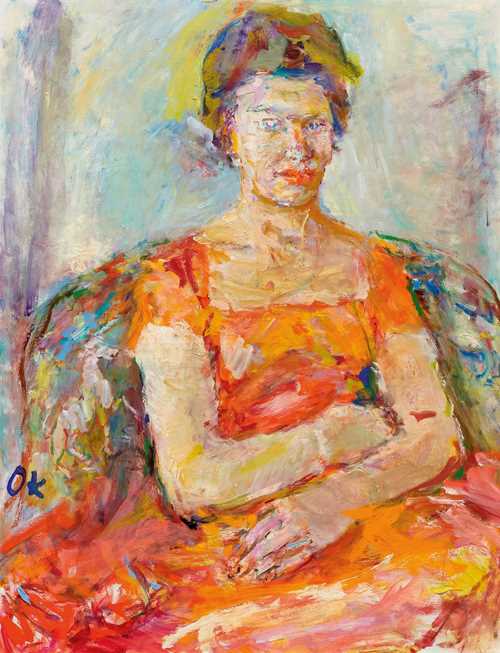
09 OSKAR KOKOSCHKA
Ann Windfohr. 1960.
Oil on canvas.
91 x 70 cm.
Sold for CHF 146 000
08 Fautrier’s art informel paintings are characterised by the pasty application of paint and concentration on an isolated, non-objective motif.
09 Kokoschka’s skill as a portraitist was in demand; here he painted the American art collector Ann Windfohr.
10 This portrait of a skier in the mountains above Maloja was one of the last paintings Giacometti made for his client Anna von Planta.
11 Countless artists, including Moret, were fascinated by the unique landscape of the Breton cliffs. In his paintings he combines the Synthetism of the Pont-Aven school with Impressionism.
12 Bugatti’s bronzes – predominantly depictions of animals and figures such as this nude – mark the transition from Art Nouveau to Art Deco.

10 GIOVANNI GIACOMETTI
Skier. 1899.
Oil on canvas.
65,5 × 102 cm.
Sold for CHF 488 000

11 HENRY MORET
Falaises, côte de Bretagne. 1910.
Oil on canvas.
64 x 79 cm.
Sold for CHF 110 000

12 REMBRANDT BUGATTI
"Le Réveil", circa 1907.
Bronze with brown patina.
H: 34.5 cm.
Sold for CHF 195 000
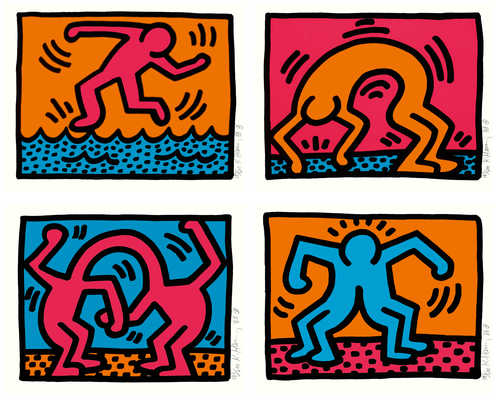
13 KEITH HARING
Pop Shop I-IV. 1988.
Lot of 4 colour screenprints.. 183/200.
Varying image sizes on wove paper 30.5 x 38 cm.
Sold for CHF 56 000
13 This series of four colour silkscreen prints was created during the years when Haring ran his Pop Shop in New York, selling originals and prints of his own works. The style of his figure paintings, which he also often painted on the walls of buildings and on billboards, is unmistakable.

14 CUNO AMIET
The fruit harvest. 1912.
Oil on canvas.
103 × 115 cm.
Sold for CHF 775 000

15 LOUISE NEVELSON
Cloud II. 1984.
Painted wood.
84 x 115 x 6,5 cm.
Sold for CHF 73 000
14 Amiet’s apple paintings were a recurring theme throughout his artistic career. Many studies and variations of this subject coalesced over the course of a few years, until about 1915, into a veritable group of works including this large-format painting. In this version of the fruit harvest the artist is at the cusp of the main artistic currents of that period: the Expressionism of the Fauves, die Brücke and Cubism. This work comes from the collection of Eugen Loeb, with whom Amiet was friends until his death.
15 With their genuine pictorial inventions, the generation of artists that included Louise Nevelson contributed to the emancipation of contemporary American art from European influences.

FRANZ GERTSCH (2018)
Dominique. 1988.
Woodcut in colour. 7/18.
103 x 115 cm.
Sold for CHF 168 000
Swiss Printmakers
Results for Swiss prints
The protagonists of Swiss printmaking have left their mark on art history in many fascinating ways, especially within the last 150 years. The tradition ranges from woodcuts and etchings by Félix Vallotton to lithographs by Alberto Giacometti, linocuts by Lill Tschudi and woodcuts by Franz Gertsch. Their works reveal an endless variety of expressive possibilities in printmaking. Particularly fascinating are the different results that can be achieved while using the same techniques: although Vallotton and Gertsch both made woodcuts, their pictorial worlds could not differ more.

LILL TSCHUDI (2018)
Guards. 1936.
Linocut in red.
Image 16 x 20.2 cm on thin Japan laid paper 22.5 x 28 cm.
Sold for CHF 2 500
Félix Vallotton (1865–1925) used powerful, flat black-andwhite contrasts in his individual prints and series to create his signet-like motifs. With only a few perfectly placed cuts in the wooden block he succeeded in creating timeless images. It is also interesting to note the stark contrast between the artist’s woodcuts and his drawings and paintings. This is not the case with Alberto Giacometti (1901–1966), whose lithographs and etchings are closely related to his drawings and paintings. Giacometti's drawings on litho stone did not differ in motif or style from his unique works on paper and canvas. His characteristic oeuvre is dominated by portraits, landscapes and interior views of his studio. In the book Paris sans fin, published in 1969, the 150 illustrations by Giacometti demonstrate his consummate skill as a lithographer. Published in a small edition, it was a milestone in 20th-century printmaking art.
Lill Tschudi (1911–2004), who studied at the innovative and influential Grosvenor School of Modern Art in London in the late 1920s, caused a sensation with her striking linocuts. Pablo Picasso was one of the principal artists to establish this technique in modern art. Claude Flight introduced the Glarus-born Tschudi to the linocut technique, while companions such as André Lhote, Gino Severini, and Fernand Léger broadened her artistic horizons. In contrast to most of her contemporaries, Tschudi worked exclusively in linocut. Her subjects of the interwar years in particular reflect the Zeitgeist impressively: her motifs are characterized by technical progress, intensity and speed, but also by anonymity and the looming crisis of the late “Roaring Twenties”.
Among contemporary Swiss artists, Franz Gertsch (*1930) is closely associated with the Swiss printmaking tradition. Monumental woodcuts play a central role in his work. From 1986 to 1994, Gertsch devoted himself exclusively to working in woodcut and in doing so advanced to completely independent forms of expression. With his own Japan paper, Gertsch attained the limits of what is possible in woodblock printing and opened up a new dimension for this classical medium. His prints are dominated by monochrome, format-filling portraits of women from his circle and fascinating details from landscapes, to which the artist has a special connection. Gertsch imbues his works with incomparable plasticity and dynamism with the simplest of means but with masterly execution.unprecedented precision, not least in the production of

FÉLIX VALLOTTON (2017)
Les Trois Baigneuses. 1894.
Woodcut. 85/100.
30.5 × 20 cm.
Sold for CHF 9 500

ALBERTO GIACOMETTI (2019)
Self-portrait. 1963.
Lithograph. 64/75.
65.4 × 50.5 cm
Sold for CHF 10 000

Founder and grand seigneur
Pierre Koller dies at the age of 94
Anyone who entered the Galerie Koller on Zurich’s Rämistrasse next to the legendary “Kronenhalle” restaurant in the 1960s–80s was received by the owner as if he or she were a regular customer. Those who were, always felt welcome there – and those who weren’t did too. For Pierre Koller barely differentiated between new customers and long-time art collectors when, stretching out his arms, he rushed towards them with a “Bonjour, Monsieur”, or a “Guten Tag, Madame”. His charm was as legendary as his wit, which he employed to keep saleroom bidders in the best of spirits during long auction sessions.
Pierre Koller was a grand seigneur in the old style, an art lover with a French penchant for the grandiose, and above all an excellent salesman. A lawyer by training, he opened a picture gallery on Zurich’s Dufourstrasse in 1958, specialising in equestrian prints – the 34-year-old was fascinated by horse-related art, and he decided to turn his hobby into his profession. The following year he was joined by his sister Antoinette, who had an eye for ceramics, silver and Asian art, and it didn’t take long before the Kollers expanded the range of the gallery.
nternationally, Pierre Koller became known for his expertise in quality antique furniture and objets d’art, especially of French origin. He held his first auction in 1960 at the Kongresshaus in Zurich, when several important collections were consigned to him, including a group of clocks from a private Augsburg collector. In 1961, the company moved to the Rämistrasse where it established an impressive five-story auction house. Soon Koller was holding regular auctions of valuable art objects and entire collections from all categories at the Rämistrasse. In 1991, Galerie Koller moved its headquarters from the Rämistrasse to the Hardturmstrasse in Zurich West, at a time when nobody had any idea that the neighbourhood would become a mecca for art galleries.
A highlight in Pierre Koller’s life as an auctioneer was the 1995 auction of an epochal private collection of Napoleonica, in which Koller specialised. In 1973, a portrait of Dora Maar by Pablo Picasso realised the first hammer price of over one million Swiss francs at Koller Auctions. One of the last of Pierre Koller’s countless successes on the rostrum was a bureau plat by the famous cabinetmaker André-Charles Boulle, which he sold to a private London collector for 3 million Swiss francs in September 2014, a few days after his 90th birthday.
Pierre Koller’s art gallery and auction house quickly grew into a small empire. In 1975, a branch was opened in Lucens Castle in French-speaking Switzerland, which was moved in 1980 to the Rue de l’Athénée, Geneva. “Koller Tiefenbrunnen” was introduced in 1977 as an outlet for medium- and low-priced works of art, a market segment later served by “Koller West” on the Hardturmstrasse. In 2004, Pierre Koller handed over the management of the family business to his eldest son Cyril.
Pierre Koller was a pacesetter for the Swiss art trade. He taught the ropes of the art business to a great many people who later became some of the most famous gallery owners and auctioneers in Zurich. The founder of today’s largest Swiss auction house died on 23 June at the age of 94.
This obituary by Philipp Meier appeared in the Neue Zürcher Zeitung on 26 June 2019.