

01 PAIR OF DECORATIVE GILT BRONZE SWANS
After a Meissen porcelain model from 1748
by JOHANN JOACHIM KÄNDLER (1706-1775)
Louis XV, Paris, probably 18th century
Sold for CHF 40 560
ReView
01 The models for these two objects were probably from the famous Meissen Swan Service, made in 1737 under the direction of Count von Brühl.

02 JOHANN RUDOLF BYS
Pair of works.
Oil on canvas.
Each 44,5 × 35 cm.
Sold for CHF 171 100
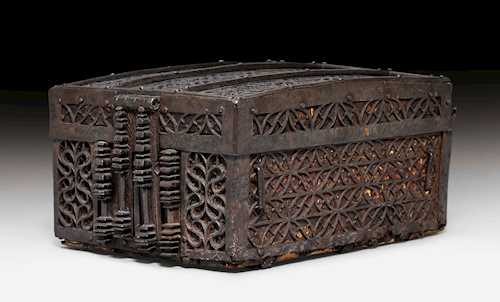
03"MINNEKÄSTCHEN" WITH IRON REINFORCEMENTS,
Gothic, France, 15th century.
Oak core, with opulent iron mounts designed
as pierced, stylised tendrils.
Sold for CHF 6 000

04SCHOOL OF THE MARCHES, 1ST HALF OF THE 15TH CENTURY
The Crucifixion.
Tempera and gold ground on panel.
42 × 30,2 cm.
Sold for CHF 152 800
02 Pairs of paintings enjoyed great popularity in the age of cabinets of curiosities and private art collections. The motifs of the Swiss artist Bys, whose known works include not only panel paintings but also many mural paintings which were influenced by models from the Netherlands and Italy.
03 Small boxes like this were literally “reliquaries of love”. Such miniature boxes made of wood, leather or ivory were given as gifts and were regarded especially from the 13th to the 15th centuries as an expression of deep friendship, for example between fiancées or a bride and groom.
04 This work from the High Gothic period shows the moment when the dying Christ commends his favourite disciple John to his mother as her son.
05 Van der Ast specialised in brilliantly painted, symbolically charged still lifes, especially flower pieces and fruit arrangements. From 1619 he lived in Utrecht, where he was a member of the Guild of St Luke, which conferred prestige and numerous commissions.
06 Klombeck’s artistry and painterly virtuosity are expressed in the myriad of details in his paintings.

05 BALTHASAR VAN DER AST
Still life with fruits in a woven basket.
Oil on panel.
29,7 × 52,3 cm.
Sold for CHF 219 900

06 JOHAN BERNHARD KLOMBECK
Forest path with travellers by a stream. 1857.
Oil on panel.
69,5 × 58 cm.
Sold for CHF 36 900

07 MEISTER VON 1537 / FRANS VERBEECK (?)
Bildnis eines Narren. Um 1550.
Öl auf Holz.
33,9 × 24,6 cm.
Sold for CHF 695 300
07 Dieses frühe Narrenbildnis ist ein exzellentes Beispiel für die flämische Porträtmalerei des 16. Jahrhunderts zwischen Hieronymus Bosch und Pieter Bruegel d. Ä.

08 JEAN-BAPTISTE-CAMILLE COROT
Naples – le Mont Saint-Elme et partie de la ville. 1828.
Oil on panel.
20,6 × 40,4 cm.
Sold for CHF 104 000

09 JAN WELLENS DE COCK
Two altar panels.
Oil on panel.
Each 48,5 × 25,5 cm.
Sold for CHF 522 800

10 PAUL TROUBETZKOY
Bronze sculpture of Ettore Bugatti on horseback.
Bronze with dark brown patina.
54 x 31 x 62 cm.
Sold for CHF 128 400
08 Corot's works – such as this city view from his early oeuvre – mark the step from classical academic landscape painting to modern art. His colours and his way of rendering the southern light were important sources of inspiration for the Impressionists.
09 These two panels were probably part of a triptych which was separated in the 19th century; they were only recently reunited by a private collector.
10 The Italian sculptor Paul Troubetzkoy had Russian roots and lived in Switzerland in the beginning of the 20th century. Depicted is the founder of the famous Bugatti car brand, whose factory was located in Alsace from 1909 to 1963, and later in Italy.
11 Michau, who was active around 1700, was one of the last representatives of the golden age of Dutch landscape painting, which began almost a century and a half earlier.
12 In the second half of the 15th century and in the early 16th century, cloth paintings were particularly popular. In this technique, the pigments are applied to a finely woven linen cloth with glue tempera without priming. In spite of the highly fragile material, this depiction of Christ has been excellently preserved.

11 THEOBALD MICHAU
Festive village gathering.
Oil on copper.
33 × 45 cm.
Sold for CHF 73 500

12 SOUTHERN NETHERLANDS / GERMANY CIRCA 1500
Christ with the crown of thorns.
Tempera and gold ground on canvas. (Tüchleinmalerei).
47 × 37,5 cm (visible dimensions).
Sold for CHF 97 900

MASTER OF 1537 / FRANS VERBEECK (?)
Portrait of a jester. Circa 1550.
Oil on panel.
33.9 × 24.6 cm.
Estimate: CHF 500 000 / 700 000
Fools say what the wise man only thinks
Preview of the Old Master Paintings Auction on 27 September 2019
The jester as a symbolic figure crops up again and again throughout history in literature as well as in the performing and visual arts. Sixteenth-century Flemish painters Quentin Massys (1466–1530) and Lucas van Leyden (1494–1533) provided outstanding examples. A coloured woodblock print by Heinrich Vogtherr the Younger, circa 1540 (see illustration below) is closely related to the work offered in the 27 September auction. The jester, wellknown for taking liberties, is probably the most iconic figure of the court; his ambivalent role is most pronounced.

© akg-images
Although the jester had a comparatively good livelihood because of his proximity to power, when he fell out of favour, the good times were over, with even the possibility of execution. Thus the court jester's life was always a risky balancing act, a continuous all-or-nothing game between the lightness of being and downfall.
The portrait of a jester offered here had been on loan to the Musée départemental de Flandre in Cassel since 2010. It is easy to recognise the established attributes of the fool: the yellow and red costume and the fool's cap with donkey-ears and cockscomb. The fool’s staff on the right is reminiscent of dolls on sticks called “Marotte” dolls. This staff depicts the portrait of its bearer, which alludes to the narcissism and possibly also the godlessness of fools. The representation against a black background and the renunciation of a pictorial context concentrates the composition – and thus the viewer’s gaze – on the facial expression and physical attitude of the jester. This portrait form was a distinct rarity in the 16th century. In order to decipher his idiosyncratic gesture, one inevitably arrives at a saying that is still common in Dutch today: “iets door de vingers zien”. “To see something through one’s fingers” stands for the desire to turn a blind eye, to tolerate, to be broadminded. Apparently the artist is suggesting that one should overlook others’ – including the jester’s – mistakes. Eyeglasses are usually considered a sign of erudition. In this case, though, they probably stand for glare and deception, because at that time making eyeglasses, like the wooden temple glasses shown here, was a technical challenge. Since the resulting spectacles were of very uneven quality, their sellers were often regarded as charlatans.
This impressive jester’s portrait has been attributed to the “Master of 1537”. Active in Mechelen between 1520 and 1570, the Master’s sobriquet derives from a dated panel depicting the Holy Family which was attributed to him. Recent art historical research suggests that the Master of 1537 may have been Frans Verbeeck (before 1530–circa 1570). On the basis of a dendrochronological examination of the wooden panel, the present painting can be dated to a period following 1548, Verbeeck’s most intensive creative phase. His works are related to those of Jan Sanders van Hemessen (1500–1566) and Pieter Coeck van Aelst (1502–1550), but Verbeeck developed his own style, characterised by exaggerated facial features, extravagant poses and unique pictorial compositions. His subjects often contain satirical features. Chronologically and stylistically, Verbeeck’s paintings represent a connection between the works of Hieronymus Bosch (circa 1450–1516) and Pieter Bruegel the Elder (circa 1525/30–1569). In this context as well, this portrait is an excellent example of high-quality Flemish portrait painting of the 16th century.

BALTHASAR VAN DER AST
Still life with fruits in a woven basket.
Oil on panel.
29,7 × 52,3 cm.
Estimate: CHF 180 000 / 280 000
Saint John – favourite disciple, bearer of hope and patron saint
Preview of the Old Master Paintings Auction on 27 September 2019
Intimately close and skilfully bound within the pictorial space by the artist – this is how Mary, the Christ child and the infant John the Baptist appear in a large-format painting which can be described as one of the major works of Pier Francesco di Jacopo Foschi (1502–1567). Foschi, whose father was a pupil of Botticelli, was one of the most sought-after and successful artists during his lifetime, but later faded into obscurity. It was not until 1953 that the renowned Italian art historian Roberto Longhi rediscovered him and his works. Today Foschi is regarded as one of the leading Florentine painters of the 16th century. This high-quality and very well-preserved work can be dated to the creative phase between 1530 and 1540, in which the artist worked primarily under and with Jacopo da Pontormo (1494–1557). While Foschi’s artistic style in his early works was decisively influenced by the painting style of his master Andrea del Sarto (1486–1530), during this period he abandoned descriptive-narrative elements in favour of an emphasis on mystical and religious ones. Stylistically committed to Mannerism, the pictorial space appears densely compressed by the interlocking positions of the figures. The well-arranged composition of gazes, hands and curved bodies lends a lively dynamic. The masterly representation is softened by the colours and the extremely delicate skin tones of the figures. Comparable depictions were already popular devotional motifs among the Florentine bourgeoisie and nobility in the 15th century, especially since John the Baptist was the patron saint of Florence at that time and has remained so to this day.

THEOBALD MICHAU
Lively village scene before a broad landscape.
Oil on panel.
42 × 62 cm.
Estimate: CHF 50 000 / 70 000

Marche School, 15th century
Crucifixion.
Tempera and gold ground on panel.
42 × 30,2 cm.
Estimate: CHF 40 000 / 60 000
The suffering of Christ on the cross is one of the central subjects of Christian art. This panel, which dates from the High Gothic period and has never before been published, depicts the moment when Christ, shortly before his death, commended his favourite disciple John to Mary as her son: “Woman, here is your son” and “Here is your mother”. The artist stages this episode subtly: Mary takes the kneeling John by the hand and wraps her cloak around him protectively. Behind them, as if witnessing this highly emotional event, one sees Saint Francis of Assisi touching the cross. The rich golden ground of the sky with its engraved plant tendrils and the fascinating directed light on the four figures and their clothing, with the rocky landscape kept in shadow, are strikingly decorative and ennobling. This small-format panel from the early 15th century was probably made in the Marche near Fabriano or San Severino. “In these regions in the 15th century a pictorial world was formed, which combined the playful high Gothic style of Northern Italy, Lombardy, Visconti and Veneto with the elegance of Tuscany’s classical, more plastic world of forms.” (Prof. Dr Gaudenz Freuler).

PIER FRANCESCO DI JACOPO FOSCHI
Madonna and Child with the Infant St John the Baptist.
Oil on panel.
109 × 85 cm.
Estimate: CHF 400 000 / 600 000

ALPHONSE DE LAMARTINE
Les Laboureurs, poème tiré de Jocelyn reproduit en caractères tissés avec
license des propriétaires éditeurs, en souvenier de l'exposition de Paris 1878.
Estimate: CHF 80 000 / 120 000
A forerunner of computer technology
Preview of the Books Auction on 24 September 2019
What do the Statue of Liberty, Braille, the telephone and electric light have in common? They were all among the exhibits at the third World’s Fair, or Exposition Universelle in Paris in 1878, which focused on modern technology. In addition to the above-mentioned prominent exhibits, there was a very exotic-looking invention on display, the fruit of an enormous technical effort: an entire book made entirely of silk. The spiritual father and creator of this visionary project was the Lyon silk manufacturer Joseph-Alphonse Henry (1836–1913). It is not known how much time was spent and how many fruitless attempts were made by Henry and his studio before they reached their goal, but one thing is certain: the production costs must have been astronomical, and were probably only justified by the extraordinary publicity promised by the Paris Exposition.

LIVRE DE PRIÈRES
One page from the book.
Tissé sur soie d’après les enluminures
des manuscrits du XIVe au XVIe siècle.
Estimate: CHF 40 000 / 60 000
LIVRE DE PRIÈRES
Tissé sur soie d’après les enluminures
des manuscrits du XIVe au XVIe siècle.
Estimate: CHF 40 000 / 60 000
This very first programmed textile book – a poem by Alphonse de Lamartine: Les Laboureurs – was produced on a Jacquard loom. Joseph-Marie Jacquard (1752–1834) developed his idea for a programmable loom as early as 1790. By experimenting with punched cards, he managed to automate the process to a large extent. By 1801, Jacquard had perfected his invention, and was able to produce endless complex patterns with the help of thousands of punched cards. By doing so, Jacquard had created a forerunner of modern computer programs.
The woven copies produced by Henry were not intended for sale. Only three examples from 1878 are known today: one in Paris’s Bibliothèque Nationale, another in the Musée des Tissus in Lyon, and the one offered here, the veritable prototype (“Exemplaire No. I”). The present copy is the only one that is numbered. Another example, more richly decorated, was later ordered by the Comte de Paris, Philippe d’Orléans, on the condition that no more copies would be produced; it is conserved in the Musée Louis Philippe, Château d’Eu. Nevertheless, at least one other copy was made, but with a modified title page sporting more lavish borders, a new address for the J. A. Henry workshop, and a woven date of 1883.
Accurate to one-tenth of a millimetre
In addition to the last copy of the original edition of Les Laboureurs in private hands, the auction on 24 September also features the second, improved woven book: a book of hours entitled Livre de Prières. Tissé d'après les Enluminures des Manuscrits du XIVe au XVIe Siècle (Lyon 1886/87), which was also made by Joseph-Alphonse Henry and is of outstanding quality; the attention to detail in this book is second to none. It took more than fifty attempts over more than two years to achieve success. The pages have elaborate borders. The text, which is very clearly printed, is enhanced with four miniatures, three of which are fullpage. The encoding of the silk pages likely required some 300,000 to 400,000 punched cards. For the precise weaving of 400 weft threads per square inch for typography and illustrations, machine movements of no more than a tenth of a millimetre were permitted. Since the pages could only be woven on one side, the front and back sides were woven separately, and the subsequent gluing process was very error-prone. Livre de Prières was presented at the 1889 Exposition Universelle in Paris.
No further experiments in this extraordinary technique are known. The fact that these two outstanding technological masterpieces can now be offered at auction is a stroke of luck for collectors, institutions and museums. Alongside this singular pair of books, two hand-written books on silk weaving from 1855 and 1880 will also be auctioned.

HENRI ADOLPHE SCHAEP
Working on the docks at night. 1856.
Oil on canvas.
47,7 × 69 cm.
Estimate: CHF 15 000 / 20 000
Immersed in light
Preview of the 19th Century Paintings Auction on 27 September 2019
Following the success of the first part of the renowned collection of Jef Rademakers auctioned at Koller in March, on 27 September 2019 the second part will be offered, with Dutch and Belgian works from the Romantic movement of the 19th century, including “Village by a river in moonlight” by Theodorus Jacobus Abels (1803–1866). With such nocturnal river landscapes, which became a characteristic feature of his late works, Abels emulated the great painters of the 17th century, such as his compatriot Aert van der Neer (1603–1677). Abels’s moonlight images can be found in the royal collections of the Netherlands and Belgium.

JEAN-BAPTISTE-CAMILLE COROT
Naples – le Mont Saint-Elme et partie de la ville. 1828.
Oil on paper laid on panel.
20,6 × 40,4 cm.
Estimate: CHF 70 000 / 90 000

THEODORUS JACOBUS ABELS
Village by a river in the moonlight.
Oil on panel.
74,3 × 95,7 cm.
Estimate: CHF 12 000 / 18 000
Abels’s contemporary Henri Adolphe Schaep (1826–1870) attained great fame as a marine painter, but he also created dramatic landscapes bathed in moonlight, like the present painting “Night work at the docks”. One of his most important sources of inspiration was the Scheldt River, plied by large schooners between Antwerp and its mouth at the North Sea.
Jean-Baptiste Camille Corot’s (1796–1875) light-flooded view of Naples and Mount Sant’Elmo in pastel tones will also be offered in the 27 September auction. The artist collected his first impressions of Italy from 1825 until 1828, during his travels to Naples as well as to Rome and the Campagna. This painting from 1828 is an early open-air work by the Parisian artist, who was one of the pioneers of Impressionism. With particular attention to the rendering of light and atmosphere, in his early work Corot laid the foundation of a new understanding of landscape painting. His early, en plein air oil sketches and paintings come alive through luminous colours and flowing brushstrokes, and they had an enormous effect on the following generation of artists. The often-exhibited landscape offered here once belonged to the influential Parisian art dealer and gallery owner Paul Durand-Ruel.
A glimpse into the private life of monks is offered by Eduard Grützner in his “Secret Study”, 1892, which depicts three clergymen studying in a monastery library. With an outstanding variety of details, this characteristic work is part of a group published under the title “Monks or priests reading and engaged in other leisure activities”. The artist – appointed in 1886 as Professor of the Munich Academy and raised to the nobility in 1916 – counts alongside Carl Spitzweg (1808–1885) and Franz von Defregger (1835–1921) as one of the most important Munich genre painters of the late nineteenth century.

PEDUARD GRÜTZNER
Heimliche Studie (Secret study). 1892.
Oil on canvas.
79,5 × 60,5 cm.
Estimate: CHF 40 000 / 60 000

RARE PRECISION SKELETON PENDULUM CLOCK
WITH DATE, DAY, SIGNS OF THE ZODIAC AND SECOND
Louis XVI/Directoire, Paris, end of the 18th century
42 x 20 x 62 cm.
Estimate: CHF 30 000 / 50 000
Technical elegance
Preview of the Furniture, Sculpture, Silver and Porcelain Auction on 26 September 2019
Skeleton clocks combine two very different professions: the art of watchmaking, and product design. At the end of the 18th century, the Industrial Revolution was still in its infancy, but fascination with technology grew rapidly. Clocks such as the French skeleton clock offered at auction on 26 September were painstakingly produced by hand at that time, and had evolved from decorative accessories in elaborately designed cases, to technical masterpieces exhibited with pride. The makers took care to show the sophisticated mechanical interplay of the highly refined and precisely crafted movements. The dial was reduced from a large white enamel disc to a ring, thus allowing an unimpeded view of the interior movement. Most valuable skeleton clocks of this period, including the one offered here, are characterised by very precise movements. A special feature of these clocks made in Paris is a compensation pendulum, which can make up for differences in movement caused by variations in temperature.

FOUR GROUPS OF LARGE FIGURES, ALLEGORIES OF THE FOUR PARTS OF THE EARTH
Meissen, models by J. F. Eberlein.
Circa 1746 / 1763.
H 25 / 30 cm.
Estimate: CHF 40 000 / 60 000

PAIR OF IMPORTANT ROCOCO SCONCES
Germany, Franconia ca. 1765.
Carved and polychrome painted wood.
H 58,5 cm.
Estimate: CHF 20 000 / 30 000
A pair of magnificent Rococo wall appliques from circa 1765 boasts an exciting provenance: the renowned Munich art dealer Karl Fischer-Böhler arranged the sale of six of these Franconian appliques to Lesley and Emma Shaefer, an American collecting couple, who in turn donated them to the Metropolitan Museum of Art in New York, where they are exhibited today. Another pair from this same series, which Fischer-Böhler kept for himself, will now be offered at auction in Zurich. In the finesse of their polychrome carvings, but also in the uniqueness of their design, the two naturalistic appliques are reminiscent of the important seating and ornamental furniture from Schloss Seehof, formerly owned by the Prince-Bishop of Würzburg, Adam Friedrich von Seinsheim (1708–1779). Presumably, these wall appliques were also part of the interior, which today – also donated by the Shaefer Collection – belongs to the Met.
Early examples of porcelain wares with the crossed swords mark from the famous Meissen manufactory are among the most sought-after pieces on the historical porcelain market. The large allegories of the four continents of Europe, America, Asia and Africa from 1745 to 1763 offered here are based on models commissioned by the Russian Empress Elizabeth Petrovna in 1745. The designs were provided by the experienced porcelain modeller Johann Friedrich Eberlein (1695–1749). In 1741, Elizabeth I received extensive deliveries of Meissen porcelain from the Saxon Elector Frederick Augustus II, and in the following years she ordered further “white gold” from the “Electoral Saxon Porcelain Manufactory” – pieces which are today in the Hermitage Museum in St Petersburg. Elizabeth’s father, Czar Peter the Great, and Frederick Augustus’s father, Augustus the Strong, were both devoted collectors of porcelain, and had already cultivated friendly relations between the two countries, including the exchange of diplomatic gifts such as porcelain figures.

LARGE COMMODE "À LA GRECQUE"
Transition, Paris ca. 1765/70.
Signed S. OEBEN.
Purpleheart, satinwood and amaranth, inlaid as geometric reserves and fillets and marquetry.
Estimate: CHF 80 000 / 120 000

01 PAIR OF BOTTLE HOLDERSR
Milan, 20th century. Maker's mark Buccellati.
Designed as swans. With removable inserts, for bottles.
H 28,5 and 34 cm. Total weight 2960 g.
Estimate: CHF 4 000 / 8 000
PreView
01 The tradition-rich Bucellatti firm in Milan is celebrating its centenary in 2019. One of its prominent customers was the poet Gabriele D'Annunzio.

02 PETER BINOIT
Glass vase with bouquet of flowers, may beetle, snail and other small insects.
Oil on panel.
33,8 × 24 cm.
Estimate: CHF 80 000 / 120 000

03 ALBRECHT DÜRER
Christ on the cross, circa 1497/98.
Woodcut.
39 x 27,5 cm. Framed.
Estimate: CHF 15 000 / 20 000

04 ORIENT -
David Roberts. Egypt & Nubia.
From Drawings made on the spot by David Roberts, R.A. Two parts in three volumes.
London, F. G. Moon, 1846–1849.
Estimate: CHF 25 000 / 40 000
02 This bouquet of flowers by the German artist Binoit is typical of the early 17th century, with a dark background and rendered in an almost photorealist manner.
03 Dürer’s “Apocalypse”, comprising 16 motifs, is one of the highlights of printmaking and his depiction of the apocalyptic riders is one of the best-known woodcuts ever made.
04 David Roberts produced this encyclopaedic work depicting buildings and monuments during his journey along the Nile in 1838 and his stays in Cairo and Alexandria in 1839.
05 The IJ was Amsterdam’s direct link to the sea. In addition to winter scenes, Leickert’s trademark was a dramatic sky bathed in evening light.
06 De Noter's painting not only gives a glimpse of everyday life in the mid-19th century, it also enhances the genre scene with details that are themselves small still lifes.

05 CHARLES HENRI JOSEPH LEICKERT
The IJ with Amsterdam in the distance.
Oil on panel.
30 × 40,8 cm.
Estimate: CHF 25 000 / 35 000

06 DAVID EMIL JOSEPH DE NOTER
Kitchen interior. 1845.
Oil on panel.
76,5 × 58 cm.
Estimate: CHF 20 000 / 30 000
07 JOHANN RUDOLF BYS
Pair of works: Large exotic sea snail, with flowers and finch /
Large scallop with flowers and goldfinch. 1694.
Oil on canvas. Each 44,5 × 35 cm.
Estimate: CHF 60 000 / 100 000
07 The Swiss painter Bys was commissioned by Emperor Leopold I to paint for the House of Habsburg and Elector Lothar Franz von Schönborn. The inclusion of pendant works was popular in many private collections, as witnessed by this pair of still lifes.

08 CIRCLE OF NICCOLÒ DA VOLTRI
Madonna and Child with Saints Peter, Paul, John the Baptist and Antonius Abbas.
Tempera and gold ground on panel.
46,4 × 33,4 cm.
Estimate: CHF 30 000 / 50 000

09 RARE TAPESTRY "TOBIAS MIT DEM FISCH"
Brussels, ca. 1530/40.
Based on the models of a successor of Bernard van Orley.
350 × 430 cm.
Estimate: CHF 10 000 / 15 000
08 This small-format Marian painting from circa 1400 was probably made in Liguria or Tuscany and was originally used for private devotions.
09 This tapestry shows a scene from the Old Testament book of Tobit. Tobit’s son Tobias is accompanied on a journey by the archangel Raphael, who helps him to allow his blind father to see again by using fish gall.
10 This master, whose identity is unknown but whose works are documented in northern Italy, was influenced by the style of the important Florentine painter Domenico Ghirlandaio. This representation of the Madonna stands out through its strict composition as well as its sublime execution.
11 Huysum was praised in his time as the “phoenix of flower and fruit painters” because the delicacy and precision of his paintings was unequalled.
12 The Roman aristocracy valued Piancastelli, who came from a humble background, both as a portrait painter and as an artistic advisor.

10 MASTER OF MARRADI
Madonna and Child surrounded by archangels. Circa 1500.
Tempera on panel.
67 × 44,5 cm.
Estimate: CHF 40 000 / 60 000

11 JAN VAN HUYSUM
Vase of flowers in a niche. Circa 1725-28.
Brown pen, black chalk, grey and brown wash on slightly brown paper.
24,2 x 18,5 cm. Framed.
Estimate: CHF 15 000 / 20 000

12 GIOVANNI PIANCASTELLI
Pair of works: Emigrazione dell' Agro Romano - Partendo und Tornando.
Oil on panel.
59,7 × 99,8 cm / 59,1 × 99,9 cm.
Estimate: CHF 180 000 / 250 000