

STEPHAN BALKENHOL
Man with green shirt and domino relief. 2007.
Sculpture. Wawa-wood, painted, 2-parts.
Estimate: CHF 50 000 / 70 000
Stephan Balkenhol plays brilliantly with scales in his wooden sculptures: while the figure placed on a pedestal is much smaller than in reality, the artist has enlarged the dominoes in the background many times over. The irritation that this shift in dimensions triggers in the viewer is at the onset of an entire narrative thread that develops around this expansive installation. “My sculptures offer suggestions of stories without telling them to the end”, says Balkenhol about his works.

ANDY WARHOL
Superman. 1981.
Colour screenprint with diamond dust. 8/200.
Sheet size 95.2 x 95.2 cm.
Estimate: CHF 120 000 / 180 000
Comic icons
Andy Warhol’s “Superman” in the PostWar & Contemporary auction on 7 December 2019
The world of comics knows many heroes: Max and Moritz (1865), Mickey Mouse (1928) and Donald Duck (1931), Popeye (1929), or Tim and Struppi (1929). But the legendary superhero of modern comics is Superman – alias Kal-El, alias Clark Kent – who saw the light of day in 1938. His inventors, comic writer Jerry Siegel and artist Joe Shuster, triggered a veritable superhero boom in the United States which produced characters such as Batman (1939) and Wonder Woman (1941). Andy Warhol, born in 1928, exemplified the target group of this medium: children, teenagers and young adults who were enthusiastic about the new idols and bought, collected and traded comic books.

ANDY WARHOL
The new spirit (Donald Duck). 1985.
Colour screenprint. 132/190.
Sheet size 95.2 x 95.2.
Estimate: CHF 24 000 / 28 000
The Superman motif is one of a series of comic icons that Warhol included in his work beginning in the 1960s. Among the most sought-after of these is his silkscreen series “Myths” from 1981, which included Mickey Mouse and this Superman. Most of the characters in Warhol’s Myths series come from old Hollywood films, early American comics, and TV programs from the 1950s. On the one and they are reminders of the great past of the American entertainment industry, on the other they took Andy Warhol back to the years of his childhood. When he was a young boy, Andy suffered from an autoimmune disease and was bedridden for months. During this time, he became enthralled by comics and movies. After completing his training as a commercial artist, Warhol collected striking magazine illustrations and covers, which he adapted – serially and repeatedly – into screenprints. He loved making repetitions, such as his Campbell soup cans or stacked Brillo boxes: “I love to do the same thing over and over again.”
How familiar Warhol was with the world of comics can also be seen in a formal detail, which he did not take from the historical Superman model, but which belongs quite naturally to the history of comic drawing: by duplicating and superimposing the motif, the artist creates the impression of movement that renders the image more active and dynamic. One of the archetypes of this artistic effect is Max and Moritz creator Wilhelm Busch’s unforgettable drawings of the piano-playing “Virtuoso”, who in the “Finale Furioso” ecstatically reaches into the keys and – as a symbol of the enormous speed of his musical performance – can be seen several times over. In a comparable manner, Warhol makes his Superman, fist forward and cape fluttering, dynamically ascend and nearly overtake himself. The fact that Warhol did not choose this type of depiction by chance is demonstrated by test prints of the motif in black and white, in which he had already doubled the image. The artist adopted the strong red and blue palette directly from the Superman original, and added diamond dust to the contours of the doubled motif. Both create a dramatic effect against the black background and thus continue the suspenseful narrative thread of the Superman comic in an independent work of art.
“The New Spirit”, a colour screenprint from Warhol’s 1985 “Ads” series, will also be offered in the 7 December auction. In this series of ten motifs, the artist not only staged the famous cartoon character Donald Duck, but also a whole potpourri of iconic images of the “American Way of Life” and the US consumer society: the logos of Apple, Paramount and Chanel, as well as portraits of Judy Garland, Ronald Reagan and James Dean. Warhol’s iconic comic figures have been in demand at Koller: in December 2018 his “Mickey Mouse” screenprint achieved CHF 168,500 – a new world record for this print.

01 ALEXANDER CALDER
17" Planets. 1976.
Gouache and ink on wove paper.
37,1 x 109,1 cm.
Estimate: CHF 40 000 / 60 000
PreView
01 Calder's fascination with the solar system was part of a broader phenomenon that was triggered, among other things, by the discovery of the planet Pluto in 1930. “The simplest forms in the universe are the sphere and the circle. I represent them by disks and then I vary them”, he said.

02 GENEVIÈVE CLAISSE
H. 1970.
Acrylic on canvas.
86 x 86 cm.
Estimate: CHF 6 000 / 8 000

03 FERNANDO BOTERO
Cane. 1979.
Pastel on thin cardboard.
31 x 41 cm.
Estimate: CHF 24 000 / 32 000

04 GETULIO ALVIANI
Superficie a testura vibratile.
Aluminium on wood.
70 x 70 cm.
Estimate: CHF 40 000 / 60 000
02 Claisse was convinced that her art didn't need “the crutches of traditional painting” – and created inimitable works of geometric abstraction.
03 Whether with women, men with moustaches, children, birds, or – as here – a dog, Botero enchants with cheerful, bright colours and seemingly inflated forms.
04 The works of the Italian artist “Get” Alviani are magical illusions charged with pulsating energy. Since the 1950s he has been experimenting with metal surfaces, which he furnishes with precisely applied, optically vibrating textures.
05 Itten, who came from the Bauhaus, directed the Kunstgewerbeschule (School of Applied Arts) in Zurich and taught at the Hochschule für Gestaltung (School of Design) in Ulm after the Second World War. He studied the interplay of colour and form throughout his life, which led to his own colour theory.
06 As co-founder of the avant-garde artists’ group ZERO, the representation of light was at the centre of Piene’s work: “In the past, paintings and sculptures seemed to glow. Now they do”.

05 JOHANNES ITTEN
Diagonals. 1962.
Oil on canvas.
60 x 60 cm.
Estimate: CHF 20 000 / 30 000

06 OTTO PIENE
Untitled (Fire Flower). 1987.
Pigments, gouache and fire on thin cardboard.
66,5 x 97,5 cm.
Estimate: CHF 12 000 / 16 000
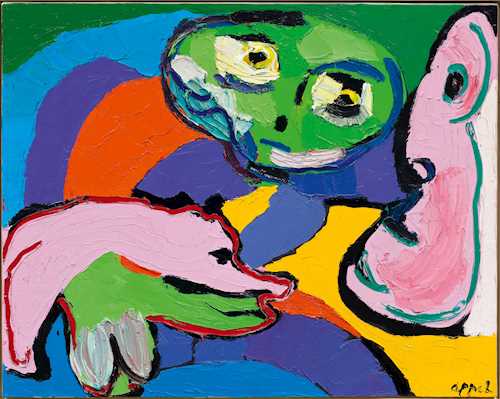
07 KAREL APPEL
Cochon avec Femme. 1971.
Oil on canvas.
37,1 x 109,1 cm.
Estimate: CHF 40 000 / 60 000
07 The painting of the Dutch artist Appel is strongly influenced by the international group of artists CoBrA, founded in 1948 (an acronym of the city names Copenhagen / Brussels / Amsterdam). In the 1970s, Appel’s child-like world of motifs manifested itself in bright colours.
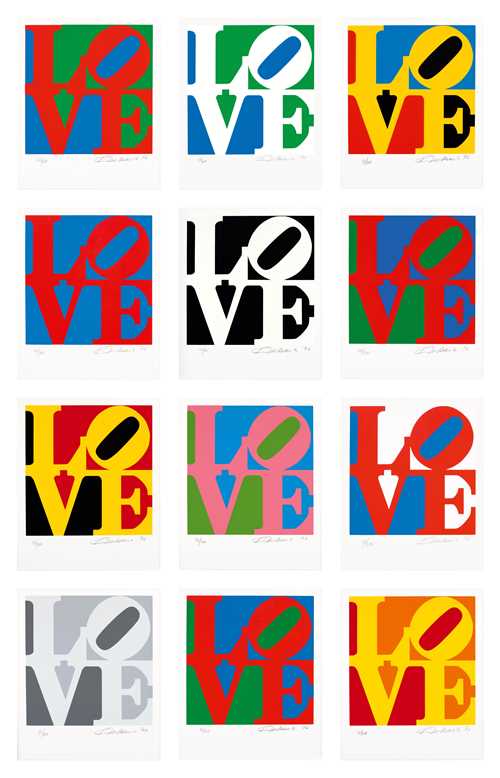
08 ROBERT INDIANA
The Book of Love. 1996.
Portfolio with 12 colour screenprints and 12 poems,
also with the imprint. 50/200.
Estimate: CHF 80 000 / 140 000

09 LUCIO FONTANA
Concetto Spaziale. 1966.
Cracks and graffiti on white wove paper.
56 x 43 cm.
Estimate: CHF 35 000 / 55 000

10 SUBODH GUPTA
Untitled #11. 2006.
Aluminium. 3/3.
46 x 54 x 75 cm.
Estimate: CHF 15 000 / 25 000
08 Indiana’s LOVE design, created in the mid-sixties, is now world-famous and adorns T-shirts and coffee mugs, billboards and even a US stamp. “The Book of Love” combines poems with the logo in twelve different screen-printed colour combinations.
09 By scratching and cutting the surface, Fontana places the three-dimensionality of the work in the foreground and leads us into a mystical realm found on the back of the picture.
10 Gupta is one of the most influential figures in contemporary Indian art. The Frankfurter Allgemeine Zeitung wrote that he is an artist who shows the everyday life of his homeland and transforms it into art – full of warm closeness to his origins.
11 Tobey spent the last years of his life in Basel thanks to Swiss art dealer and collector Ernst Beyeler. During this time he painted temperas like these, in which he continually created new textures.
12 Vasarely’s geometric abstractions built on formal inventions of the Suprematists, the De Stijl movement and the Constructivists to create mesmerizing optical illusions.

11 MARK TOBEY
Untitled. 1965.
Tempera on wove paper.
26 x 17 cm.
Estimate: CHF 40 000 / 60 000

12 VICTOR VASARELY
Kezdi-RSZ. 1970.
Acrylic on canvas.
160 x 160 cm.
Estimate: CHF 90 000 / 140 00

JEAN DUBUFFET
Site avec 5 personnages. 1981.
Acrylic on paper, firmly laid down on canvas.
50 x 68 cm.
Estimate: CHF 160 000 / 240 000
Dubuffet’s metamorphosi
Jean Dubuffet in the PostWar & Contemporary Auction on 7 December 2019
Five very different works from the December auction allow us to trace the artistic development of French artist Jean Dubuffet (1901–1985), from the end of the 1950s until shortly before his death. In the 1920s, Dubuffet was in the circle of the Paris Surrealists. He did not devote himself to painting, found objects, printmaking and sculpture until after 1942. With his manifesto “L'Art brut préféré aux arts culturels”, published in 1949, he established an important art theoretical discourse parallel to his own artistic development

JEAN DUBUFFET
L'Aguicheuse. 1966.
Marker and coloured pen on wove paper.
25 x 16,5 cm.
Estimate: CHF 30 000 / 50 000

JEAN DUBUFFET
Personnage. 1965.
Black felt-tip pen on wove paper by Montgolfier S.M.
27 x 21 cm.
Estimate: CHF 15 000 / 25 000
In the 1950s, Dubuffet created a series of oil paintings as experiments with materials and textures; “Texturologie LII”, 1958, is a typical example from this series, to be offered in the 7 December auction. The vital surfaces created by dripping paint represent “teeming matter, soils, or even galaxies and nebulae”, according to the artist.
Dubuffet became well known as a result of exhibitions in the USA, featuring the colourful and strongly formal works with which his work became associated, created in his Paris studio beginning in 1960. Three examples in the 7 December auction typify this phase: “Personnage”, 1965, a felt-tip pen drawing reduced to the artist’s characteristic monochrome cell-like forms, “L'aguicheuse”, a coloured drawing made in 1966, and the sculpture “Le tétrascopique”, 1971, one of only five hors-commerce examples that were reworked by hand. This last example shows Dubuffet’s playful penetration into the third dimension, which began in 1966. Finally, “Site avec 5 Personnages”, 1981, evokes Dubuffet's enthusiasm for naive art. He began collecting outsider art in 1945 and donated his extensive collection to the Collection de l’Art Brut in Lausanne, where it has been on display since 1976.

JEAN DUBUFFET
Texturologie LII (pariétale mouchetée). 1958.
Oil on canvas.
66 x 80 cm.
Minimum hammer price: CHF 32 000

JEAN DUBUFFET
Le Tétrascopique. 1971.
Sculpture with four polychrome panels. Colour screenprint on polyvinyl, one panel is hand painted.
97.5 x 50 x 50 cm. With metal plinth.
Estimate: CHF 25 000 / 35 000
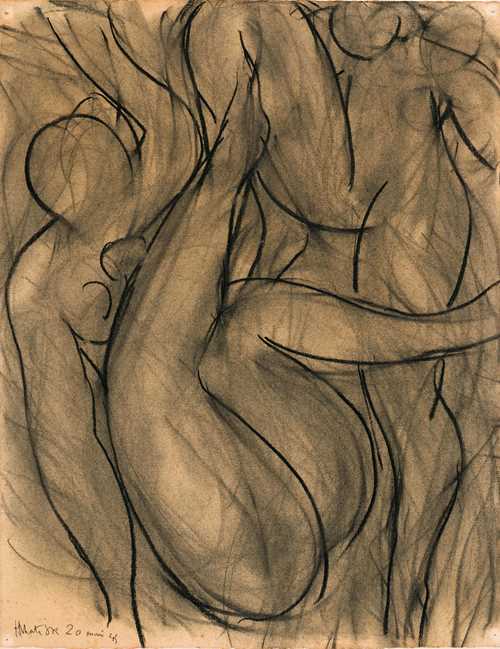
HENRI MATISSE
Nymphes. 20 May 1945.
Charcoal on paper.
48 x 37 cm.
Estimate: CHF 120 000 / 180 000
Silent Cézanne, moving Matisse
Preview of the Impressionist & Modern Art Auction on 6 December 2019
Still lifes played a central role in Cézanne's work. At least 170 of them are known today, though they rarely appear on the art market – in the past ten years, only 13 Cézanne still lifes have been auctioned worldwide. Through continually new arrangements of form and surface, and experiments with light and colour, Cezanne created unique pictorial spaces. “Treat nature in terms of the cylinder, the sphere and the cone” was how he famously characterised his search for a new pictorial language in 1904. At the time this still life was created (1879-80), he was regarded as a maverick and had only a few advocates, among them the influential Parisian art dealer Ambroise Vollard. This painting has an interesting provenance: it once belonged to Franz Meyer, $ long-time director of the Kunstmuseum Basel and president of the Alberto Giacometti Foundation in Zurich, who was Marc Chagall’s son-in-law.

PAUL CÉZANNE
Bol, boîte à lait et bouteille. 1879-80.
Oil on canvas.
15,7 x 20 cm.
Estimate: CHF 300 000 / 500 000
The shifts in perspective that came to decisively shape Cézanne’s paintings can be seen in this work: while the bright, painted bowl is viewed from the front, one looks down into the taller jug to the left. Cézanne’s distancing from conventional representation is taking shape. His painting technique, his pictorial inventions and his experiments with perspective fascinated subsequent generations of artists, and the complexity and modernity of Cézanne’s creations continued to do so well into the 20th century.
Like Picasso (“Cézanne was my one and only master”), Braque and Derain, Henri Matisse repeatedly referred to Cézanne as the “father of modern art”. Matisse’s lively depiction of three nymphs, which will also be offered in the 6 December auction, dates from 1945. Four years earlier, after a severe abdominal operation left him bedridden, the artist turned to drawing with charcoal. Through the partially effaced traces of underlying charcoal strokes, the creative process remains visible in the finished picture. The importance Matisse attached to the transformative conversion of a motif was impressively demonstrated at the opening exhibition of the Galerie Maeght in Paris in 1946, where the artist presented photographs documenting the creation of the six paintings on display. In the accentuated forms of the naked bodies, Matisse’s last creative phase, his cut-outs, is already apparent. In his last years, these cut-out and glued forms replaced his drawings, paintings and sculptures.

13 BEN NICHOLSON
Helmos. December 1963.
Wood relief, painted.
78 x 78 cm.
Estimate: CHF 100 000 / 150 000
PreView
13 As early as the 1930s Nicholson experimented with purely geometric, almost architectural forms. Piet Mondrian and Naum Gabo both had a lasting influence on the British artist, and their strict reduction of visual language is also reflected in this relief.

14 PABLO PICASSO
Françoise. 1946.
Lithograph. 2/50.
Image 59,5 x 48,5 cm.
Estimate: CHF 25 000 / 35 000

15 MARC CHAGALL
Repos sur coq et chevauchée au village rouge. 1975-78.
Gouache, tempera and ink on paper.
65,3 x 50 cm.
Estimate: CHF 120 000 / 180 000

16 PIERRE-AUGUSTE RENOIR
Paysage, vallée village sur la hauteur et fond de montagnes. 1900.
Oil on canvas.
26 x 36 cm.
Estimate: CHF 100 000 / 150 000
14 This is a portrait of Picasso’s lover and mother of their children Claude and Paloma, the painter and graphic artist Françoise Gilot, for whom Picasso ended his relationship with Dora Maar in the mid-1940s. For several years, this litho was the only portrait the artist had made of Gilot.
15 Every detail of Chagall’s painting is part of an entire pictorial narrative, as well as symbolically charged. From the 1960s he worked on several large commissions for murals and glass paintings, in Japan, Israel and the USA. At the same time he created stage and costume designs for the theatre.
16 Exquisite colours and enchanting light – with these ingredients Renoir created almost all his landscape paintings. With his early works, Renoir gave Impressionism an essential stimulus, and he conserved the liveliness of his style well into his advanced age.
17 Picasso’s drawings in particular demonstrate his mastery of the line. This work exemplifies a central theme of his oeuvre with its depiction of a three-way relationship. Begun on 11 July 1966, Picasso reworked and condensed the image several days later.
18 This painting was created in 1908, the year Giovanni Giacometti exhibited his work together with the artists’ association “Die Brücke” in Dresden.

17 PABLO PICASSO
Trois personnages. 1966.
Crayon and felt pen on paper.
50 x 61 cm.
Estimate: CHF 280 000 / 350 000

18 GIOVANNI GIACOMETTI
Waldinneres. 1908.
Oil on canvas.
38 × 46 cm.
Estimate: CHF 80 000 / 120 000

19 ADOLF DIETRICH
Clivia. 1943.
Oil on panel.
65 × 57 cm.
Estimate: CHF 60 000 / 90 000
19 In the 1940s, the Swiss artist Dietrich reached the peak of his success. His newly objective, in part hyperrealistic paintings – landscapes, still lifes, animal paintings and portraits – attracted a large circle of collectors and museum curators who exhibited his works.

20 ALEXANDRE CALAME
Lac des Quatre-Cantons, près de Brunnen.
Oil on canvas.
64,6 × 87,5 cm.
Estimate: CHF 30 000 / 50 000
20 Calame's landscape paintings, often bathed in dramatic light, enjoyed success throughout Europe and left their mark on the artistic image of the Swiss Alps in the second third of the 19th century.

ALBERT ANKER
Der Gemeindeschreiber (The community record keeper) V. 1899.
Oil on canvas.
62,5 × 49 cm.
Estimate: CHF 600 000 / 900 000
Between Val Poschiavo and Valtellina
Preview of the Swiss Art Auction on 6 December 2019
Born in 1864 in St. Moritz, Peter Robert Berri studied medicine in Switzerland and Germany. In 1892, he was appointed chief physician of the St. Moritz-Bad Mineral Springs Society. Six years later he became acquainted with Giovanni Segantini and Giovanni Giacometti, whose painting techniques and pictorial worlds Berri skilfully adapted in his own early paintings. Giacometti encouraged him to paint, to pursue his vocation: “After all, you are a colourist. Colours attract you. Give free range to your desires”. Berri pursued his goal to move beyond dilettantism and become a true artist through studies at the renowned private Académie Julian in Paris, and a drawing course with Heinrich Knirr in Munich. He spent the productive years between 1905 and the outbreak of World War I in the Alps of the Grisons and the Engadine, the Val Poschiavo and the Valtellina in Italy. During that time he met Ferdinand Hodler and Friedrich Nietzsche, among others, and his works were shown at major Swiss art exhibitions as well as at the Venice Biennale.

PETER ROBERT BERRI
Lej da Suvretta.
Oil on canvas.
97,5 × 147 cm.
Estimate: CHF 60 000 / 100 000

GOTTARDO SEGANTINI
Maloja "Paesaggio paradisiaco". 1920.
Oil on canvas.
120 × 100 cm.
Estimate: CHF 100 000 / 150 000
Central to Berri’s work are views of the mountainous landscape around the Julier and Bernina passes. His paintings, in a style reminiscent of Giovanni Segantini, were created en plein air. “For ten years I worked for several months each winter on the Julier and Bernina passes, because I was particularly attracted to this altitude with its greater abundance of light and colour”, Berri later recalled. Berri captured the mountain ranges’ shimmering spectrum of light and colour in large landscapes, to which an application of impasto colour lends an additional dynamic. Berri’s feelings for nature found their counterpart in oil painting: “Last autumn, excited by the wonderful colour symphonies of the autumn landscape, I travelled about the mountains for weeks on end with coloured pencils and sketchbooks, following an irresistible desire to sketch. I soon came to the sad conclusion that the cold, hard coloured pencils were unable to reproduce my painterly sensations”.
Snow is particularly important in Berri’s work. In the two early summer pictures offered in the 6 December auction the shady mountain flanks retain remains of white splendour. In addition to landscape paintings, Berri created impressive portraits and self-portraits, as well as a number of works that reflect everyday life in the mountain villages of the Grisons, marked by traditions and centuries-old customs, hard work and little comfort

PETER ROBERT BERRI
Piz Julier.
Oil on canvas.
70,5 × 111 cm.
Estimate: CHF 50 000 / 80 000

AN EXCELLENT GILT BRONZE FIGURE
OF THE SEATED BUDDHA
Tibet, 14th/15th. century. H 27 cm.
Base plate lost.
Estimate: CHF 100 000 / 150 000
East meets West
Preview of the Asian Art Auction on 3 December 2019
Cultural exchanges between East Asia and Western Europe reached their height in the 19th century. In particular, the international exhibitions or world’s fairs, which had their origins in London’s Crystal Palace in 1851, developed into platforms where not only industries but also the visual and applied arts of various nations were exhibited together. The extravagant national pavilions brought Asian art to Europe and America, where it could be experienced in such abundance for the first time, inspiring Japonism – to use a term coined by the French art historian Philippe Burty in 1872 – which spawned important works of Impressionism, Art Nouveau and Viennese Modernism. At the same time, a select group of dealers such as Samuel Bing, and collectors who devoted themselves primarily to Japanese art became established in Europe. Woodcuts by Hokusai and Hiroshige, Utamaro and Kesai Eisen soon joined the cultural-historical treasures of Europe. Artists such as Vincent van Gogh and Édouard Manet, Aubrey Beardsley, Gustav Klimt and Paul Klee often referred to these Far Eastern influences in their works.

A CYLINDRICAL BRONZE VASE DECORATED WITH A CICADA
Japan, Meiji period (early 20th c.)
H 39,5 cm.
Estimate: CHF 5 000 / 8 000
The international exhibitions also affected the visitors and exhibitors who travelled from the Far East: Asian artists’ encounters with Art Nouveau led to a reverse flow of influence, especially after 1900. Japanese artists – in addition to their own roots such as those of the Rinpa school around Ogata Kōrin (1658–1716) – integrated design influences from the West into their painting, lacquer art and metal works. Art Nouveau in its heyday reached Japan through Japanese travellers to Europe, including the painters and woodcut artists Kuroda Seiki (1866–1924) and Asai Chu (1856–1907). The elegance of the naturalistic and ornamental decorations characteristic of Art Nouveau inspired the Japanese to make more creative designs. This complex network of exchanges and interrelationships gave rise to unique works such as the two Meiji bronze jars which will be offered in the 3 December auction.
The mutual transfer was made possible by the extensive social modernization and opening of the former feudal state of Japan in the last third of the 19th century. The Meiji Restoration that began in 1868 with Tennō Mutsuhito favored yōga, Western-style painting, and sent young students to Europe to bring Western knowledge and technique to Japan. Western naturalism was clearly reflected in the sculptures of the Tokyo School, also represented in the 3 December auction. Traditional Japanese metalwork – especially the production of samurai swords – involved an extremely high level of craftsmanship. Metal alloys could be varied for different colour effects; gold and silver coatings were used for sword decoration on the tiniest surface. Bans on carrying weapons in public issued in the 1870s led craftsmen to apply their technical mastery to new objects. Bronze work in particular experienced a new boom as a result. Alongside the artisan elite, new metalworking schools were developed, creating elaborate objects such as vases and sculptures.

A GREEN ENAMELLED DRAGON-JAR AND COVER
China, 19th century.
H 20,3 cm.
Estimate: CHF 10 000 / 15 000

A VERY RARE BUDDHIST RELIQUARY IN THE SHAPE OF A PAGODA
Japan, dated 1698, H 81,5 cm.
Fire-gilt copper sheet with delicate incised ornamental decor, base with woodcore.
Estimate: CHF 50 000 / 80 000

TAMARA DE LEMPICKA
Cruche et citrons sur une chaise. Circa 1942.
Oil on canvas.
51 x 40,5 cm
Minimum hammer price: CHF 27 500
Modern & Contemporary Art
Compulsory auction: 5.12.2019
This auction comprises 17 paintings, prints and sculptures by Jean Dubuffet, Andy Warhol, Jan Schoonhoven, David Smith, Richard Paul Lohse, Robert Indiana, Tamara de Lempicka, Félix del Marle, Auguste Herbin, Edmond van Dooren, Albert Gleizes, Alexandra Exter, Man Ray, David Nestorovich Kakabadze, Julio Gonzáles and Miguel Barceló.* Please note the special auction conditions in the catalogue.

ROBERT INDIANA
Chief. 1969.
Oil on canvas.
61 x 56 x 4 cm.
Minimum hammer price: CHF 79 500