

AN IMPORTANT IMPERIAL "PHOENIX AND PEONY"-BRONZE CENSER (2019)
China, 17th/18th century
Height 24 cm, widht 59 cm, weight 22,3 kg.
Parcel-gilt bronze.
Sold for CHF 4,8 Mio
4.8 million for an incense burner
Top results for Asian art
Koller’s Asian Art specialists made an important discovery when they visited a client’s home last autumn: they were offered a large bowl which had been owned by the family for generations, and was now being used as a container for tennis balls and other items. The owners obviously didn’t realize that the misappropriated vessel was an important Chinese imperial censer, made around 1700 in parcel-gilt bronze. This rare find was auctioned at Koller’s Asian Art sale in June, where it fetched the record price of 4.8 million Swiss francs.

A BRONZE FIGURE OF BUDDHA SHAKYAMUNI ON A LION THRONE (2017)
Northeastern India, Pala, 8th/9th century.
Height 16,5 cm.
Silver and copper inlays.
Sold for CHF 1,17 Mio.

A TURQUOISE GROUND CLOISONNÉ ENAMEL DISH (2017)
China, Ming dynasty, first half of 15th century.
Diameter 26 cm.
Golden double vajra on the back. Slightly damaged.
Sold for CHF 144 000
In May, the richly decorated incense burner was the star of the International Antiques Fair in Hong Kong, where Koller exhibited it along with other highlights in advance of the auction. Many of Asia’s most important collectors participated in the auction room in Zurich, or via telephone, creating an intense bidding competition; more than thirty interested parties submitted bids for this unique work. The lot was finally won by a collector from China who is setting up a private museum in Beijing. Interestingly, the censer could have ended up in an important museum of East Asian art as early as the 1960s, when the owners offered it for sale, but the museum politely refused to make an offer. Another attempt at sale in the 1970s did not come to fruition because a London auction house thought the object was likely a 19th-century copy and told the owners that the costs of shipping “would hardly be worth it”.
Phoenix and peonies
China is regarded as the ancient capital of bronze casting. The technique was developed early on there, and perfected over thousands of years. The price of CHF 4.8 million achieved for the incense burner is a record for such an object, for which there are no comparable pieces known in terms of size and quality. Its design is unique: the heads of two phoenixes, whose wings blend into peonies and embrace the vessel, serve as handles. The phoenix is considered the king of birds in China; the peony the queen of flowers. Its symbolic power permeates all branches of Chinese culture. One of the most famous opera pieces of the Ming period, written by Tang Xianzu, a contemporary of Shakespeare, bears the title “Peony Pavilion”. The phoenix is also a symbol of the Chinese empress, which is why it can be assumed that the basin – almost 60 centimetres in diameter and weighing 22 kilograms – was created for an imperial palace or temple. There is a Xuande six-character stamp at the base of the vessel. According to their original purpose, such vessels were filled with rice ashes, into which glowing incense sticks were placed. China has had an important tradition of ancestor veneration for thousands of years, which has always been accompanied by the burning of incense. At such ceremonies, ancestors and gods were honoured by burning incense sticks in temples or before household altars.
The record price for this censer is the culmination of a series of excellent results for important Asian works of art achieved at Koller in recent years. For example, a Tibetan bronze of the deity Panca Raksha was sold for CHF 3.24 million. An imperial room partition made of carved wood fetched CHF 940,000 in 2017. In the same year, Koller sold a bronze sculpture of Buddha Shakyamuni on a lion throne for CHF 1.17 million and an imperial Chinese bronze bell changed hands for CHF 1.2 million.

A DARK COPPER GLAZED MEIPING VASE (2018)
China, Qianlong mark and of the period.
Height 30 cm.
Sold for CHF 102 000

01 RENÉ MAGRITTE
Les voies et moyens. 1948.
Gouache and gold on paper.
40,5 × 32,8 cm.
Sold for CHF 439 000
ReView
01 Magritte deliberately provoked le tout Paris in 1947/48 with a series of caricature-like portraits pervaded by biting criticism.

02 PIERO DORAZIO
Mimet. 1962.
Oil on canvas.
46 × 33 cm.
Estimate: CHF 88 000

03 FERDINAND HODLER
Schreitende. (figure stepping) Circa 1910.
Oil on canvas.
46,5 × 40 cm.
Sold for CHF 340 000

04 MAGNUM PHOTOS
“Sélection Esther Woerdehoff ”, 1947–2007.
Portfolio with 15 original photographs.
Sheet dimension 28 x 35.5 cm to 40 x 50 cm (various portrait and landscape formats)
Sold for CHF 45 000
02 Dorazio translated phenomena of light and colour into energetic, shimmering compositions.
03 Hodler enjoyed great success throughout Europe in the years around 1900 with variations on symbolically charged full-length fi gures such as this woman (his model, Giulia Leonardi), moving as if in a dance. These female fi gures not only became the artist's trademark, but also icons of Swiss modern art.
04 For the agency’s 60th birthday, gallery owner Woerdehoff published a selection of world-famous Magnum photographs.
05 In Dietrich’s intense landscape paintings, expressiveness and colour combine to create drama, and sometimes also “operatic exaltation”.
06 Sisley does not describe the drama of nature, but reveals the unique amongst the seemingly ordinary.

05 ADOLF DIETRICH
Evening at the lake with red clouds. 1915.
Oil on board.
28 × 38,5 cm.
Sold for CHF 183 000

06 ALFRED SISLEY
Autour de la forêt, juin. Circa 1885.
Oil on canvas.
54 x 72,7 cm.
Sold for CHF 800 000

07 ROBERT MANGOLD
Red with Green Ellipse / Black frame. 1988/89.
Acrylic and pencil on canvas (diptych).
140 x 210 cm.
Sold for CHF 315 000
07 In Mangold’s voluminous double pictures, colour and material move into space, and this expansion of the picture into the three-dimensional creates a relationship of its own with the viewer. In his works, the artist addresses the dialogue between uncertainty and conviction, between intuition and analysis.

08 JEAN FAUTRIER
La passoire. 1947.
Oil on wove paper on canvas.
46 x 55 cm.
Sold for CHF 207 000
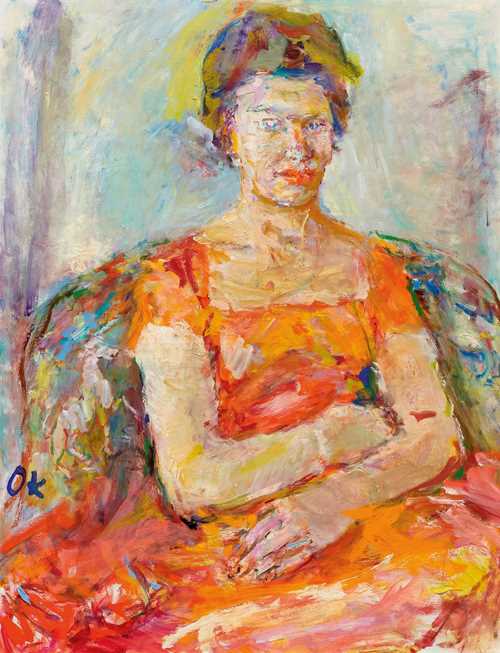
09 OSKAR KOKOSCHKA
Ann Windfohr. 1960.
Oil on canvas.
91 x 70 cm.
Sold for CHF 146 000
08 Fautrier’s art informel paintings are characterised by the pasty application of paint and concentration on an isolated, non-objective motif.
09 Kokoschka’s skill as a portraitist was in demand; here he painted the American art collector Ann Windfohr.
10 This portrait of a skier in the mountains above Maloja was one of the last paintings Giacometti made for his client Anna von Planta.
11 Countless artists, including Moret, were fascinated by the unique landscape of the Breton cliffs. In his paintings he combines the Synthetism of the Pont-Aven school with Impressionism.
12 Bugatti’s bronzes – predominantly depictions of animals and figures such as this nude – mark the transition from Art Nouveau to Art Deco.

10 GIOVANNI GIACOMETTI
Skier. 1899.
Oil on canvas.
65,5 × 102 cm.
Sold for CHF 488 000

11 HENRY MORET
Falaises, côte de Bretagne. 1910.
Oil on canvas.
64 x 79 cm.
Sold for CHF 110 000

12 REMBRANDT BUGATTI
"Le Réveil", circa 1907.
Bronze with brown patina.
H: 34.5 cm.
Sold for CHF 195 000
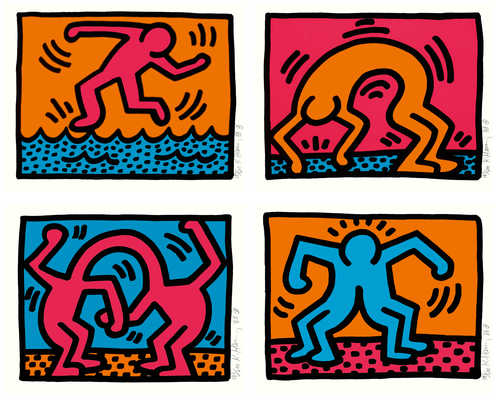
13 KEITH HARING
Pop Shop I-IV. 1988.
Lot of 4 colour screenprints.. 183/200.
Varying image sizes on wove paper 30.5 x 38 cm.
Sold for CHF 56 000
13 This series of four colour silkscreen prints was created during the years when Haring ran his Pop Shop in New York, selling originals and prints of his own works. The style of his figure paintings, which he also often painted on the walls of buildings and on billboards, is unmistakable.

14 CUNO AMIET
The fruit harvest. 1912.
Oil on canvas.
103 × 115 cm.
Sold for CHF 775 000

15 LOUISE NEVELSON
Cloud II. 1984.
Painted wood.
84 x 115 x 6,5 cm.
Sold for CHF 73 000
14 Amiet’s apple paintings were a recurring theme throughout his artistic career. Many studies and variations of this subject coalesced over the course of a few years, until about 1915, into a veritable group of works including this large-format painting. In this version of the fruit harvest the artist is at the cusp of the main artistic currents of that period: the Expressionism of the Fauves, die Brücke and Cubism. This work comes from the collection of Eugen Loeb, with whom Amiet was friends until his death.
15 With their genuine pictorial inventions, the generation of artists that included Louise Nevelson contributed to the emancipation of contemporary American art from European influences.

FRANZ GERTSCH (2018)
Dominique. 1988.
Woodcut in colour. 7/18.
103 x 115 cm.
Sold for CHF 168 000
Swiss Printmakers
Results for Swiss prints
The protagonists of Swiss printmaking have left their mark on art history in many fascinating ways, especially within the last 150 years. The tradition ranges from woodcuts and etchings by Félix Vallotton to lithographs by Alberto Giacometti, linocuts by Lill Tschudi and woodcuts by Franz Gertsch. Their works reveal an endless variety of expressive possibilities in printmaking. Particularly fascinating are the different results that can be achieved while using the same techniques: although Vallotton and Gertsch both made woodcuts, their pictorial worlds could not differ more.

LILL TSCHUDI (2018)
Guards. 1936.
Linocut in red.
Image 16 x 20.2 cm on thin Japan laid paper 22.5 x 28 cm.
Sold for CHF 2 500
Félix Vallotton (1865–1925) used powerful, flat black-andwhite contrasts in his individual prints and series to create his signet-like motifs. With only a few perfectly placed cuts in the wooden block he succeeded in creating timeless images. It is also interesting to note the stark contrast between the artist’s woodcuts and his drawings and paintings. This is not the case with Alberto Giacometti (1901–1966), whose lithographs and etchings are closely related to his drawings and paintings. Giacometti's drawings on litho stone did not differ in motif or style from his unique works on paper and canvas. His characteristic oeuvre is dominated by portraits, landscapes and interior views of his studio. In the book Paris sans fin, published in 1969, the 150 illustrations by Giacometti demonstrate his consummate skill as a lithographer. Published in a small edition, it was a milestone in 20th-century printmaking art.
Lill Tschudi (1911–2004), who studied at the innovative and influential Grosvenor School of Modern Art in London in the late 1920s, caused a sensation with her striking linocuts. Pablo Picasso was one of the principal artists to establish this technique in modern art. Claude Flight introduced the Glarus-born Tschudi to the linocut technique, while companions such as André Lhote, Gino Severini, and Fernand Léger broadened her artistic horizons. In contrast to most of her contemporaries, Tschudi worked exclusively in linocut. Her subjects of the interwar years in particular reflect the Zeitgeist impressively: her motifs are characterized by technical progress, intensity and speed, but also by anonymity and the looming crisis of the late “Roaring Twenties”.
Among contemporary Swiss artists, Franz Gertsch (*1930) is closely associated with the Swiss printmaking tradition. Monumental woodcuts play a central role in his work. From 1986 to 1994, Gertsch devoted himself exclusively to working in woodcut and in doing so advanced to completely independent forms of expression. With his own Japan paper, Gertsch attained the limits of what is possible in woodblock printing and opened up a new dimension for this classical medium. His prints are dominated by monochrome, format-filling portraits of women from his circle and fascinating details from landscapes, to which the artist has a special connection. Gertsch imbues his works with incomparable plasticity and dynamism with the simplest of means but with masterly execution.unprecedented precision, not least in the production of

FÉLIX VALLOTTON (2017)
Les Trois Baigneuses. 1894.
Woodcut. 85/100.
30.5 × 20 cm.
Sold for CHF 9 500

ALBERTO GIACOMETTI (2019)
Self-portrait. 1963.
Lithograph. 64/75.
65.4 × 50.5 cm
Sold for CHF 10 000

ADOLF DIETRICH
Evening at the lake with red clouds. 1915.
Oil on board.
28 x 38,5 cm.
Estimate: CHF 150 000 / 200 000
Dietrich was one of the most important Swiss artists of the early 20th century in terms of formal balance and fascinating colouring. This is the first of a long series of sunset paintings by Dietrich which began in 1915. Pastel studies from nature served as a basis for studio-painted oils on canvas. Here the artist shows himself to be completely independent and unaffected by external influences.

01 ALFRED JULIO JENSEN
Temple of Numbers at Paestum. 1961.
Oil on canvas.
186,5 x 136,5 cm.
Estimate: CHF 250 000 / 350 000
American Avant-garde after 1945
Preview of the PostWar & Contemporary Auction on 29 June 2019
Following his emigration, the German-American Hans Hofmann (1880–1966), ostracized by the National Socialists as “degenerate”, was an influential teacher of the New York School and a driving force for the first generation of Abstract Expressionists. His gouache “The tree” (08) is invigorated by the intense colour tones that characterise his late work. The US art critic Clement Greenberg noted: “Hofmann treats the picture surface not as a passive object, but as an object that reacts receptively”.

02 ROBERT MANGOLD
Red with Green Ellipse / Black frame. 1988/89.
Acrylic and pencil on canvas (diptych).
140 x 210 cm.
Estimate: CHF 180 000 / 240 000

03 THEODOROS STAMOS
Hovering Yellow Sun Box. 1967.
Acrylic on canvas.
143 x 132 cm.
Estimate: CHF 40 000 / 60 000
Emancipation from Europe
Hofmann influenced an entire generation of artists who, increasingly detached from European trends and with new references to indigenous and so-called “primitive” art, went their own way. Among them were Theodoros Stamos (1922–1997), one of the leading first-generation Abstract Expressionists, and Hofmann pupils such as Alfred Jensen (1859–1953) and Louise Nevelson (1899–1988), who created genuine forms of expression that contributed to the emancipation of new contemporary art in the USA. They were followed by artists such as Jasper Johns and Robert Rauschenberg, who became the links to Pop Art. Geometric forms on a monochrome ground compose Stamos’s “Hovering Yellow Sun-Box” (03), one of a series of Sun-Box paintings he began in the early 1960s. Alfred Jensen created his monumental “Temple of Numbers at Paestum” (01) in 1961, when the Guggenheim Museum in New York dedicated an important solo exhibition to him. The artist, of German-Danish descent, became well known for his geometric-abstract paintings in thick impasto, which, starting in the late 1950s, were based mainly on colour spectra and mathematical number systems.
Eine ebenfalls höchst individuelle Spur legt der Minimalist Robert Mangold (geb. 1937). Sein Diptychon «Red with Green Ellipse/Black Frame» von 1988/89 (02) hat tektonischen Charakter. In ihm rücken Farbe und Material in den Raum und es entsteht über diese Ausdehnung des Bildes ins Dreidimensionale eine eigene Beziehung zum Betrachter. Die markante Diptychon-Kombination von Ellipse und schwarzem Rahmen taucht um 1990 in einer Werkgruppe auf, zu der Mangold konstatierte: «Ich wollte, dass diese fast gegensätzlichen Strukturen, die an einer Kante oder sogar nur an einem Punkt verbunden sind, ein einziges Werk ergeben. Es war dieser Kampf zwischen Trennung und Einheit, der mich interessierte.» Obwohl Mangolds abstraktes Werk Vielen als Inbegriff des Reduktionismus und Minimalismus gilt, erweist es sich in seinen Quellen und Ambitionen als komplexer. Der Künstler stützt sich vor allem auf den Dialog zwischen Unsicherheit und Überzeugung, zwischen Intuition und Analyse.
04 Polke, trained as a glassmaker (he created the new glass and agate windows in the Zurich Grossmünster church, 2006–2009), founded the “Capitalist Realism” movement with Gerhard Richter and Konrad Lueg in 1963. Many of his works are ironic reactions to the established art scene.
05 Gertsch’s monumental woodcuts are not only outstanding in their craftsmanship, but also as astonishing testimonies to his intensive, even meditative preoccupation with nature and its secrets.

04 SIGMAR POLKE
Untitlet. 1999.
Watercolour and gouache on wove paper.
70,2 x 99,7 cm.
Estimate: CHF 60 000 / 80 000

05 FRANZ GERTSCH
Gräser I. 2000.
Woodcut in colours.
Estimate: CHF 40 000 / 50 000

06 JEAN FAUTRIER
La passoire. 1947.
Oil on wove paper on canvas
46 x 55 cm.
Estimate: CHF 100 000 / 200 000
06 Fautrier’s paintings draw their vitality from the impasto application of paint and the concentration on an isolated motif. The Frenchman is regarded as the most important representative of his country in the non-geometric art informal.
07 The work of the Canadian action painter Riopelle is closely related to the works of the Parisian automatistes and tachistes.
08 The German-American Hans Hofmann, in his role as teacher of the New York school, provided the American Abstract Expressionists with a driving force. Colourintensive gouaches like this one characterise his late work.

07 JEAN-PAUL RIOPELLE
Untitled. 1958.
Oil on wove paper on canvas.
79,5 x 59 cm.
Estimate: CHF 50 000 / 70 000

08 HANS HOFMANN
The Tree. 1944.
Oil and gouache on wove paper (double sided).
73,5 x 58,5 cm.
Estimate: CHF 35 000 / 45 000
09 Produced in a small edition, this plate shows Picasso’s ability to create works of art with the simplest of means.
10 The first “Balloon Dogs” were issued by Koons as part of his “Celebration” series in 1993. These playful sculptures – here in a limited edition of porcelain – are now among the most well-known works of contemporary art.
11 Dorazio, trained as an architect, brought abstraction to Italy with his non-objective pictorial language and chromatic structures.

09 PABLO PICASSO
Tête au masque. 1956.
Plate. Ceramic with relief.
Estimate: CHF 5 000 / 7 000

10 JEFF KOONS
Animals II. 2019.
3 Multiples. Porcelain.
Estimate: CHF 25 000 / 30 000

11 PIERO DORAZIO
Mimet. 1962.
Oil on canvas.
46 x 33 cm.
Estimate: CHF 30 000 / 40 000
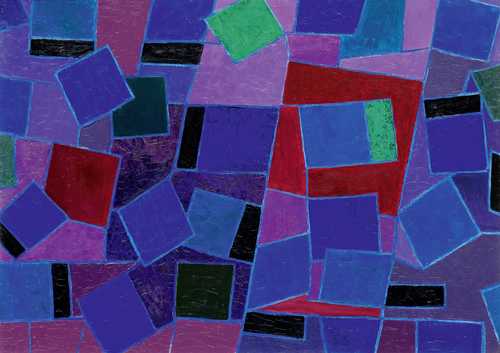
12 JOHANNES ITTEN
Quadrate in Bewegung. 1958.
Oil on masonite.
70 x 100 cm.
Estimate: CHF 60 000 / 80 000
12 During his time as a Bauhaus teacher, Itten set up a whole theory of colour types, centred on the relationship between colour and form and between colours themselves. Abstractions such as these squares shaped his work through the post-war period.

13 SIGMAR POLKE
Untitled. 1999.
Ink, watercolour and goauche on wove paper.
70,2 x 100 cm.
Estimate: CHF 80 000 / 140 000

14 ANDY WARHOL
Apple. 1985.
Colour screenprint. 165/190.
Sheet size 96,5 x 96,5 cm
Estimate: CHF 50 000 / 70 000
13 For decades, Polke was engaged in watercolour and gouache painting, alternating between abstraction and figuration in a multifaceted and metaphorically charged manner.
14 In 1985, Warhol created a series of ten “advertising” motifs in which famous brand logos – such as Apple’s here – were employed as symbols of mass consumption.
LOUISE NEVELSON
Cloud II. 1984.
Painted wood.
84 x 115 x 6,5 cm.
Estimate: CHF 50 000 / 70 000
The Centre for Artistic Estates
In Zurich, a newly founded institution is dedicated to estates in the fields of art, music and literature
Collectors, artists, musicians and writers: they will all pass on their material and immaterial works and they will all have to deal with similar questions: Who should make the artistic and commercial decisions about the inherited works? What sort of strategy will keep the artistic estate relevant and interesting for future generations? How can the financial value of an artistic estate be estimated and how can the copyright peculiarities relating to immaterial works in an estate situation be dealt with? To ensure that these and other issues surrounding estates in the fields of art, music and literature receive more attention, the attorney Dr Florian Schmidt-Gabain and the literary scholar Prof. Dr Thomas Strässle founded the Zentrum für künstlerische Nachlässe (ZKN), or Centre for Artistic Estates.